
Lieferung heute & morgen

Qualitätsgarantie

Willkommens-Angebote freischalten: KOSTENLOSE Lieferung | Bis zu 80 % RABATT | Kostenlose 30-Tage-JoyPlus-Testphase
App herunterladen
A foldable transport trolley can make it much easier to move shopping, camping equipment, garden tools or luggage. However, there can be significant differences between a sturdy folding trolley and a short-lived model. Large litre capacities, high load limits and stair-climbing functions may sound convincing at first, but on their own they reveal little about how practical a trolley is for everyday use.
If you are looking in Germany for a foldable Bollerwagen, a foldable sack truck or a hand trolley with wheels, you should therefore not focus solely on the price. The intended use, load, wheel construction, folded dimensions and safety features are what really matter.
A 200 kg transport trolley may look attractive on paper. However, the stated maximum load only applies when the trolley is fully unfolded, correctly locked and the load is evenly distributed. On slopes, sand, coarse gravel or uneven grass, safe handling can become considerably more difficult.
You should therefore look for:
The load capacity should always match the goods being transported. A small shopping trolley is sufficient for light shopping, while a larger garden trolley may be more suitable for garden materials or camping equipment.
A trolley with 300 litres of storage space offers plenty of room, but it can also become cumbersome. You should therefore check the actual external dimensions, the length of the loading area and the folded size. A large shopping trolley must fit in your hallway, cellar, boot or storage room.
Removable bags, side pockets and a fully opening rear section are practical features. They make loading easier without smaller items disappearing deep inside the trolley.
A shopping trolley with a stair-climbing function usually uses several wheels on each side to overcome kerbs or steps. This does not mean that it can climb stairs independently. The load must be moved slowly and under control. The risk of tipping increases on high steps, with heavy items or in narrow stairwells.
Such a trolley is also not a mobility aid, a seat or a product intended for transporting children or pets. These limitations should be clearly stated in the product description.
Compare the stated load capacity with the intended use:
With a 2-in-1 foldable sack truck, it is important to remember that the load capacity may vary depending on the operating mode. For example, a model may carry 80 kg as a sack truck and 150 kg as a platform trolley. The relevant figure is always the manufacturer’s specification for the mode selected.
Wide wheels distribute weight more effectively across grass, sand and gravel. Small, hard castors are more suitable for smooth floors. For a camping trolley or garden trolley, wheel width, material, bearings and manoeuvrability are therefore more important than a marketing term such as “off-road”.
Look for:
Brakes are generally intended for parking rather than controlled braking while pulling. A fully loaded trolley should never be left unattended on a slope.
600D Oxford fabric is often used for foldable trolleys. It is hard-wearing enough for everyday use, but should be allowed to dry completely before folding. An aluminium frame is comparatively lightweight and rust-resistant; steel frames can be sturdy depending on their construction, but they add more weight.
A good folding trolley should:
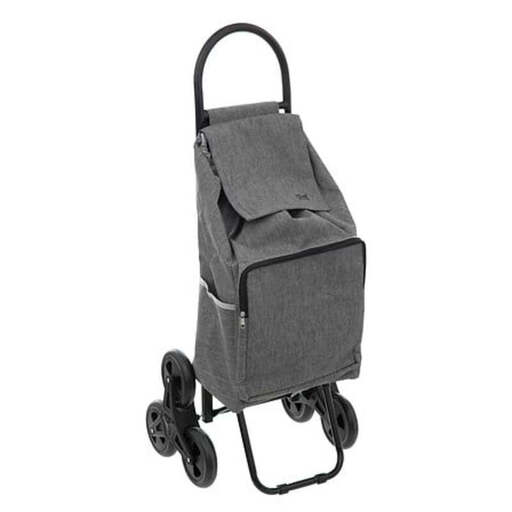
Why this product suits the profile: With a stair-climbing function, 40-litre capacity and a weight of 2.5 kg, this shopping trolley is designed for regular shopping trips as well as transporting laundry and household items.
The stated 40-litre capacity, 2.5 kg unladen weight and six wheels make its limitations easier to understand than broad “heavy-duty” marketing claims.
Steel frame, removable polyester bag and 6-wheel configuration; the bag can be removed for cleaning.
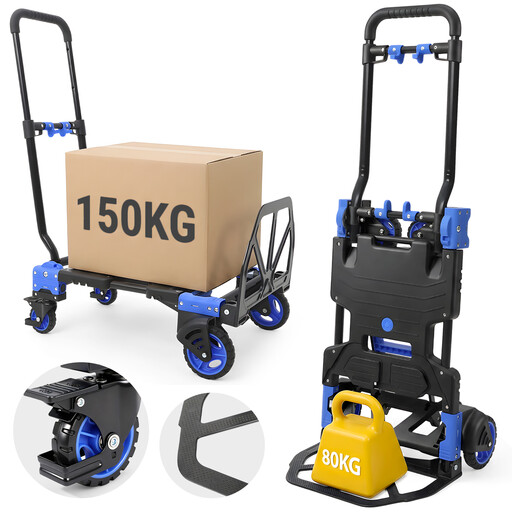
Why this product suits the profile: This model switches between sack truck and platform trolley functions. It is therefore suitable for moving house, warehouses, cellars and everyday transport tasks involving items of different shapes.
The load limits are specified separately for each operating mode: 80 kg as a hand trolley and 150 kg as a platform trolley. This makes it easier to plan the load.
Reinforced aluminium frame, height-adjustable handle, TPR wheels with double bearings and integrated parking brake.
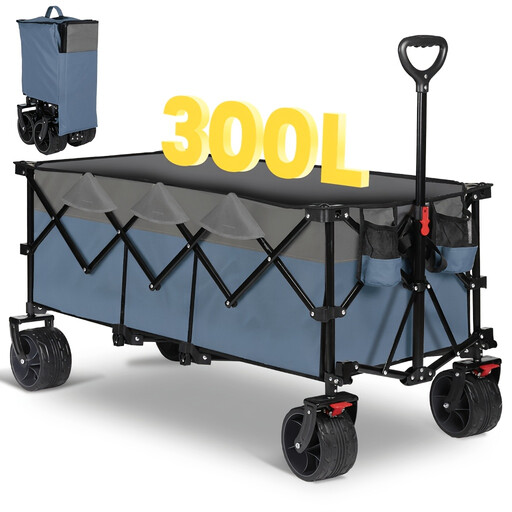
Why this product suits the profile: With 300 litres of storage space and a stated load capacity of 200 kg, this foldable transport trolley is aimed at campers, garden owners and users with extensive transport needs.
The description gives specific figures for capacity, load limit and wheel size. It also points out the importance of even loading, folding the trolley when dry and using it on a stable surface.
600D Oxford fabric, four-way folding mechanism, wide 7-inch tyres, brakes and two drinks holders.
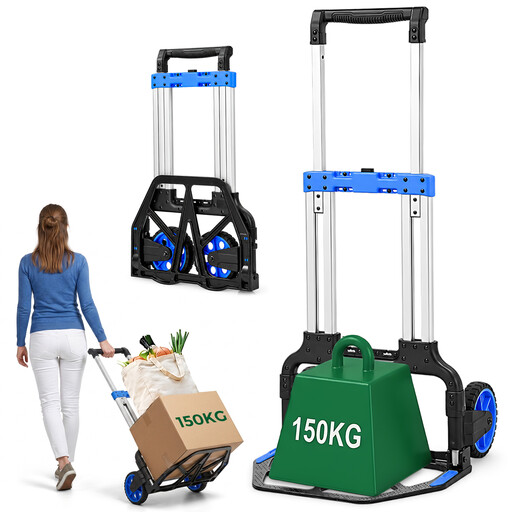
Why this product suits the profile: This foldable sack truck is designed for boxes, tools, garden materials and heavy individual items, which can be secured on the loading platform with tie-down straps.
The stated 150 kg load capacity is combined with an XXL loading platform and two expansion straps. This helps secure the load and prevent it from shifting.
Height-adjustable telescopic handle, aluminium frame, TPR wheels with ball bearings and a foldable design.
We have put together a complete, regularly updated list of products that fully meet these strict selection criteria and the safety regulations applicable in the EU.
To keep a foldable transport trolley in working order for the long term, you should carry out a quick check after every use:
With a camping trolley featuring a removable bag, it is also advisable to check the attachment points and seams regularly. For longer-term storage, choose a dry place protected from direct exposure to the weather.
For occasional shopping trips, 40 litres of storage space and a moderate load capacity are often sufficient. For crates of drinks, garden tools or camping equipment, models with a capacity of 100 to 150 kg are more practical. A 200 kg transport trolley only makes sense if you regularly move heavy loads and the surface is suitable. The stated load capacity must not be exceeded.
Models with six wheels can overcome kerbs and individual steps. They must be guided slowly and loaded evenly. They are not automatically suitable for long or steep staircases. You should also check whether the trolley is expressly intended only for transporting goods and must not be used as a walking aid.
Its service life depends on the load, surface, storage conditions and care. Frequent pulling over gravel or sand puts more strain on the wheels and joints than smooth floors. Dry storage, regular cleaning and observing the load capacity can reduce wear. The quality of the frame, wheels, seams and locking mechanisms is more important than any general figure for the number of years it will last.