
Lieferung heute & morgen

Qualitätsgarantie

Willkommens-Angebote freischalten: KOSTENLOSE Lieferung | Bis zu 80 % RABATT | Kostenlose 30-Tage-JoyPlus-Testphase
App herunterladen
A foldable transport trolley can make shopping, camping equipment, gardening tools or crates of drinks much easier to move. At the same time, unclear load-capacity information, unstable wheels and impractical folding mechanisms can quickly lead to the wrong purchase. The key consideration is therefore not simply a low price, but the right combination of load capacity, storage space, ease of use and folded dimensions.
A high figure on the product page does not automatically mean that the trolley can safely move every load on every surface. The following factors are also important:
For a trolley with a high load capacity, the maximum load should always be assessed solely according to the manufacturer's specifications. Actual handling can vary considerably on asphalt, paving, grass, sand or kerbs.
A large transport trolley offers more storage space, but also requires more room when turning, loading and storing. For supermarket trips or the car boot, a compact folding shopping trolley with a 25 kg load capacity may be more practical than a bulky foldable utility wagon.
It is therefore important to check three dimensions:
Wide wheels improve mobility on softer surfaces. However, they do not automatically make a trolley tip-proof. Take particular care on slopes, uneven ground and high kerbs. On many models, the brakes are intended only for parking and are not designed to slow the trolley while it is moving.
For light shopping, 20 to 30 kg is often sufficient. A shopping trolley with wheels for crates of drinks, tools or heavier household loads should have a correspondingly higher, clearly stated load capacity. For camping and gardening, models with a manufacturer's stated capacity of 70 to 200 kg may be worth considering.
Check the following:
A high load capacity should not be confused with the trolley's own weight.
A foldable hand trolley should be easy to pull or push in a controlled manner. A height-adjustable telescopic handle may be more practical for people of different heights. For older users, an ergonomic handle with a secure grip is also important. A stair-climbing shopping trolley with a suitable multi-wheel or stair-climbing system is designed for stairs; an ordinary trolley should not be pulled up or down stairs while loaded.
Look out for:
The folding mechanism should lock securely and unambiguously. Before loading, the trolley must be fully opened and secured. For fabric models, wipe-clean materials such as 600D Oxford fabric are practical for camping, gardening and the beach. Plastic boxes are also easy to clean and are suitable for carrying damp shopping.
After use, the fabric, frame and wheels should be allowed to dry before the trolley is folded. Joints, wheel axles and fasteners require regular visual checks. Dirt in the mechanism can make folding more difficult.
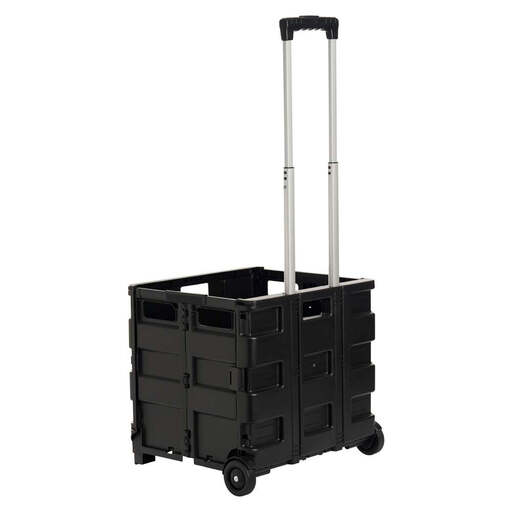
Why this product suits this profile: With a capacity of 42.5 litres and a maximum load of 25 kg, this compact trolley is suitable for shopping, household items and transporting smaller tools.
The stated load capacity and 8 cm folded dimensions provide clear guidance for light to medium loads and space-saving storage.
42.5-litre capacity, a net weight of 2.65 kg and an extendable handle reaching 97.5 cm in height.
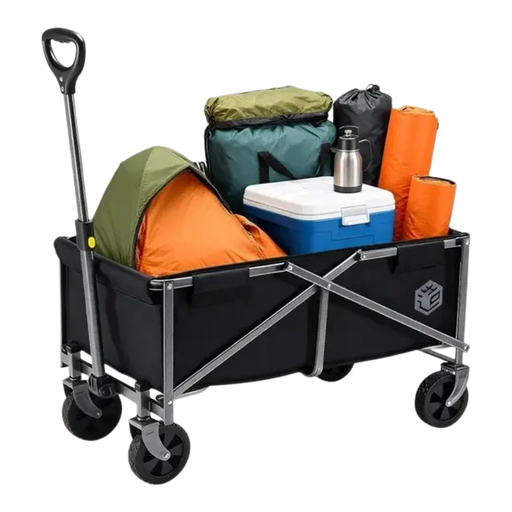
Why this product suits this profile: This camping wagon combines a 75-litre compartment with a stated load capacity of 100 kg and swivel wheels for outdoor activities.
The product information lists capacity, load capacity, materials and care instructions separately. This makes it easier to distinguish storage space from the permitted load.
600D Oxford fabric, an integrated construction requiring no assembly and 360-degree swivel wheels, according to the product description.
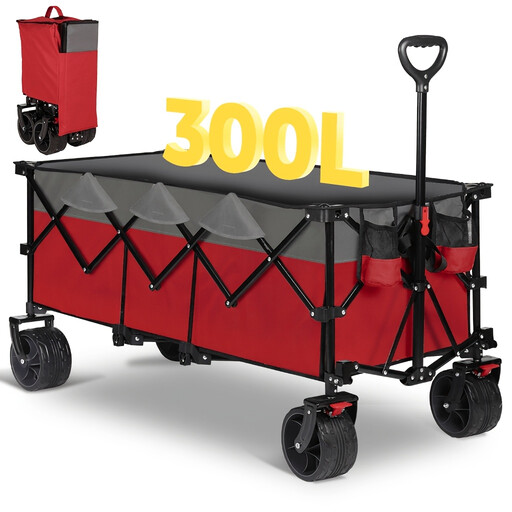
Why this product suits this profile: With a capacity of 300 litres and a stated load capacity of 200 kg, this foldable utility wagon is designed for camping, gardening and transport tasks involving large loads.
Wide 7-inch wheels, even loading and the recommendation to use it on stable surfaces make its usage limits easier to understand.
300 litres of storage space, a stated load capacity of 200 kg, a foldable four-way mechanism and parking brakes.
We have put together a complete, regularly updated list of products that fully meet these strict selection criteria and the safety regulations applicable in the EU.
For normal shopping, 20 to 30 kg is often sufficient. For gardening materials, crates of drinks or camping equipment, 70 kg or more may be suitable. The decisive factor is always the stated maximum load capacity of the model in question. The load should be distributed evenly.
Its service life depends on the load, surface, storage conditions and care. Dry the fabric and frame after use in damp conditions, remove dirt from the wheels and joints, and do not exceed the load capacity. Damaged wheels, tears in the fabric or a locking mechanism that no longer engages are reasons not to continue using the trolley.
An ordinary shopping trolley or utility wagon is not automatically designed for stairs. For steps, you need a stair-climbing model specifically designed for this purpose. Even then, follow the manufacturer's instructions regarding load capacity, step height and operation. The risk of tipping is higher on stairs than on level surfaces.