
Lieferung heute & morgen

Qualitätsgarantie

Willkommens-Angebote freischalten: KOSTENLOSE Lieferung | Bis zu 80 % RABATT | Kostenlose 30-Tage-JoyPlus-Testphase
App herunterladen
A foldable transport trolley can make moving crates of drinks, gardening tools, camping equipment and shopping much easier. In practice, however, models vary considerably in load capacity, handling and storage space. A high kilogram rating alone says little about whether the trolley will work safely and comfortably on a pavement, in the garden or on uneven ground.
To avoid disappointment after a short time, pay particular attention to three common pitfalls: unclear load specifications, inadequate wheels and a folding mechanism that looks compact but is awkward to use in everyday situations.
Some suppliers only state a maximum overall load without distinguishing between different operating modes. For example, a foldable pull wagon may have a different load limit when used as a handcart than when the weight is pulled or distributed across a platform.
You should therefore look for the following information:
A heavy-duty transport trolley with a load capacity of 200 kg is not automatically suitable for every situation. When heavily loaded, uneven ground, narrow paths or an unfavourable centre-of-gravity position can affect stability.
A shopping trolley with small castors is easy to manoeuvre on level ground, but may struggle on gravel, grass or sand. For camping, the beach and the garden, larger, wider or shock-absorbing wheels are generally more practical.
Check the following:
A foldable garden trolley with detachable wheels and a removable bag can also be easier to clean after transporting soil, sand or damp leaves.
A transport trolley with a brake can provide extra stability when loading or parking on a slight incline. However, the brake is designed to keep the trolley stationary, not to actively slow it down while it is moving. On some models, the brakes are integrated into the wheels, while on others only one axle is locked.
Before buying, check:
For crates of drinks, parcels and removal boxes, a foldable hand truck is often more practical than a large fabric trolley. A vertical hand truck takes up little width and allows loads to rest directly against an edge. A trolley with a platform, on the other hand, is suitable for bulky items.
For camping or family outings, 80 to 127 litres is often sufficient. Anyone transporting extensive equipment, garden sacks or several picnic boxes may need more capacity. What matters is that the dimensions when open fit through doors, along cellar paths and into the boot.
An aluminium frame is lightweight and rust-resistant, while steel constructions can be heavier depending on their design. A durable coating is useful on fabric trolleys, but it does not replace dry storage. The trolley should be completely dry before being folded away.
Compare the trolley’s own weight with its load capacity. A lightweight trolley is convenient to store, but may feel less stable when heavily loaded. The following features are also important:
A collapsible transport trolley should open without complicated assembly steps. One-handed or quick-folding mechanisms are convenient, but must lock securely into place. Before loading it for the first time, check that the frame is fully open and that the wheels are correctly positioned.
For regular shopping or transporting parcels, a foldable hand trolley with a platform may be the better choice. Anyone mainly moving bags and smaller goods may find a compact shopping trolley sufficient. For longer journeys, handle height, wheel movement and how easily it can be pulled over kerbs are more important than storage capacity alone.
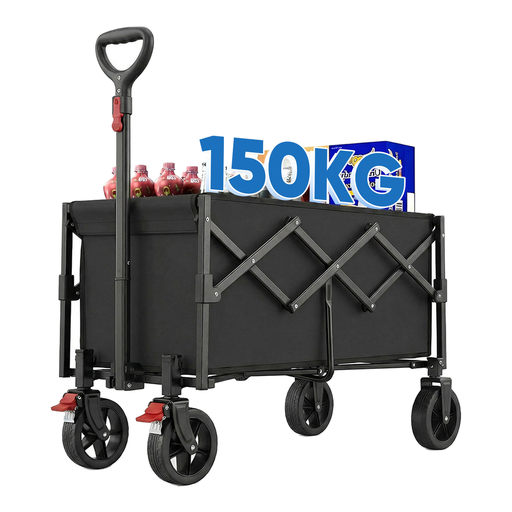
Why this product suits this profile: With a capacity of 80 litres, an own weight of 5.8 kg and a stated load capacity of up to 100 kg, this foldable hand trolley is suitable for smaller shopping trips, gardening and outings.
The stated load capacity, volume and braking equipment make comparison easier. The bag and wheels can be removed for cleaning.
80-litre capacity, 100 kg maximum load, 600D Oxford fabric and foldable construction.
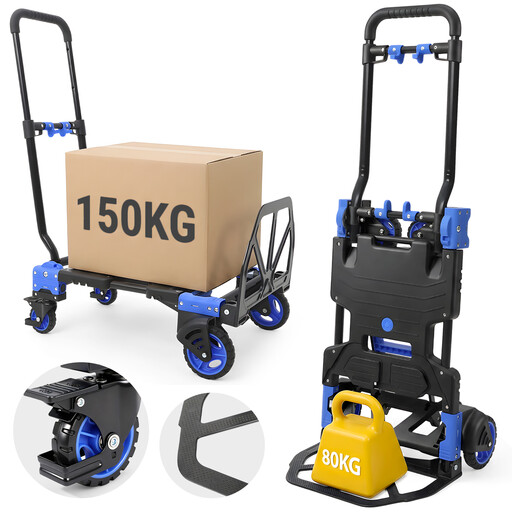
Why this product suits this profile: The combination of handcart and platform modes offers flexibility for parcels, crates and bulky items around the home, office or during a move.
The load limits are stated separately: 80 kg in handcart mode and 150 kg in platform mode. An integrated parking brake is included.
Aluminium frame, 360-degree TPR wheels with twin wheel bearings, height-adjustable handle and one-handed folding.
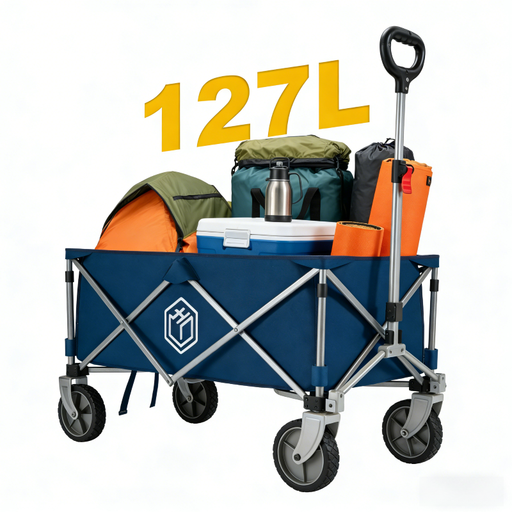
Why this product suits this profile: With 127 litres of internal space and a stated maximum load of 200 kg, this camping trolley is designed for users who regularly transport extensive equipment, gardening accessories or picnic supplies.
The product specifications state both the capacity and the maximum load. Even weight distribution and use on ground that is as level as possible are still required.
127-litre internal space, foldable design, no usual assembly required and cleaning with a damp cloth.
We have compiled a complete, regularly updated list of products that fully meet these strict selection criteria and the safety regulations applicable in the EU.
Even a sturdy trolley will only remain fully functional if the joints, wheels and fabric are checked regularly. Remove sand, soil and small stones from the running gear. Metal frames should be dried after coming into contact with moisture. If your trolley has a brake, it is advisable to test it before loading.
Also remember:
For shopping and smaller gardening jobs, 50 to 100 kg is often sufficient. For house moves, camping equipment or heavy sacks, models with a capacity of 150 to 200 kg may be more suitable. The key consideration is whether the stated figure applies to a platform, an internal compartment or a specific operating mode.
Wider wheels with shock-absorbing properties are generally more suitable for grass, gravel and firm sand than small, hard castors. On very soft sand, however, even an off-road camping trolley may have limited mobility. Also check the turning circle and the trolley’s own weight.
Its lifespan depends on the load, surface, storage conditions and care. Keeping within the stated load capacity, storing the trolley in a dry place and regularly checking the wheels and folding joints will reduce common causes of wear. When choosing a model, clear information about the frame, wheels, fabric and spare-part or returns policies is helpful.