
Lieferung heute & morgen

Qualitätsgarantie

Willkommens-Angebote freischalten: KOSTENLOSE Lieferung | Bis zu 80 % RABATT | Kostenlose 30-Tage-JoyPlus-Testphase
App herunterladen
A foldable transport trolley can make a great deal of work easier when camping, gardening, moving house or working in a warehouse. At the same time, many shoppers are faced with product specifications that offer only limited guidance in everyday use. A high load capacity alone does not automatically make a trolley suitable for every situation. The frame, loading area, wheels, braking function and folded dimensions are also important.
Specifications such as “150 kg” usually refer to a maximum load under certain conditions. On uneven ground, with an unevenly distributed load or on slopes, handling can change significantly. Values also vary depending on the design: a 2-in-1 transport trolley, for example, may carry 150 kg in platform mode but only 80 kg in hand-truck mode.
The load should be distributed evenly. A 150 kg hand trolley is therefore only useful if the frame, loading area and wheels are designed for the goods actually being transported.
A pull-along wagon with large wheels will often roll more easily on grass, gravel or paving than a model with small castors. Wheel size alone does not determine stability, however. Tyre width, bearings, axle design and the connection between the wheels and frame are also important.
With a foldable camping wagon featuring wide 7-inch tyres, smooth-running bearings and sufficient ground clearance can make transport easier across different surfaces. The manufacturer's safety instructions still apply on steep paths or very uneven terrain.
A transport trolley with a brake can be useful when leaving the trolley on gently sloping surfaces. On the models considered here, however, the brake is designed as a parking brake and not for braking while the trolley is in motion. A trolley should never be used as a seat or step. Before loading, the folding and locking mechanism must be fully engaged.
First check the permissible load for each operating mode. A folding pull-along wagon with a fabric compartment is particularly suitable for bulky, loose items. A foldable transport trolley with a loading platform, on the other hand, is more practical for boxes, tool cases or sacks.
Pay attention to the following details:
For fabric trolleys, 600D Oxford fabric is a specific material specification. A PE coating can make the surface more resistant to moisture and abrasion, but it does not automatically make the trolley waterproof. After cleaning, the fabric should be allowed to dry completely before the trolley is folded.
Aluminium frames are comparatively lightweight on hand trucks. Reinforced profiles, bolted connection points and a sufficiently large loading platform are more relevant for heavy loads than weight specifications alone. With a heavy-duty transport trolley, the handles, axles and fixing points should also be suitable for the stated load capacity.
Measure the intended storage space in your boot, cellar or shed. A compact folded size is only practical if the trolley can be folded without complicated dismantling.
A height-adjustable handle can be useful for users of different heights. For the wheels, the following points are relevant:
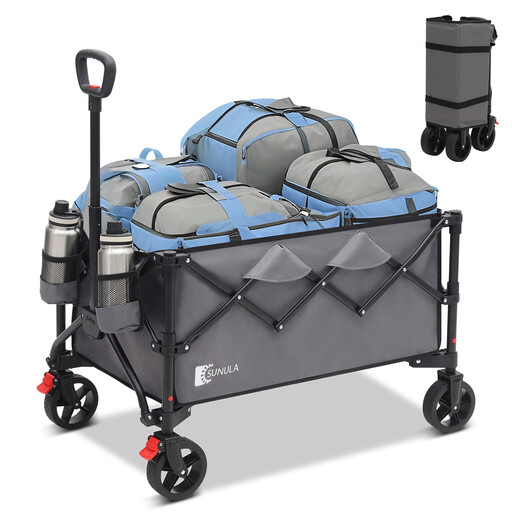
Why this product suits this profile: This trolley combines a 120 kg load capacity with 150 litres of storage space, making it suitable for shopping, gardening, camping and smaller transport tasks.
The off-road wheels and parking brakes are explicitly specified. The frame is secured by a locking structure.
600D Oxford fabric with PE coating, a handle operated from one side and removable wheels for cleaning.
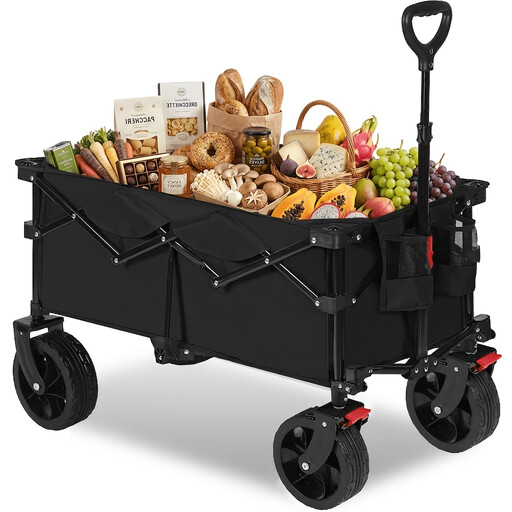
Why this product suits this profile: The combination of a 150 kg load capacity, 150 litres of storage space and wide 7-inch tyres is well suited to frequent outdoor transport tasks.
The stated load capacity is combined with wide tyres, brakes and a welded steel frame. The load must still be distributed evenly.
600D Oxford fabric, adjustable handle, two drink holders and a folding mechanism for compact storage.
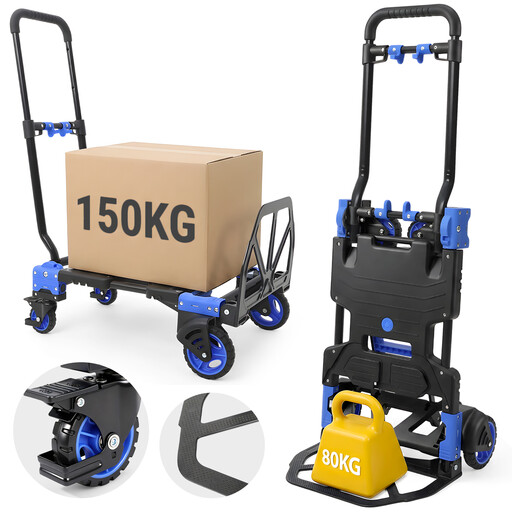
Why this product suits this profile: Combining a sack truck and platform trolley, this model is suitable for moving house, warehouses, offices, workshops and households with changing transport needs.
The load ratings are separated by operating mode: 80 kg as a hand truck and 150 kg as a platform trolley. The integrated parking brake is intended for securing the trolley when stationary.
Aluminium frame, height-adjustable handle, 360-degree twin castors and a folding mechanism for storage.
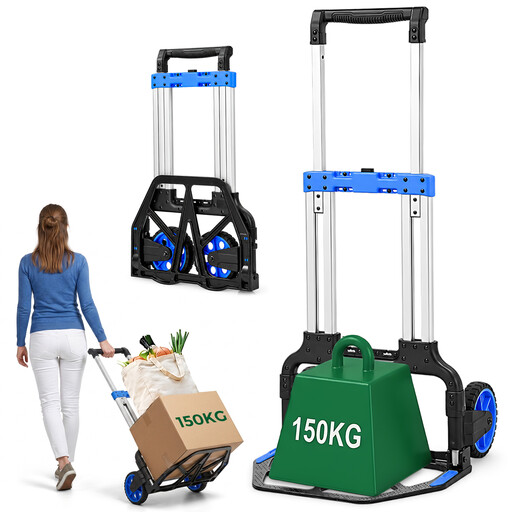
Why this product suits this profile: This compact sack truck is designed for heavy individual items such as tool cases, boxes or materials for gardening and construction work.
The load can be secured with two bungee straps. An XXL loading platform and a lockable telescopic bar are also specified.
Aluminium frame, 150 kg load capacity, height-adjustable handle at 77 and 107 cm, plus TPR wheels with precision bearings.
We have put together a complete, regularly updated list of products that fully meet these strict selection criteria and the safety regulations applicable in the EU.
Before each use, check the frame, wheels, screw connections and locking mechanisms. Load the trolley on a level surface and do not exceed the stated load capacity. Heavy items should be placed as low and centrally as possible. With a foldable sack truck, straps should be used if the load could tip or shift.
For the models mentioned, a damp cloth and mild cleaning detergent are usually sufficient for care. Store the transport trolley in a dry place and only fold fabric models once they have dried completely. Remove sand, soil and small stones from the wheels and bearings, as they can impair rolling performance.
Depending on the load, 80 to 120 kg is often sufficient for shopping, garden waste and camping. Models with a 150 kg capacity may be suitable for boxes, tools or construction materials. The key point is whether the stated capacity applies to a platform, a sack-truck function or the fabric interior.
Wide wheels and sufficient ground clearance make it easier to roll across grass, gravel and paving. Uneven or sloping paths do, however, increase the risk of tipping. The load must be distributed evenly and the trolley secured on a slope using the parking brake.
Its service life depends on the load, surface, weather conditions and care. Keeping within the maximum load capacity, not overloading the frame, keeping the wheels clean and storing the trolley in a dry place will reduce wear on the fabric, bearings and connections. Folding mechanisms should be operated without force and checked regularly to ensure they engage fully.