
Lieferung heute & morgen

Qualitätsgarantie

Willkommens-Angebote freischalten: KOSTENLOSE Lieferung | Bis zu 80 % RABATT | Kostenlose 30-Tage-JoyPlus-Testphase
App herunterladen
A foldable transport trolley can make it much easier to move shopping, camping equipment, gardening accessories or sports gear. However, there are important differences between a compact foldable pull-along wagon, a classic handcart with wheels and a foldable sack truck. Anyone who focuses solely on maximum load capacity or particularly large volume could end up buying a model that is difficult to steer in everyday use, too large for the boot or unstable on uneven ground.
That is why our selection is based on clear specifications such as empty weight, load capacity, volume, folded dimensions, brakes, wheel design and material.
A high maximum load does not automatically mean that the trolley can be pulled comfortably with that weight. The centre of gravity, frame construction, handle and wheels are also important. A fully loaded camping trolley needs different wheel characteristics on sand or grass than a foldable shopping trolley that is mainly used on level tarmac.
The stated load limit should never be exceeded. Heavy or unevenly distributed items can affect handling even below the maximum stated capacity.
A high litre capacity may sound practical at first. When choosing, you should also consider the external dimensions, the internal shape and whether bulky items can be stored securely. A trolley with plenty of storage space may still take up a lot of room when folded.
Before buying, check the following:
Marketing terms such as Offroad, Heavy-Duty or Outdoor are no substitute for technical specifications. For gravel, grass and sand, wide wheels, sufficient ground clearance and stable axle guidance are important. On sloping ground, a transport trolley with brakes can provide additional safety when loading and unloading.
It is also important to check whether the brakes actually act on the wheels, how many wheels are braked and whether the trolley needs to be fully unfolded and locked in place.
A lightweight transport trolley is easier to take out of the cellar, car or motorhome. However, the empty weight must be appropriate for the intended load. A 3.5 kg aluminium handcart may be suitable for parcels or crates of drinks, while a larger garden trolley may be considerably heavier because of its sturdier frame.
Folded dimensions are particularly important for small flats and car boots. Automatic wheel folding or a quick-fold mechanism can make handling easier, but does not replace checking that all locks have engaged properly.
The load capacity in kilograms describes the permitted weight, while the volume in litres indicates the available storage space. Both figures should be considered together. An 80-litre trolley with a 100 kg load capacity is designed differently from a very large trolley intended mainly for transporting bulky but lightweight items.
For a foldable pull-along wagon used for family outings or camping, a robust base and stable frame are also important. For shopping, however, a smaller model with more compact folded dimensions may be sufficient.
Oxford fabric with a PE coating can provide a hard-wearing, water-repellent outer surface. This does not mean that the trolley is permanently waterproof, however. After exposure to rain, the fabric should be allowed to dry completely before the trolley is folded away.
Metal frames should be dried after contact with moisture. Wheels, axles and connection points should be checked regularly for wear, loose fastenings and dirt. Removable wheels or a detachable fabric container make cleaning and maintenance easier.
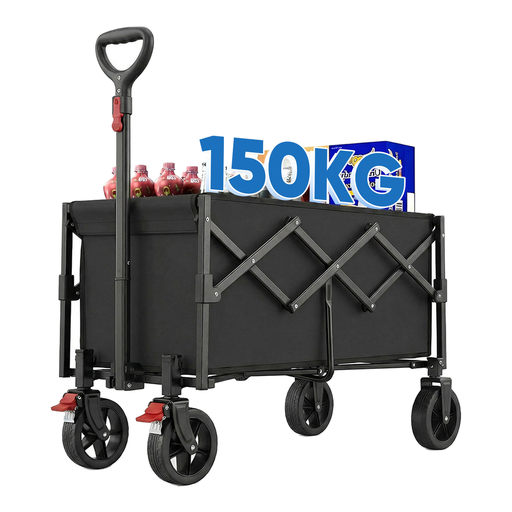
Why this product suits this profile: With an 80-litre capacity, an empty weight of 5.8 kg and a stated maximum load of 100 kg, this compact wheeled handcart is suitable for shopping, gardening and days out.
The specific details of the empty weight, volume and load capacity make it easier to assess suitability. The brakes are designed to keep the trolley safely stationary; the trolley must be fully unfolded.
600D Oxford fabric with PE coating, detachable fabric container and removable wheels for cleaning.

Why this product suits this profile: This camping wagon offers 127 litres of storage, a stated load capacity of 200 kg and two front brakes for camping, trips to the beach and larger amounts of equipment.
In addition to its high load capacity, the volume, brake type and usage instructions are clearly stated. The load limit must not be exceeded.
Collapsible frame, 360-degree swivel wheels and stated folding time of 3 seconds.
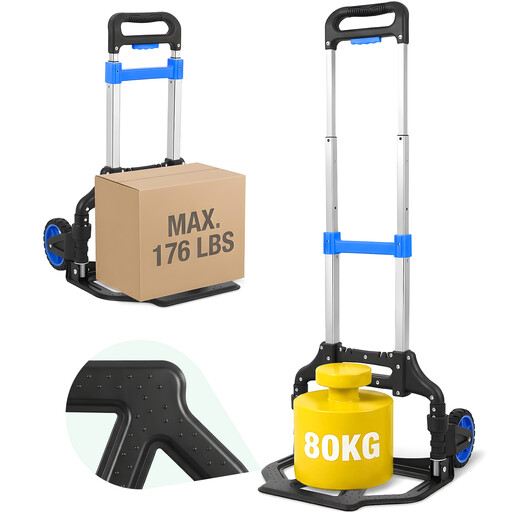
Why this product suits this profile: Designed for parcels, crates of drinks and individual heavy items, this narrow sack truck weighs 3.5 kg and has a load capacity of 80 kg.
The folded dimension of 5.7 cm is clearly specified. This makes it easier to compare the space required with the storage available at home or in your vehicle.
Aluminium frame, three-stage height-adjustable handle and TPR wheels with double ball bearings; the stated handle height ranges from 63 to 100 cm.
We have put together a complete, regularly updated list of products that fully meet these strict selection criteria and the safety regulations applicable in the EU.
For light shopping or smaller parcels, 50 to 80 kg may be sufficient. For camping equipment, gardening accessories or crates of drinks, a higher load capacity is advisable. It is still essential to distribute the load evenly and not exceed the manufacturer’s stated limit.
This depends on the wheel width, ground clearance, axle design and load. Wider wheels can offer advantages on soft ground. Even an off-road model should be moved carefully on sand, slopes and rough terrain. A loaded trolley can tip over more easily than an empty one.
Fabric surfaces should be cleaned with a damp cloth and mild detergent, then dried completely. Metal parts should be stored in a dry place to prevent corrosion. Before each use, it is advisable to carry out a quick check of the wheels, handle, folding mechanism, locks and, where applicable, the brake.