
Lieferung heute & morgen

Qualitätsgarantie

Willkommens-Angebote freischalten: KOSTENLOSE Lieferung | Bis zu 80 % RABATT | Kostenlose 30-Tage-JoyPlus-Testphase
App herunterladen
Whether for bulk shopping, gardening, moving house, or a trip to the beach – a foldable trolley promises to move heavy loads effortlessly and store away compactly when not in use. But the market is flooded with models of widely varying quality. Many buyers discover only after a short time that their new transport helper can't handle the rigours of daily use.
As your Joybuy Product Recommendation Officer, I'm here to filter through the essential information so you can make an informed decision. In this guide, we'll highlight the three most common design flaws that can quickly render a seemingly practical cart useless, and show you what to look for when making your choice.
Many products look robust at first glance, but only reveal their flaws in real-world use. Pay close attention to these three pitfalls to avoid disappointment:
To find the right foldable hand cart for your needs, you should carefully examine three technical specifications. These determine the durability, functionality, and safety of the cart.
The maximum load capacity (in kg) is an important benchmark, but it should always be evaluated in relation to the frame's material and construction.
The wheels are the direct link to the ground and are crucial for ease of use and comfort.
A good foldable trolley must be easy to set up and break down in a few intuitive steps. Check the dimensions when folded. Will the cart fit easily into your car trunk, garage, or cellar? Models that fold down in both length and width offer the most compact packed size.
Instead of presenting an overwhelming list, we have selected models that meet specific requirements and avoid the aforementioned weak points.
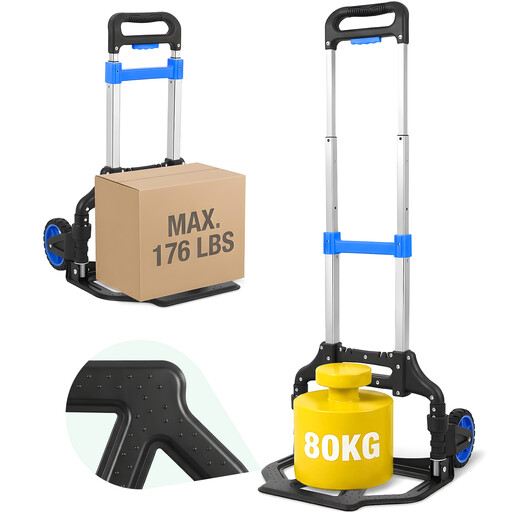
Why This Fits Their Persona: Ideal for transporting parcels, drink crates, or shopping in the city. Its low weight and extremely compact folded size make it the perfect companion for apartment living or keeping in the car.
Avoids the unrealistic load capacity trap with a clear 80 kg rating that matches the lightweight aluminium frame. The TPR wheels are a clear upgrade from cheap hard plastic rollers.
Extremely lightweight (3.5 kg) and folds down to a width of just 5.7 cm. The telescopic handle is height-adjustable for ergonomic use.
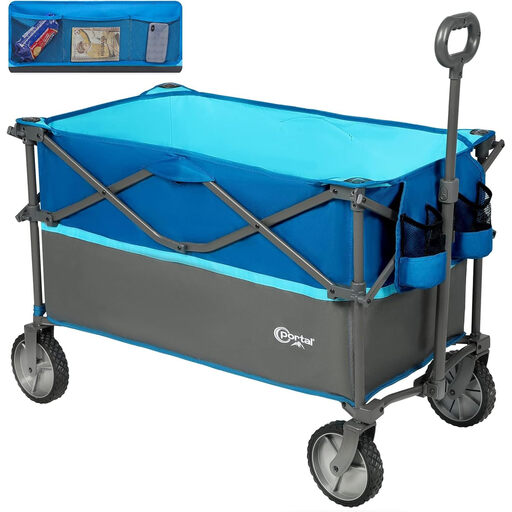
Why This Fits Their Persona: A classic all-rounder for family outings, transporting sports equipment, or gardening. Offers plenty of storage space and useful extras for recreational use.
The robust steel frame and durable polyester fabric are designed for regular use. The wheels are designed for mixed terrain, avoiding the problem of getting stuck on grass.
Large loading volume (228 litres) and practical details like side pockets and two cup holders. No assembly required.
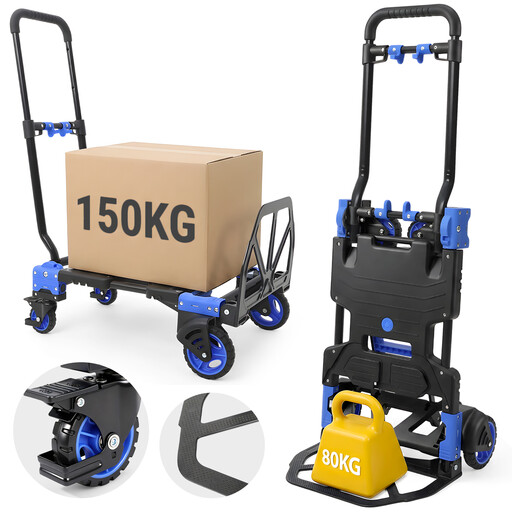
Why This Fits Their Persona: Perfect for DIY enthusiasts, moving, or commercial use where flexibility is key. It converts from a hand truck to a platform cart in seconds.
Offers two clearly defined functions, each with a realistic load capacity (80 kg as a hand truck, 150 kg as a platform cart). The 360° bearing wheels with an integrated brake ensure control and safety.
Convertible 2-in-1 design for maximum flexibility. High load capacity of 150 kg in platform mode, yet still folds compactly.
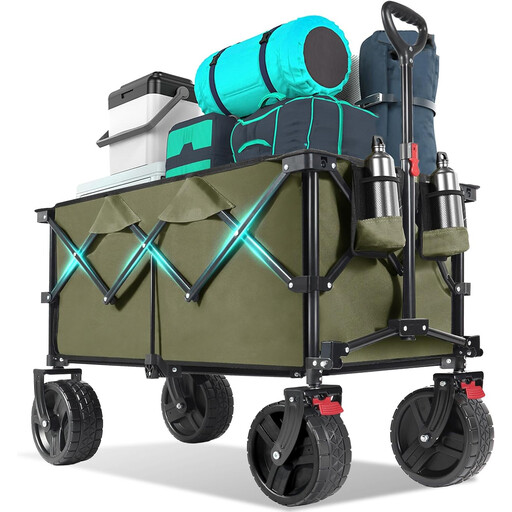
Why This Fits Their Persona: Specifically designed for use at festivals, camping, or at the beach, where uneven or soft ground is the norm. The high load capacity is ideal for tents, chairs, and supplies.
Directly addresses the weakness of unsuitable wheels by using 7-inch wide tires. These prevent sinking into sand or mud. The high 200 kg load capacity is supported by a solid frame.
Extra-wide all-terrain wheels for maximum mobility on difficult terrain. Very high load capacity (200 kg) and large volume (200 L).
We have compiled a complete, up-to-date list of products that fully meet these strict selection criteria and our high safety standards.
Clean the cart after use, especially the wheels and the joints of the folding mechanism, to remove dirt and sand. Let the fabric cover dry completely before folding the cart. Store it in a dry place to prevent rust on the frame and mould on the fabric.
This depends on the model. Some higher-end wagons have wheels with a quick-release mechanism that can be easily removed and replaced. On many simpler hand trucks or platform carts, the wheels are permanently attached to the axle, which makes replacement difficult. Check the product description for terms like "detachable wheels" or "quick-release feature".
The load capacity specifies the maximum weight in kilograms (kg) that the cart can safely transport. The loading volume describes the available storage space in litres (L). For heavy, compact items (e.g., cement bags), the load capacity is crucial. For bulky but light items (e.g., beach gear, empty containers), a large loading volume is more important.