
Lieferung heute & morgen

Qualitätsgarantie

Willkommens-Angebote freischalten: KOSTENLOSE Lieferung | Bis zu 80 % RABATT | Kostenlose 30-Tage-JoyPlus-Testphase
App herunterladen
A foldable transport trolley can make shopping, camping equipment, garden soil or tools much easier to move around. However, not every model offers a practical solution for everyday use. Buyers often choose based solely on the stated capacity in litres or maximum load capacity, overlooking important details such as the trolley’s own weight, wheel design or its actual folded size.
This buying guide explains what individuals, families, campers, garden owners and DIY enthusiasts should consider before buying. The selection is based on clear product data and different usage scenarios.
A trolley with a large interior is not automatically suitable for heavy items. The figure in litres describes the volume, not the permitted load. Conversely, a 100 kg transport trolley may be able to carry heavy loads without offering enough space for bulky camping or gardening equipment.
Always check both values:
The load should be distributed evenly. A high figure on the product label does not replace stable loading or suitability for use on the surface in question.
Many trolleys can be folded, but still take up considerable space when folded. For fitting one in the boot, the folded dimensions, its own weight and the folding mechanism are therefore crucial.
A lightweight transport trolley weighing 3.5 or 5.8 kg may be more practical for regular loading and unloading than a heavier model with a larger frame. For camping trolleys with steel frames and large wheels, however, you should check whether the weight is manageable when carrying it through stairwells or over longer distances.
A sack truck with a brake or a trolley with a parking brake can provide additional stability when loading and unloading on gently sloping surfaces. However, the brake is not automatically a travelling brake. On several models, it is explicitly intended for parking only.
Look out for:
For light shopping, picnic items or smaller gardening jobs, 50 to 80 kg is often sufficient. If you plan to move plant pots, toolboxes or extensive camping equipment, you should compare the permitted load capacity with your usual load and leave a safety margin.
A foldable utility wagon is generally suitable for flexible transport with a fabric bag. A folding hand trolley or foldable transport sack truck, on the other hand, is often more practical when boxes or crates of drinks need to stand on a solid loading platform.
Wheels have a greater impact on the effort required than many buyers expect. Wider tyres may be more suitable for grass, gravel or sand. Small swivel castors are particularly manoeuvrable on smooth floors, but reach their limits more quickly on uneven ground.
When choosing, consider the following:
Oxford fabric with a PE coating is used on several outdoor models. According to the product details, it is water-repellent or designed for easy cleaning. After contact with rain or damp sand, the fabric should be allowed to dry fully before the trolley is folded.
A steel frame can offer a high load capacity, but adds weight and should be stored in a dry place. Aluminium frames are a lighter alternative for hand and platform trolleys. On every foldable system, joints, locking mechanisms and wheel attachments should be checked regularly for dirt and secure fitting.
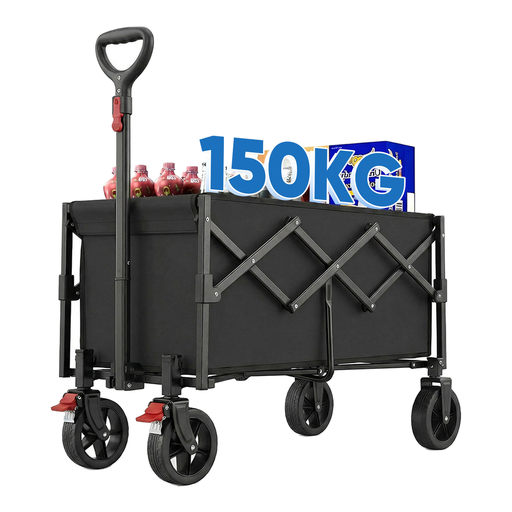
Why this product suits the profile: This trolley combines 80 litres of storage space with a stated load capacity of up to 100 kg and an own weight of 5.8 kg. This makes it suitable for shopping, smaller gardening jobs and trips where boot space is limited.
Load capacity and volume are stated separately. The wheels and fabric bag can also be removed for cleaning.
5.8 kg own weight, 80-litre volume, foldable frame and stated brakes.
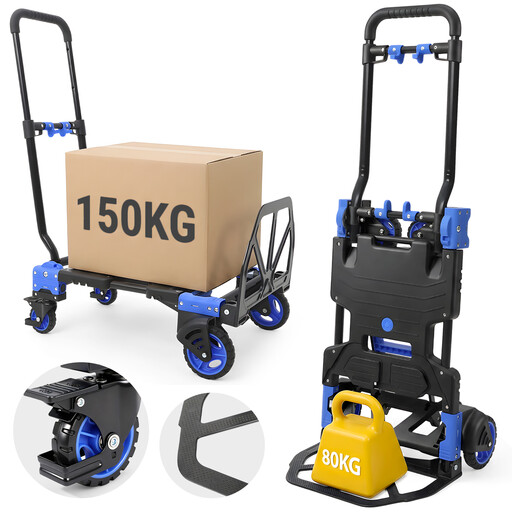
Why this product suits the profile: The aluminium trolley can be used as a sack truck with a capacity of up to 80 kg or as a platform trolley with a capacity of up to 150 kg. The adjustable handle height supports different working positions when moving house, storing items or carrying out workshop tasks.
The load capacity is stated separately for each mode of use. An integrated parking brake is provided for securing the trolley when parked.
Two modes of use, 7 kg own weight, adjustable handle and TPR wheels with twin bearings.

Why this product suits the profile: With 127 litres of storage space and a stated load capacity of 200 kg, this camping wagon is designed for extensive equipment, larger shopping trips and heavy loads.
The product details list storage space and load capacity separately. Before loading, the trolley must be fully unfolded and locked in place.
127-litre capacity, stated load capacity of 200 kg, collapsible frame and two front brakes.
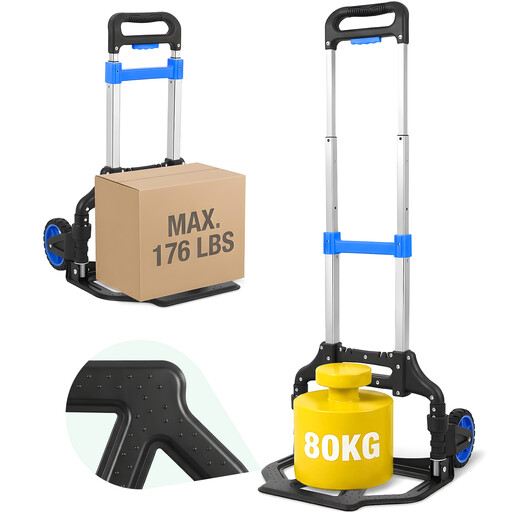
Why this product suits the profile: According to the product details, this hand trolley weighs 3.5 kg and can carry up to 80 kg. It is suitable for parcels, crates of drinks and short-distance transport when you need a model that folds down to a slim profile.
The own weight and folded width of 5.7 cm are clearly stated. This makes it easier to assess the space required before buying.
3.5 kg own weight, 80 kg load capacity, three-stage adjustable handle and automatic wheel folding.
We have put together a complete, regularly updated list of products that fully meet these strict selection criteria and the safety regulations applicable in the EU.
For shopping and light trips, 50 to 80 kg may be sufficient. For gardening jobs, tools or extensive camping equipment, models with a capacity of 100 kg or more are a sensible choice, provided the frame, wheels and surface are suitable for the load. The load should never exceed the manufacturer’s stated limit.
Its service life depends on the load, surface, storage conditions and care. Dry fabric parts before folding the trolley, remove sand and dirt from the wheels, and regularly check the joints and fastenings. For a garden or camping trolley, storing it in a dry place can help reduce material ageing.
A parking brake is generally intended to secure the trolley when it is stationary. It is not a substitute for a controlled travelling brake. On slopes, you should only use the trolley in accordance with the instructions for use, secure the load and prevent the trolley from rolling away when loading and unloading.