
Lieferung heute & morgen

Qualitätsgarantie

Willkommens-Angebote freischalten: KOSTENLOSE Lieferung | Bis zu 80 % RABATT | Kostenlose 30-Tage-JoyPlus-Testphase
App herunterladen
A foldable wagon is a handy companion for family outings, transporting shopping, gardening, or your next camping trip. But the market is flooded with models whose advertised features often fail to deliver in practice. Many buyers discover only after a short time that their new cart isn't up to the task. This guide reveals the three most common pitfalls and explains which technical features you should look for to make an informed decision.
When choosing a wagon, crucial details that determine its durability and functionality are often overlooked. Pay special attention to these three weak points:
To avoid these problems, you should base your choice on objective technical data. The following three criteria are crucial for the performance and longevity of a folding wagon.
The foundation of any robust cart is its frame. Models made from alloy steel or powder-coated tubular steel offer high stability and resistance to deformation. Always check the manufacturer's stated maximum load capacity in kilograms (kg). This figure defines the maximum weight the wagon can safely transport without damaging the frame or axles. Exceeding this limit can lead to permanent damage. For transporting crates of drinks, garden soil, or heavy camping equipment, models with a load capacity of at least 100 kg are a sensible choice.
The choice of wheels should depend on the intended terrain.
A good folding wagon features an intuitive folding mechanism that can ideally be operated with a single pull or in just a few simple steps. Check the dimensions when folded (packed size). Will the wagon fit easily into your car's trunk or the intended storage space in your cellar or garage? Models that don't require parts like the wheels to be removed are much more practical for everyday use. Some products also offer quick-release wheels, which allow for easy cleaning or replacement.
Based on the criteria above, we have compiled a selection of models that are well-suited for specific use cases.
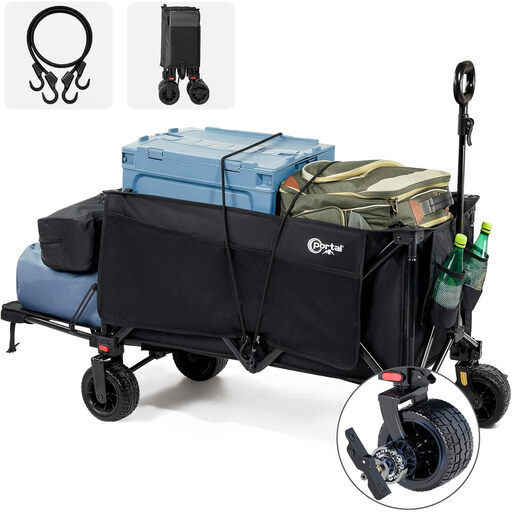
Why This Fits Their Persona: Ideal for families who need plenty of space for beach gear, picnic supplies, or the weekly shop. The drop-down tailgate allows for transporting longer items, while cup holders and side pockets keep things organised.
The alloy steel frame is rated for a 132 kg load capacity, preventing it from bending. The 10 cm wide PU wheels with ball bearings can handle sand and uneven terrain where narrow wheels would fail.
Very large load volume (300 L) with a flexible tailgate; dual brakes for safety on slopes; quick-release wheels for easy cleaning.
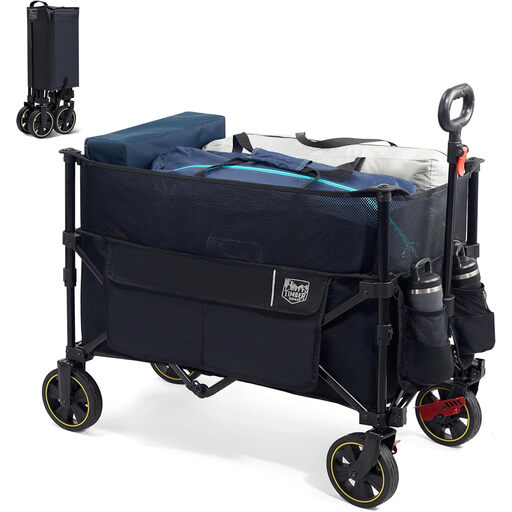
Why This Fits Their Persona: Perfect for users seeking a balance between high load volume and a minimal packed size. Ideal for transporting a tent, sleeping bag, and supplies from the car park to the campsite without taking up much space in the car.
The folding mechanism requires no assembly and operates in seconds, preventing jammed joints. Its extremely compact packed size of 30x20x76 cm solves the problem of bulky, hard-to-store models.
Very compact folded size for easy transport; 225 L volume with a 100 kg load capacity; integrated brakes for added control.
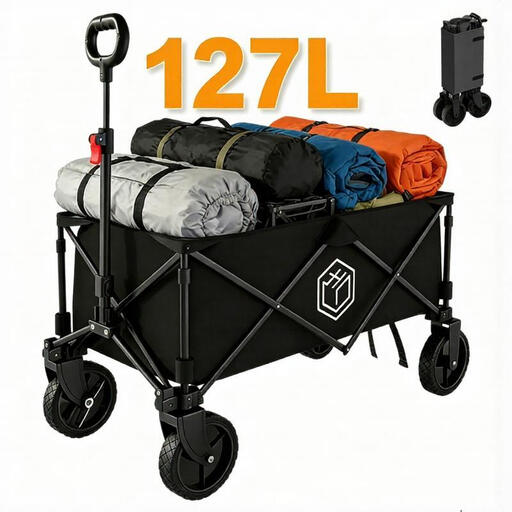
Why This Fits Their Persona: For users who regularly need to move heavy loads like tools, garden equipment, or large quantities of supplies. Its high load capacity makes it a reliable foldable garden cart or a great help for moving house.
With a maximum load capacity of 200 kg, the frame is explicitly designed for heavy-duty use and resists the risk of bending. The dual front-wheel brakes ensure safe handling even when fully loaded.
Extremely high load capacity of 200 kg; fast 3-second folding mechanism; dual front-wheel brakes for maximum safety.
We have compiled a complete, up-to-date list of products that fully meet these strict selection criteria and applicable safety regulations.
Maintenance is generally straightforward. The fabric cover can be cleaned with a damp cloth and, if necessary, a mild soap solution. Avoid harsh cleaning agents or machine washing. The wheels and frame should be cleared of dirt after outdoor use. Store the wagon in a dry place to prevent rust from forming on the frame.
The load capacity (in kg) indicates the maximum weight the wagon's structure can withstand. The volume (in litres), on the other hand, describes the pure storage space inside. A wagon can have a large volume but a low load capacity, making it suitable for light but bulky items. For heavy loads, the load capacity is the crucial figure.
This depends on the model. Some wagons, particularly in the higher price range, feature quick-release wheels. These can be removed without tools, which makes cleaning, replacement due to wear, or even more compact storage much easier. Check the product specifications for this feature if this flexibility is important to you.