
Lieferung heute & morgen

Qualitätsgarantie

Willkommens-Angebote freischalten: KOSTENLOSE Lieferung | Bis zu 80 % RABATT | Kostenlose 30-Tage-JoyPlus-Testphase
App herunterladen
A foldable wagon seems like the ideal solution for transporting gear, groceries, or beach essentials. But reality often tells a different story: a promising model proves to be impractical or defective after just a short time. Many buyers get frustrated by design flaws that only become apparent with use. Before you make a decision, it's crucial to understand the typical weaknesses often hidden behind appealing product images.
This guide focuses on the objective criteria that separate a reliable foldable wagon from an unsuitable one. We'll highlight the three most common pitfalls and explain which technical parameters you should pay close attention to.
The 3 Most Common Flaws in Foldable Wagons:
To avoid a bad purchase, you should base your decision on three fundamental technical properties. These determine the durability and practicality of your wagon.
The maximum load capacity, specified in kilograms, is the most critical value for stability. It indicates how much weight the frame and axles can permanently withstand. A robust collapsible wagon with a high load capacity features a frame made of tubular steel. Pay attention to the material thickness and the quality of the welds or joints. The storage volume in litres is secondary—it's no use having a lot of space if the wagon collapses under the weight of its cargo.
The wheels are the direct connection to the ground and are crucial for user comfort.
A good foldable wagon can be reduced to a compact size in just a few steps and without any tools. Check the dimensions when folded to ensure the wagon fits in your car trunk or storage space.
An indispensable safety feature is a wagon with a brake. Parking brakes on at least two wheels prevent the wagon from rolling away on a slope or during loading and unloading. An adjustable handle also ensures ergonomic handling for people of different heights.
Instead of making a one-size-fits-all recommendation, we have identified models tailored to specific use cases.
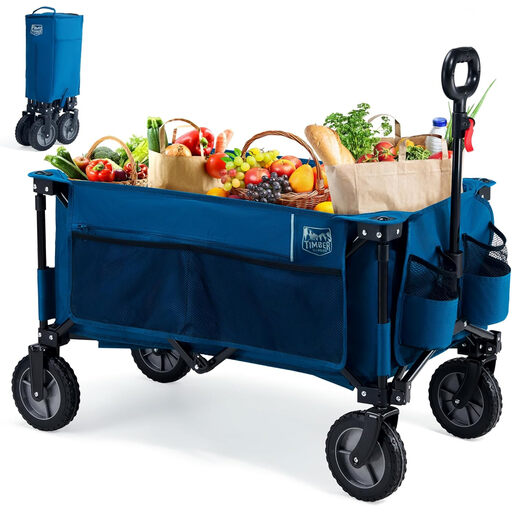
Why it's a good fit: This model offers a balanced combination of 200 litres of storage volume and a 100 kg load capacity. That's plenty for picnic gear, toys, and groceries. Side pockets and drink holders keep things organised.
The robust iron frame is designed for a real-world load of 100 kg, preventing the bending that occurs in models with exaggerated volume claims and weak frames.
The folding mechanism allows for quick setup and collapse without tools, resulting in a compact packed size for transport in a car.
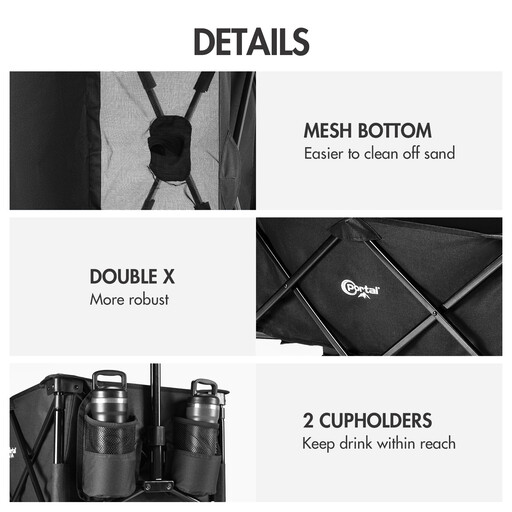
Why it's a good fit: This off-road wagon is designed for challenging terrain. The wide PU wheels with ball bearings can handle grass, gravel, and forest trails. With a 132 kg load capacity and 300 litres of volume (with the tailgate open), it's ideal for bulky camping gear.
Unlike models with basic wheels, this wagon is equipped with all-terrain PU wheels. The dual brakes provide the necessary safety on slopes, which is often missing in basic models.
The combination of high load capacity, large PU wheels, and dual brakes makes it a reliable transport solution for heavy loads in rough terrain.
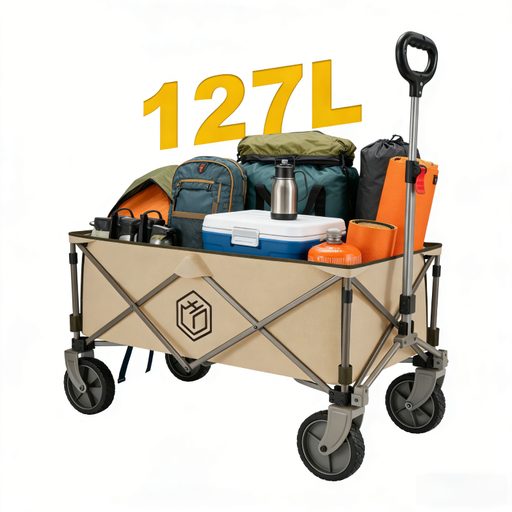
Why it's a good fit: With a stated load capacity of 200 kg, this foldable utility cart is designed for transporting heavy goods like potting soil, tools, or large grocery hauls. The 360° swivel wheels ensure maneuverability in tight spaces.
This model prioritises an extremely high load capacity and a reinforced steel frame. It avoids the pitfall of a large but structurally weak wagon and is designed for true heavy-duty applications.
The 200 kg load capacity, combined with dual brakes, offers a high degree of control and safety when moving heavy and bulky items.
We have compiled a complete, up-to-date list of products that fully meet these strict selection criteria and UK safety regulations.
1. What should I look for in the wheels of a foldable wagon? Pay attention to the material and width. For firm surfaces like asphalt, narrow hard plastic wheels are sufficient. For mixed terrain like grass, gravel, or forest trails, wider wheels made of PU (polyurethane) or rubber are better as they absorb shocks more effectively. For the beach, very wide wheels are essential to minimise sinking into the sand.
2. What is the difference between load capacity and volume? The load capacity (in kg) indicates the maximum weight that the wagon's frame and axles can safely support. This is the most important value for stability and durability. The volume (in litres) merely describes the available storage space. A high volume is useless if the load capacity is too low to fill that space with heavy items.
3. How do I properly maintain my collapsible wagon? Clean the fabric cover and frame with a damp cloth after use to remove dirt. Let the wagon dry completely before folding and storing it to prevent rust on the frame and mildew on the fabric. Regularly check that all screws and joints are tight and that the wheels are free of debris.