
Lieferung heute & morgen

Qualitätsgarantie

Willkommens-Angebote freischalten: KOSTENLOSE Lieferung | Bis zu 80 % RABATT | Kostenlose 30-Tage-JoyPlus-Testphase
App herunterladen
A foldable wagon promises to be the perfect companion for family outings, festivals, or garden work. But the reality is often different: a promising purchase quickly turns out to be impractical or defective. As your Joybuy Product Recommendation Officer, I'll help you identify the common pitfalls and make an informed decision based on objective criteria.
Many buyers focus on a single feature, like load capacity, while overlooking crucial design details. Here are the most common mistakes that lead to disappointment:
To avoid a bad purchase, you should focus on the technical specifications relevant to your intended use. A good foldable wagon is always a balance of mobility, stability, and load capacity.
The wheels determine where and how effectively you can use your wagon. Pay attention to the following distinctions:
The stated maximum load capacity usually refers to a static, evenly distributed load on a flat surface. In dynamic use on uneven terrain, it's the frame's stability that counts.
High utility comes from the ratio of storage volume to packed size. A camping wagon needs to hold a lot of gear but take up minimal space in the car.
Based on these objective criteria, we have identified several models that are well-suited for specific use cases.
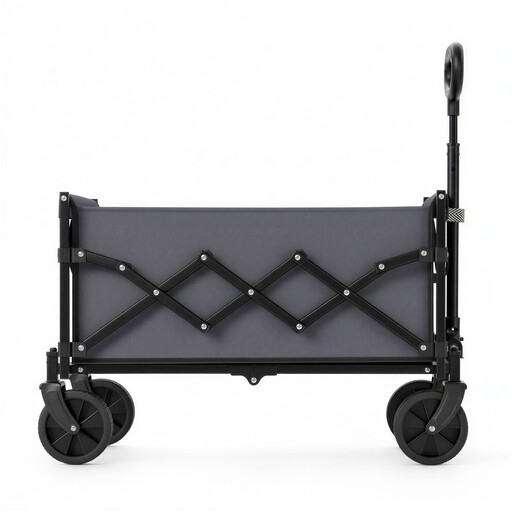
Why It's a Good Fit: Ideal for those who need a lightweight and straightforward cart for the city park, weekly grocery runs, or trips from the car to the apartment. Its low unladen weight makes it especially easy to handle.
This model bypasses the "wheel trap" by focusing on its core purpose: use on paved surfaces. It doesn't promise exaggerated all-terrain capability, making it reliable for its intended environment.
Low Unladen Weight: At approx. 5 kg, the cart is very easy to carry and store. Simple Folding Mechanism: Collapses with a single pull.
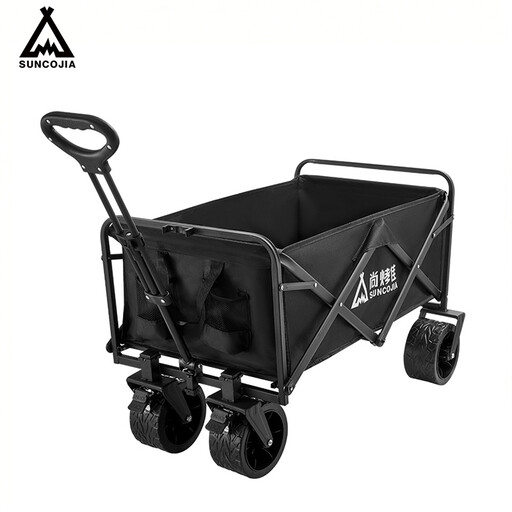
Why It's a Good Fit: Designed for transporting large and heavy equipment. Its enormous volume is ideal for tents, chairs, coolers, and supplies for several days at a campsite or festival grounds.
This model avoids the misleading capacity trap. The very high storage volume of 350 litres is supported by a carbon steel frame designed for heavy loads. The wide wheels are a good compromise for meadows and gravel.
Very Large Storage Volume: At 350 litres, it's one of the largest volumes available. Robust Materials: Carbon steel frame and durable Oxford fabric.

Why It's a Good Fit: The wide off-road wheels are specifically designed for softer surfaces like sand or loose soil. With 200 litres of volume, the cart offers enough space for a family's entire beach gear.
This model directly addresses the "wheel trap" at the beach. The wide contact surface of the wheels effectively prevents them from sinking into the sand where narrower wheels would fail. The dual brakes provide additional safety.
Specialised Off-Road Wheels: For improved performance on sand and uneven terrain. Dual Brakes: Secure the cart in place, even on a slight incline.
We have compiled a complete, up-to-date list of products that fully meet these strict selection criteria and comply with current safety regulations.
The stated maximum load capacity is a laboratory value. In practice, the actual capacity depends on the frame construction, the wheels, and the surface. A good rule of thumb is to consistently load the wagon with only about 70–80% of the stated maximum, especially when travelling on uneven terrain, to protect the joints and fabric.
For sand, wide wheels with a large contact surface are crucial. Wheels with a width of 8 cm or more are ideal. The material (solid rubber, PU) is less important than the sheer width, which prevents sinking. Narrow hard plastic wheels are unsuitable for the beach.
Most models have a removable Oxford fabric cover that can be cleaned by hand or on a gentle wash cycle. The metal frame should be wiped with a dry cloth after use, especially in damp or salty environments (like the beach), to prevent rust. Regularly check that all screws and rivets are tight, and lubricate the wheel axles and joints with a little silicone spray if necessary.