
Lieferung heute & morgen

Qualitätsgarantie

Willkommens-Angebote freischalten: KOSTENLOSE Lieferung | Bis zu 80 % RABATT | Kostenlose 30-Tage-JoyPlus-Testphase
App herunterladen
A foldable wagon seems like the ideal solution for family outings, camping weekends, or transporting heavy groceries. It promises to move loads effortlessly and then be stored compactly. In practice, however, many models turn out to be impractical or break after only a short time. Before you make a purchase, it's crucial to understand the typical weak points often hidden behind appealing product images.
Many buyers are frustrated by three main problems:
An informed decision is not based on marketing promises, but on an understanding of fundamental technical parameters.
To avoid a bad purchase, you should carefully examine three core aspects. These determine whether a foldable wagon is genuinely a help or just a hindrance in daily life.
The maximum load capacity, specified in kilograms (kg), is a key metric. However, it means little on its own. Pay attention to what the frame is made of. Simple steel tubes are often cheaper, while frames made of alloyed or powder-coated steel offer greater stability and durability. A robust frame is the foundation of a long-lasting foldable transport cart. The connection points between the frame and the fabric liner should be reinforced to prevent tearing under a full load.
The wheels are crucial for all-terrain performance.
A wagon with a brake is also an important safety feature. Locking brakes on at least two wheels prevent the wagon from rolling away on a slope or while loading and unloading.
The storage volume is given in litres (L) and describes how much space the liner offers. A high volume is useful for bulky items like camping chairs or beach accessories. This is contrasted by the packed size (length x width x height in cm), which indicates how large the foldable hand cart is when collapsed. Measure the available space in your car's boot or cellar and compare it with the manufacturer's specifications to ensure the wagon can truly be stored compactly.
Based on these objective criteria, we have identified several models that represent a smart choice for specific user profiles.
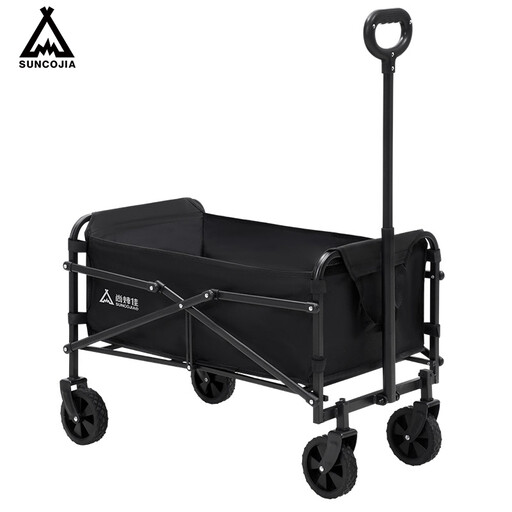
Why This Fits Their Persona: Ideal for families looking for a straightforward wagon for the park, weekly grocery runs, or trips to the playground. It offers a good balance between storage volume and a compact packed size for everyday use on paved paths.
This model relies on a realistic load capacity of 100 kg, supported by its cold-rolled iron frame. The PVC wheels are clearly designed for urban use, without being falsely advertised as all-terrain wonders.
Generous storage volume of 170 litres; Lightweight and features a simple folding mechanism for quick storage.
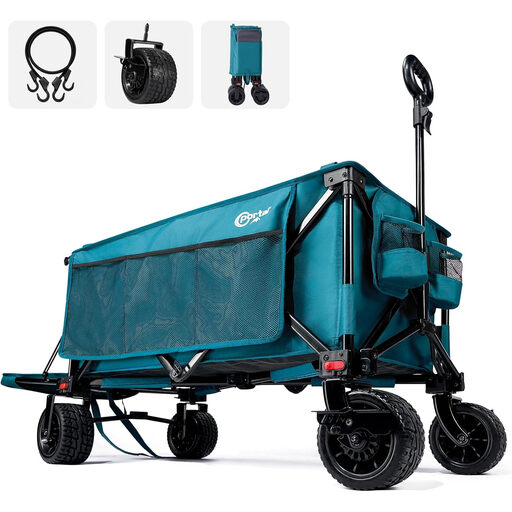
Why This Fits Their Persona: Perfect for campers, festival-goers, and beach lovers who need a robust wagon for challenging terrain. The high capacity and thoughtful details like the drop-down tailgate make it extremely versatile.
This model solves the problem of unsuitable wheels with wide all-terrain PU wheels with ball bearings, designed for sand and gravel. The dual brake system provides necessary safety on slopes, a common weakness in simpler models.
Very large storage volume of 300 litres (with tailgate open); All-terrain wheels with quick-release for easy cleaning.

Why This Fits Their Persona: Anyone who regularly transports heavy loads like drink crates, garden soil, or extensive equipment needs maximum stability. This model is designed for heavy-duty use and combines it with a very fast folding mechanism.
It bypasses the trap of exaggerated load capacity claims by backing its high load capacity of 200 kg with a visibly robust, spray-painted steel tube frame. The quick-fold mechanism also addresses the problem of bulky and complicated models.
Very high load capacity of 200 kg; Fast folding mechanism (in 3 seconds, according to the manufacturer); Front wheel brakes for a secure stance.
We've compiled a complete, up-to-date list of products that meet these strict selection criteria.
Most fabric liners are made of durable polyester (e.g., 600D Oxford fabric), which can be cleaned with a damp cloth and mild soapy water. Let the fabric dry completely before folding the wagon to prevent mold growth. The frame can be wiped dry. The wheels, especially after a trip to the beach, should be rinsed with clean water to remove sand and salt.
Yes, but only if it has the right wheels. Narrow wheels will immediately dig into soft sand. Look for models explicitly equipped with wide all-terrain or beach wheels made of PU or rubber. These distribute the weight more effectively, allowing you to pull the wagon across the sand instead of sinking into it.
The load capacity (in kg) specifies the maximum weight the wagon can be loaded with before the frame or wheels are damaged. The storage volume (in litres), on the other hand, describes the available space inside the liner. A wagon can have a large volume for light, bulky items (e.g., blankets, toys) but a low load capacity. Conversely, a model with a smaller volume might be designed for very heavy items (e.g., tools). Both metrics are crucial for making the right choice.