
Lieferung heute & morgen

Qualitätsgarantie

Willkommens-Angebote freischalten: KOSTENLOSE Lieferung | Bis zu 80 % RABATT | Kostenlose 30-Tage-JoyPlus-Testphase
App herunterladen
A foldable wagon seems like the ideal solution for family outings, festivals, or gardening. But the reality is often different: a promising model quickly turns out to be a poor investment. The causes are often the same design flaws and exaggerated marketing promises that many buyers fall for. Before you make a decision, you should know the typical weak points that can quickly render a practical helper useless.
As a Joybuy Product Recommendation Officer, I analyze product data daily to provide you with objective, practical advice. This guide focuses on the crucial technical features that distinguish a robust and durable folding wagon from a short-lived nuisance.
Many models on the market look sturdy at first glance but fail in practice due to fundamental flaws. Pay special attention to these three points:
To avoid a bad purchase, you should base your decision on objective technical data. Focus on these three core aspects to find the right model for your needs.
The load capacity (in kg) is the most important safety feature. It indicates the maximum weight the frame can withstand. The storage volume (in liters), on the other hand, only describes the available storage space. A high volume is useless if the load capacity is low. For transporting beverage crates, garden soil, or camping gear, a load capacity of at least 80 kg is recommended. Look for a frame made of alloyed or powder-coated steel, as it offers greater stability and corrosion resistance.
The choice of tires determines the possible applications.
A good collapsible transport cart is characterized by an intuitive folding mechanism. So-called "4-sided folding mechanisms" often allow for a particularly compact packed size, so the wagon can be easily stored in a car trunk or a niche. Check the dimensions when folded to ensure the wagon fits into your intended storage space. Models where the wheels and fabric cover can be removed with a click also make cleaning and maintenance significantly easier.
Based on the criteria mentioned, we have identified some models that are particularly suitable for specific use cases.
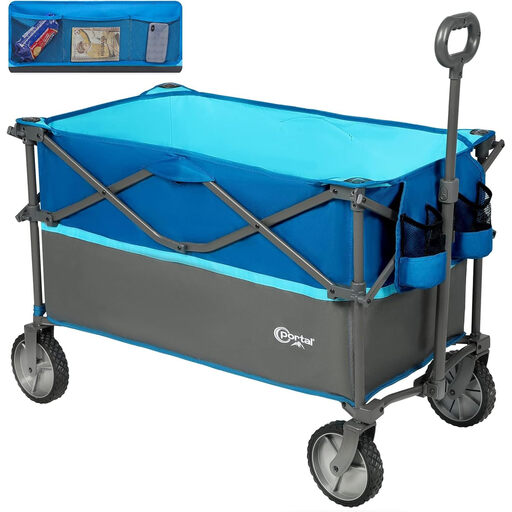
Why This Fits Their Persona: Ideal for families looking for a reliable all-rounder for the park, the zoo, or weekly shopping trips. The combination of high storage volume and a solid load capacity handles toys, picnic blankets, and groceries with ease. Additional side pockets and cup holders keep things organized.
The sturdy steel frame is designed for a load capacity of 120 kg, preventing it from warping under load. The folding mechanism requires no assembly and is built for durability.
Large storage volume of 228 liters; adjustable handle for different heights; integrated cup holders and side pockets.
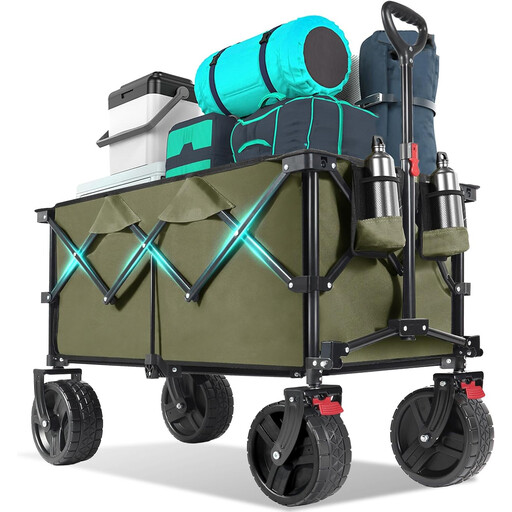
Why This Fits Their Persona: Perfect for festival-goers, campers, and beach lovers who need to transport heavy gear over rough terrain. The high load capacity and special tires make carrying a tent, chairs, and supplies straightforward.
The 7-inch wide tires prevent it from sinking into mud, sand, or grass. The aluminum alloy frame is rated for a load capacity of 200 kg and can withstand heavy use.
Very high load capacity of 200 kg; patented four-way folding mechanism for compact storage; waterproof 600D Oxford fabric.
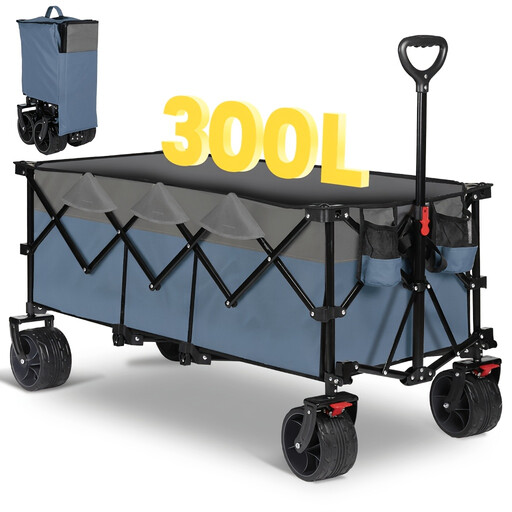
Why This Fits Their Persona: This collapsible garden cart is designed for demanding tasks. With its huge storage volume and high load capacity, it's perfect for transporting heavy bags of soil, tools, wood, or garden waste.
The certified load capacity of 200 kg and the robust frame are explicitly designed for heavy loads. The wide tires with bearings and brakes ensure stable and controlled transport even when fully loaded.
Enormous storage volume of 300 liters; high load capacity of 200 kg; four-way folding mechanism for easy handling.
We have compiled a complete, up-to-date list of products that fully meet these strict selection criteria and safety regulations.
Maintenance is straightforward. Wipe the fabric cover with a damp cloth if it gets dirty. The wheels should be regularly cleared of dirt, sand, or stones to keep them running smoothly. On many models, the wheels and cover can be removed for easier cleaning. Store the wagon folded in a dry place to prevent rust on the frame and material fatigue.
No. Foldable wagons are designed as transport carts for objects and are not approved for carrying people or children. They lack the necessary safety features such as seatbelts, a stable seat shell, and specialized braking systems that are legally required for strollers. Using one as a substitute for a stroller poses a significant safety risk.
The main difference lies in the contact surface and the material. Wide off-road tires (often made of PU or rubber) have a larger contact area with the ground. This distributes the weight more effectively, preventing the wagon from sinking easily into soft surfaces like sand, grass, or mud. Standard tires made of hard plastic (PVC) are narrower and harder. They run well on smooth asphalt but offer little traction and comfort on uneven or soft terrain.