
Lieferung heute & morgen

Qualitätsgarantie

Willkommens-Angebote freischalten: KOSTENLOSE Lieferung | Bis zu 80 % RABATT | Kostenlose 30-Tage-JoyPlus-Testphase
App herunterladen
Whether it's a family outing, a trip to the grocery store, or gearing up for a festival, the question of how to conveniently transport all your essentials from A to B often arises. A foldable wagon is a flexible solution for this challenge, combining ample cargo capacity with a space-saving design for easy storage when not in use.
This article serves as your comprehensive guide. It highlights the key features to consider when choosing a collapsible wagon and presents a curated selection of different models to help you make an informed decision.
Selecting the right model depends on your individual needs. Three central criteria will help you objectively compare the features of various wagons.
The maximum load capacity, specified in kilograms (kg), defines how much weight the wagon can safely transport. For carrying beverage crates or heavy camping equipment, a high load capacity is a significant advantage. The storage volume, measured in litres (L), indicates how much space is available inside. Families often need more volume for beach gear and toys than someone who is only transporting garden tools. Some models also offer expandable cargo areas, for instance, through a drop-down tailgate.
The wheels are crucial for ride comfort on different surfaces.
A collapsible wagon should be easy to fold in just a few steps and without any tools. The packed size is relevant for storage in the basement, garage, or the boot of your car. Compare the dimensions when folded to ensure the foldable utility cart actually fits into its intended storage space. An included protective cover can shield the wagon from dust and dirt during storage.
Here is a look at three models with different specialisations, designed for various applications.

Why It Stands Out: This model is distinguished by its exceptionally large cargo capacity, achieved via a drop-down tailgate. This makes it suitable for transporting longer items. The quick-release wheels facilitate easy cleaning and maintenance.
Pros:
Who It's For: Ideal for families and campers who need to transport a lot of gear and require a flexible loading area. The all-terrain wheels make it a practical companion for trips on various surfaces.

Why It Stands Out: The focus of this wagon is on a very high load capacity combined with a rapid folding mechanism. According to the manufacturer, it can be collapsed in just three seconds, making it particularly user-friendly.
Pros:
Who It's For: Suitable for users who regularly transport heavy loads like tools, beverage crates, or heavy equipment. The quick-fold mechanism is practical for anyone who frequently sets up and breaks down the wagon.
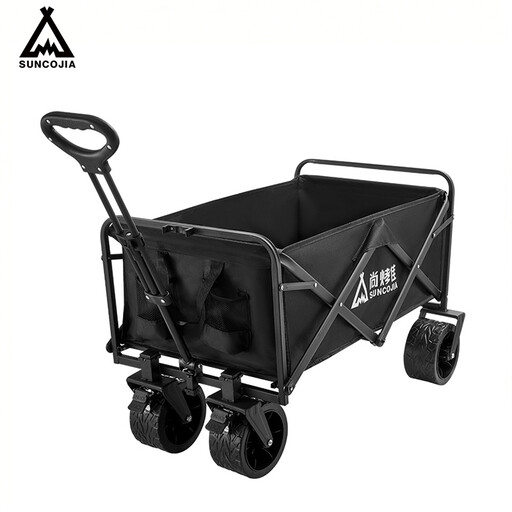
Why It Stands Out: At 350 litres, this model offers the largest cargo capacity in this selection. The Oxford fabric liner is removable, which simplifies cleaning. The wide wheels are designed for all-terrain use.
Pros:
Who It's For: Perfect for users who need maximum storage space, for example, for large grocery hauls, gardening, or transporting festival gear. Its high capacity makes it a versatile assistant.
The models presented here already cover a broad spectrum of needs. If you haven't found the right model for your specific requirements, you can find a larger selection of utility carts in our category.
See More Portable Camping Wagons
Yes, many models are suitable for the beach. The key is to have wide wheels made of plastic or PU, as they don't sink into soft sand as easily as narrow, hard rubber tires. An all-terrain wagon is the right choice here.
The load capacity varies greatly depending on the model and construction. Basic models often carry around 70 kg, while more robust versions designed for heavy loads can have a capacity of 100 kg, 150 kg, or even up to 200 kg. The manufacturer's specified maximum load capacity should not be exceeded.
PU (polyurethane) wheels are often slightly softer and offer better shock absorption, similar to rubber tires, but are lighter and more abrasion-resistant. PVC (polyvinyl chloride) wheels are harder and very durable, rolling very well on smooth surfaces but can be louder on uneven ground. Both materials are puncture-proof.