
Lieferung heute & morgen

Qualitätsgarantie

Willkommens-Angebote freischalten: KOSTENLOSE Lieferung | Bis zu 80 % RABATT | Kostenlose 30-Tage-JoyPlus-Testphase
App herunterladen
A foldable wagon seems like the ideal solution for transporting gear to the beach, a festival, or for hauling groceries. It's compact, promises a high load capacity, and can supposedly be stored effortlessly in a car or basement. In practice, however, many models turn out to be a bad investment. Before you make a decision, it's crucial to understand the most common weaknesses, which often only become apparent after the purchase.
As your Joybuy Product Recommendation Officer, I have analyzed the key features that distinguish a functional and durable folding wagon from an impractical one. This guide focuses on the three most common design flaws and shows you what to look for to make an informed choice.
The 3 Most Common Pitfalls When Buying a Foldable Wagon:
To avoid these pitfalls, you should focus on three core technical features. These largely determine the functionality and longevity of your utility cart.
The load capacity, often specified in kilograms (kg), is a central selling point. A 200kg wagon sounds impressive, but this figure must be considered in the context of the storage volume (in liters) and the frame's stability.
The wheels are the direct interface with the ground and are therefore crucial for ease of use.
A good collapsible utility cart is characterized by an intuitive and robust folding mechanism.
Based on these objective criteria, we have identified several models that provide a suitable solution for specific user groups and their requirements.
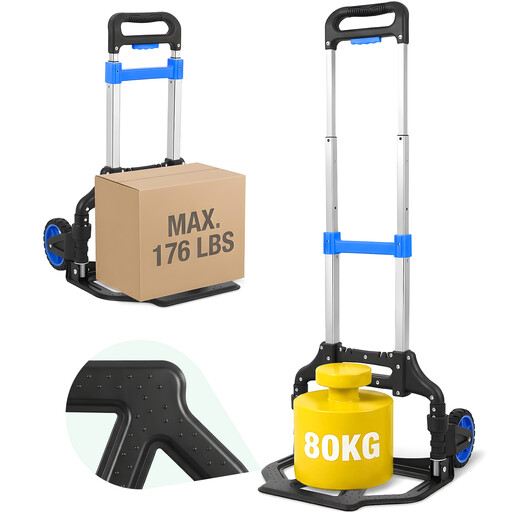
Why This Fits Their Persona: Ideal for those who need an extremely compact solution for transporting beverage crates, packages, or groceries in the city. It fits into any nook and is ready for immediate use.
The sturdy aluminum frame is designed for loads up to 80 kg, avoiding the issue of unstable joints common in similarly priced wagons. The focus is on stability for defined loads.
Extremely Lightweight and Compact: Weighing only 3.5 kg with a folded width of 5.7 cm, this model is exceptionally space-saving. The telescopic handle is height-adjustable.
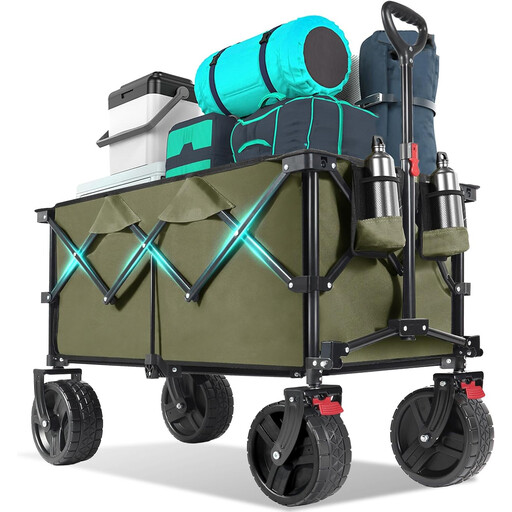
Why This Fits Their Persona: Designed for transporting heavy and bulky gear like tents, coolers, and drinks over difficult terrain such as sand, grass, or mud.
The 7-inch wide tires directly solve the problem of sinking into soft ground. The robust frame is designed for a high load capacity of 200 kg, thus preventing overload.
High Capacity and All-Terrain Capability: Offers a 200-liter storage volume and a 200 kg load capacity. The 600D Oxford fabric cover is waterproof and durable.
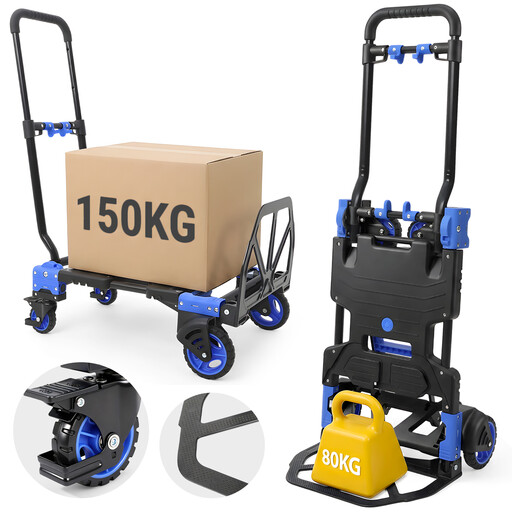
Why This Fits Their Persona: Perfect for home and garden owners who need a versatile solution for various transport tasks—from moving boxes and garden soil to bulky items.
The 2-in-1 design with clearly defined load limits (80 kg as a hand truck, 150 kg as a platform cart) prevents improper use and overloading. The reinforced aluminum frame ensures stability in both modes.
Maximum Flexibility: Switches between a hand truck and a platform cart in seconds. The 360° dual-bearing wheels and integrated brake ensure smooth and safe handling.
We have compiled a complete, up-to-date list of products that fully meet these strict selection criteria and safety regulations.
The specified load capacity (e.g., 100 kg or 200 kg) refers to an evenly distributed load on a flat surface. Avoid exceeding the manufacturer's specified maximum load limit. Point loads or sudden movements on uneven terrain can damage the frame even below the rated capacity. Always check the manufacturer's specifications and plan for a safety margin.
For use on the beach, wagons with wide tires (often called all-terrain or beach tires) are the only sensible choice. Their wide surface area distributes the weight over a larger area, preventing the wheels from sinking deep into the soft sand. Narrow hard plastic wheels are completely unsuitable for this purpose.
Most high-quality models use durable polyester or Oxford fabric. Check if the cover is removable. If so, it can often be cleaned by hand or in a gentle machine wash cycle (follow the manufacturer's instructions). If the cover is permanently attached, it's best to clean it with a soft brush, lukewarm water, and a mild soap solution. Always let the fabric air dry completely after cleaning to prevent mold growth.