
Lieferung heute & morgen

Qualitätsgarantie

Willkommens-Angebote freischalten: KOSTENLOSE Lieferung | Bis zu 80 % RABATT | Kostenlose 30-Tage-JoyPlus-Testphase
App herunterladen
Whether it's for a family trip to the lake, hauling camping gear, or tackling garden work, moving heavy and bulky items from A to B can be a hassle. A foldable wagon offers a practical and space-saving solution. However, the market is flooded with models, and the differences are in the details. This article serves as a guide, presenting objective criteria to help you select the perfect model for your needs.
To find the right model, you should consider several technical features that directly impact user comfort and durability.
Two of the most critical metrics are load capacity and storage volume. Load capacity, specified in kilograms (kg), defines the maximum weight the wagon can safely transport. A high load capacity is crucial if you plan to move heavy items like crates of drinks, bags of potting soil, or heavy camping equipment. Storage volume, on the other hand, is measured in liters (L) and describes how much space is available inside. For bulky but lightweight items such as beach toys, blankets, or festival gear, a large storage volume is a major advantage. Consider which of these features is more relevant for your typical use cases.
The design of the wheels determines how well the wagon handles on various surfaces. Standard hard plastic wheels are well-suited for firm, flat ground like asphalt or paved stones. For more demanding conditions such as sand, gravel, or uneven forest paths, an off-road wagon with wide tires is the better choice. Models with wide polyurethane (PU) wheels offer better weight distribution, are less likely to sink into soft ground, and absorb shocks more effectively. This makes them an ideal hand cart for the beach or for use while camping.
A good collapsible wagon is characterized by a simple and quick folding mechanism. Ideally, the foldable utility cart can be reduced to a compact size in just a few steps, allowing it to be easily stored in a car trunk or a storage closet. Pay attention to safety aspects as well. A parking brake, often listed as with brakes, is essential for securely parking the wagon on slopes or uneven ground and preventing it from rolling away. Dual brakes, which act on two wheels, provide additional stability.
Based on objective product features like capacity, materials, and functionality, we have curated a selection of models for various applications.

Why It Stands Out This model from Portal is distinguished by its exceptionally large storage volume. With an open tailgate, it reaches a capacity of 300 liters, enabling the transport of extra-long items like tents or beach umbrellas. The 10 cm thick PU wheels with ball bearings are designed for various terrains, while the dual brake system ensures safety on inclines.
Pros
Who Is It For? Ideal for families and campers who need to transport a lot of bulky gear. The open tailgate makes it especially practical for carrying long objects that won't fit in standard wagons.

Why It Stands Out The Ochama camping wagon focuses on an extremely high load capacity of 200 kg. Its robust, powder-coated tubular steel frame is designed to handle very heavy loads. Despite its sturdiness, it can be folded in just three seconds, according to the manufacturer. The dual front-wheel brake ensures a secure stance during loading and unloading.
Pros
Who Is It For? This wagon is the right choice for users who regularly move very heavy items, such as festival-goers with technical equipment, ambitious gardeners, or for large grocery hauls.
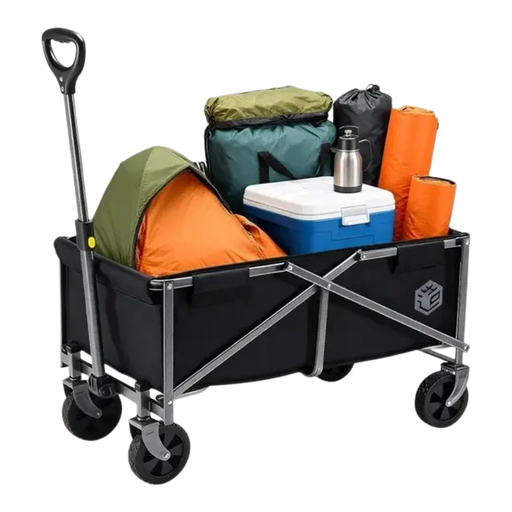
Why It Stands Out This model from Ochama is designed as a compact and versatile everyday helper. With a load capacity of 100 kg and a storage volume of 75 liters, it delivers solid performance for daily tasks. Its biggest advantage is the one-piece design that requires no assembly and allows it to be folded in a single second. The durable 600D Oxford fabric is also wear-resistant and scratch-proof.
Pros
Who Is It For? Perfect for city use, weekly grocery runs, trips to the park, or small picnics. Its compact design and easy handling make it a practical collapsible garden cart for lighter jobs or an everyday transport assistant.
Haven't found the right model for your specific needs yet? There are many other variations with different features available.
Discover more models in our heavy-duty camping wagon category.
1. How do you clean a foldable wagon? Most models have a fabric liner made of polyester or Oxford cloth that can be cleaned with a damp cloth and a mild soap solution. Allow the fabric to dry completely before folding and storing the wagon. The wheels can be rinsed with water to remove dirt and sand. On some models, the wheels can be detached for a more thorough cleaning.
2. Are wagons with wide tires really suitable for sand? Yes, models with wide tires, especially those made of PU material, are significantly better suited for sand than those with narrow, hard plastic wheels. The wider contact patch distributes the weight more evenly and prevents the wheels from sinking deep into the sand. This makes pulling the wagon considerably easier, although some effort will still be required in very soft, deep sand.
3. What should I look for in terms of wagon safety? A crucial safety feature is a reliable parking brake to secure the wagon on a slope or while loading. Also, check that the folding mechanism locks securely in the unfolded position to prevent accidental collapse during use. Never exceed the manufacturer's specified maximum load capacity and distribute the weight of the load evenly to minimize the risk of tipping.