
Lieferung heute & morgen

Qualitätsgarantie
App herunterladen
Kategorien
A foldable wagon is a versatile transport solution whose utility depends on matching its technical specifications to the intended use case. Selecting the right model is based on an analysis of key parameters such as load capacity, wheel design, packed size, and material quality. This article breaks down the crucial criteria and presents two models with different specialisations.
The functionality of a collapsible transport cart is determined by the interplay of its components. An objective evaluation of the following technical features is essential for making an informed purchasing decision.
The maximum load capacity, specified in kilograms (kg), defines the upper limit of weight the wagon can safely transport. Models for everyday use often offer a capacity of 70 to 80 kg, which is typically sufficient for groceries or carrying gear for a family outing. For more demanding tasks, such as transporting heavy camping equipment or garden tools, models with a load capacity of 100 kg or more are preferable. The storage volume, measured in litres (L), describes the available space and is crucial for transporting bulky yet lightweight items.
The wheels are a critical component that determines manoeuvrability on various surfaces.
A key advantage of this wagon category is its collapsibility. The mechanism should allow for quick and straightforward operation, ideally in just a few simple steps. The packed size (dimensions when folded) is crucial for storage and transport in a car trunk. Compact models can be stowed in a space-saving manner in niches or small vehicles. The weight of the wagon itself also affects its portability.
The durability of a foldable wagon depends significantly on the materials used.
A wagon with brakes significantly enhances safety, especially when loading or unloading on slopes or uneven ground. Parking brakes on the rear wheels prevent it from rolling away unintentionally. A telescopic handle allows the handle height to be adjusted to the user's height, promoting an ergonomic posture and optimising pulling force.
Based on an analysis of technical specifications, we present two models that cater to different requirement profiles.
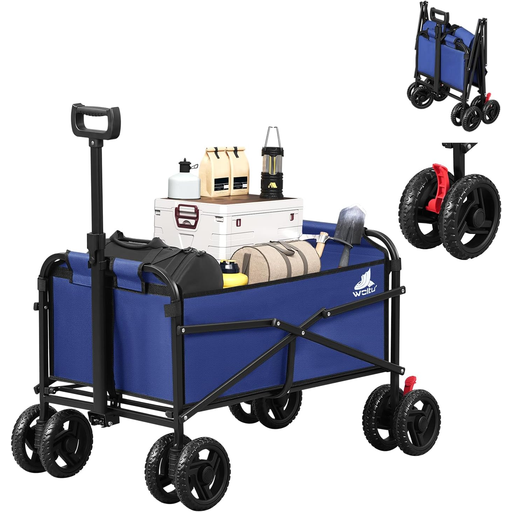
Why We Recommend This Product The WOLTU Garden Wagon is a well-balanced solution for versatile applications. With a load capacity of 80 kg and all-terrain dual swivel wheels, it combines solid durability with good manoeuvrability on various surfaces. The integrated parking brakes on the rear wheels provide additional control and safety.
Pros
Who It's For This model is suitable for users looking for a reliable all-rounder for family outings, festivals, or shopping, who also value the safety of brakes and good all-terrain performance.
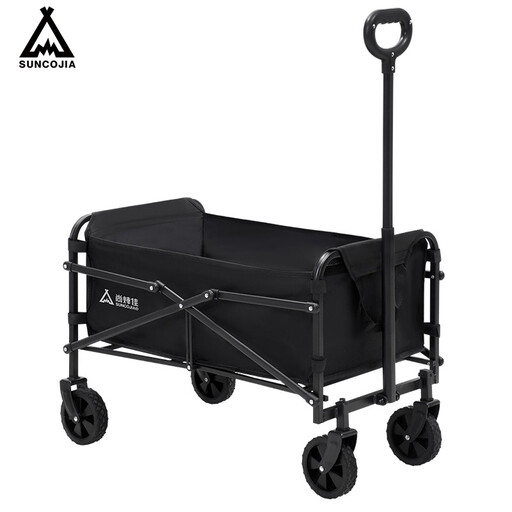
Why We Recommend This Product The SUNCOJIA wagon focuses on maximum loading capacity. With a load capacity of 100 kg and a volume of 170 litres, it is designed for transporting heavy and bulky goods. The reinforced, cold-rolled iron frame provides the necessary stability, while the total weight remains comparatively low at approx. 4.8 kg.
Pros
Who It's For This model is the right choice for users whose priority is high transport capacity. It is ideal for carrying camping gear, garden tools, or large quantities of groceries, primarily on paved surfaces.
If the models presented do not exactly meet your requirements, or if you are looking for specialised equipment for specific conditions, you can find more products and accessories optimised for use on soft surfaces in our Beach Sand category.
1. What is the difference between a wagon and a hand cart? The German term Bollerwagen traditionally refers to a four-wheeled wooden cart with a drawbar handle. Modern versions, especially the foldable wagon, typically consist of a metal frame with a fabric liner. A hand cart is a more general term for manually pulled or pushed transport carts, which can also include dollies or other two-wheeled models. In common parlance, the terms are often used interchangeably for foldable transport wagons.
2. How much weight can a foldable wagon carry? The load capacity varies significantly depending on the model and construction. Basic models for light loads are often designed for 50-70 kg. Standard models for recreational use typically carry between 70 and 100 kg. Heavy-duty models can be certified for loads exceeding 100 kg. The maximum load capacity is a manufacturer's specification that should not be exceeded for safety reasons.
3. Is every foldable wagon suitable for the beach? No. A wagon for the beach requires special features to avoid sinking into loose sand. The key is to have wide plastic or rubber wheels that distribute the weight over a larger surface area. Models with narrow, hard wheels are unsuitable for beach use, as they will get stuck in the sand, making them extremely difficult to pull.