
Lieferung heute & morgen

Qualitätsgarantie

Willkommens-Angebote freischalten: KOSTENLOSE Lieferung | Bis zu 80 % RABATT | Kostenlose 30-Tage-JoyPlus-Testphase
App herunterladen
A foldable wagon is a handy companion for family outings, hauling camping gear, or managing weekly grocery runs. However, the market is flooded with models of widely varying quality. Many buyers discover too late that their new wagon can't withstand the rigours of daily use. As your Joybuy Product Recommendation Officer, I'm here to help you identify the crucial features and steer clear of common purchase pitfalls.
Before you make a decision, it's important to understand the most common flaws that often only become apparent with use and lead to disappointment.
To avoid these pitfalls, focus your attention on three core technical parameters. These are the primary determinants of your wagon's functionality and longevity.
The maximum load capacity, specified in kilograms, is a key metric. However, don't just look at the number; examine the construction behind it. A robust foldable utility cart is built on a solid, powder-coated steel frame. Check if the joints and connectors appear sturdy. A model with a designated high load capacity should feature a reinforced base and a proportionally sized frame to safely distribute the weight, especially when in motion.
The wheels are the direct point of contact with the ground and are crucial for ride comfort.
A good foldable wagon should collapse with just a few intuitive steps. The most common design is an accordion-style fold, where the wagon collapses by lifting a loop in the centre of the cargo area. The packed size is also crucial. Measure the available space in your car boot or storage area and compare it with the manufacturer's specifications for the folded state. This is the only way to ensure the collapsible hand cart is truly practical for everyday use.
To make your decision easier, we have matched several models from our collection to different user profiles.

Why This Fits Their Persona: This model offers a great balance for daily use. The 70 kg load capacity is sufficient for groceries, toys, or picnic gear for the park. Its simple folding mechanism and compact packed size make it a hassle-free companion.
The sturdy metal frame is more reliable than many ultra-light, no-name products, avoiding the pitfall of an unstable structure. The standard wheels are designed for its intended use in the city and at the park.
Very compact packed size; straightforward folding mechanism; durable polyester fabric.

Why This Fits Their Persona: Anyone needing to transport heavy camping equipment or garden tools requires superior stability. With a 200 kg load capacity, a large cargo volume, and two locking brakes, this model is designed for demanding tasks and uneven terrain.
The high 200 kg load capacity, supported by a reinforced tubular steel frame, directly addresses the pitfall of unstable constructions. The brakes provide additional safety that basic models lack.
Very high load capacity (200 kg); dual locking brakes for safety; large cargo volume of 127 litres.
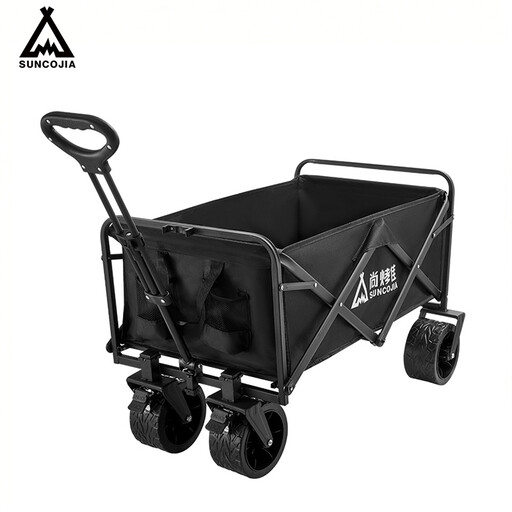
Why This Fits Their Persona: For hauling a tent, cooler, and chairs across sand or muddy festival grounds, wide wheels are crucial. This model combines wide off-road wheels with a massive 350-litre cargo volume, ideal for bulky gear.
The wide PVC wheels are the direct solution to the inadequate-tyre pitfall. They effectively prevent sinking on soft surfaces, making the wagon truly beach- and off-road-capable.
Wide off-road wheels for sand and soft ground; very large cargo volume (350 L); removable Oxford fabric cover.
We have compiled a complete, up-to-date list of products that meet these strict selection criteria and relevant regulations.
The fabric liner on most models can be cleaned with a damp cloth and mild soap solution. Some liners are removable and can be cleaned separately. The metal frame should be dried after exposure to moisture to prevent rust. The joints of the folding mechanism and the wheel axles will remain smooth with an occasional spray of silicone lubricant or penetrating oil.
No. Foldable wagons are designed to transport objects, not people or animals. Manufacturers typically state this explicitly. They lack essential safety features such as seat belts, a stable passenger compartment, or a braking system certified for human transport. Using them to carry children poses significant safety risks.