
Lieferung heute & morgen

Qualitätsgarantie

Willkommens-Angebote freischalten: KOSTENLOSE Lieferung | Bis zu 80 % RABATT | Kostenlose 30-Tage-JoyPlus-Testphase
App herunterladen
A foldable wagon is an indispensable tool for a wide range of activities: it can haul your groceries, carry the family's beach gear, transport your tent at a festival, or move tools around the garden. However, the market is flooded with models whose promises often don't hold up in practice. Before you make a decision, it's crucial to understand the common weaknesses that can quickly turn a useful transport solution into a regrettable purchase.
As your Joybuy Product Recommendation Officer, I have analyzed the key features that distinguish a functional foldable wagon from a useless one. This guide focuses on the three most common design flaws and shows you what to look for.
Many models look sturdy at first glance but reveal their weaknesses only after you start using them. Pay close attention to these three points to avoid disappointment.
To avoid the pitfalls mentioned above, you should carefully examine three technical features before buying. These determine the durability and functionality of your wagon.
A high load capacity is a popular selling point, but the number alone is meaningless if the frame material can't support it.
The wheels are the direct point of contact with the ground and are crucial for usability.
For use at the beach or at festivals, wide wheels (at least 5 cm, preferably 10 cm) with a deep tread are essential. 360-degree swivel wheels on the front axle significantly increase maneuverability.
A good collapsible wagon strikes the right balance between a generous loading volume and a compact folded size.
Instead of making a one-size-fits-all recommendation, we have identified models that are particularly well-suited for specific scenarios and budgets.
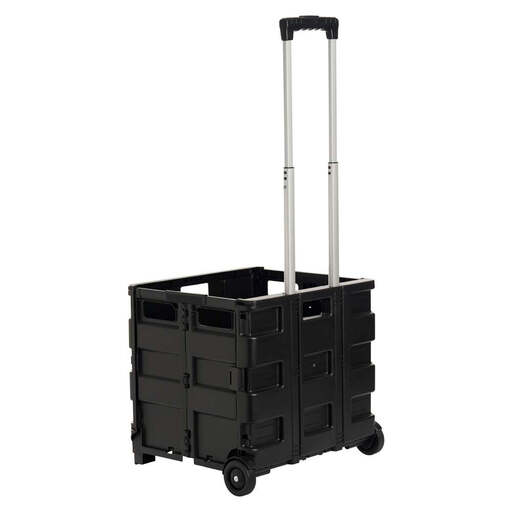
Why it's a good fit: Ideal for transporting groceries or light items on paved surfaces. Its extremely compact folded size makes it the perfect solution for small apartments or cars where every inch counts.
This model avoids the trap of exaggerated claims. It is clearly positioned as a lightweight transport cart with a 25 kg load capacity and is not designed for heavy loads or rough terrain, thus preventing frame overload.
Extremely space-saving: When folded, the cart is only 8 cm deep, making it effortless to store.
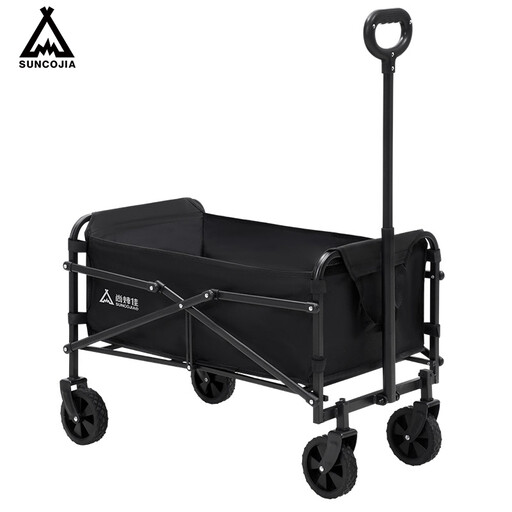
Why it's a good fit: With a 100 kg load capacity and 170-liter volume, this wagon is a versatile companion for family outings, weekly grocery runs, or transporting sports equipment. It offers a great balance of capacity and manageability.
The cold-rolled iron frame provides a solid structure that handles typical family loads without bending, thus avoiding the "unstable frame" pitfall. The multi-directional wheels offer better maneuverability than simple, rigid wheels.
High load capacity of 100 kg and a large 170-liter volume in an easy-to-fold design.
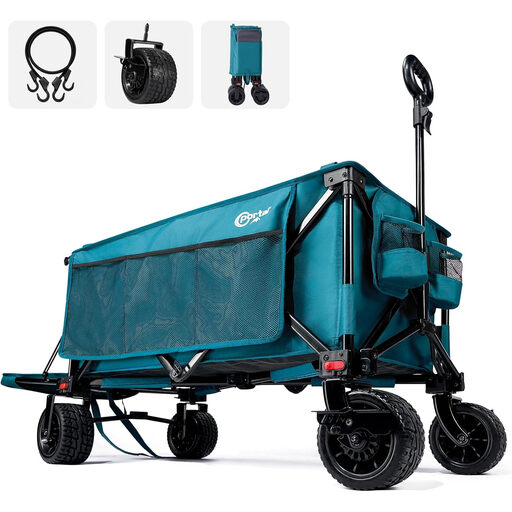
Why it's a good fit: Designed for heavy loads and difficult terrain. The large PU wheels, high 132 kg load capacity, and enormous 300-liter volume make it the top choice for multi-day festivals, camping, or extensive garden projects.
This model directly solves the "inadequate wheels" problem with its 10 cm thick, bearing-mounted PU wheels. These are explicitly designed for sand, grass, and gravel. The dual brakes also provide a crucial safety feature on slopes.
All-terrain PU wheels with bearings and brakes; enormous 300-liter capacity thanks to a drop-down tailgate for transporting long items.
We have compiled a complete, up-to-date list of products that fully meet these strict selection criteria and all applicable safety regulations.
1. How do you properly clean and maintain a foldable wagon? Most models have a polyester fabric cover that can be cleaned with a damp cloth and mild soap solution. The metal frame should also be wiped down and kept dry to prevent rust. After use at the beach, rinse the wheels with fresh water to remove sand and salt. Occasionally lubricating the wheel axles and folding joints will ensure smooth operation over time.
2. What should I specifically look for in a wagon for the beach? Two features are critical for beach use: wide tires (at least 5-10 cm) and the wheel material. Wide PU or rubber tires distribute the weight over a larger area, preventing the wagon from sinking into soft sand. Narrow, hard plastic wheels are unsuitable for this purpose.
3. Is a higher load capacity always better? Not necessarily. A high load capacity is only beneficial when combined with a sturdy frame and robust wheels. A wagon with a stated capacity of 100 kg but a thin steel frame may in practice handle less than a model with a 70 kg capacity and a high-quality, alloy steel frame. Choose the load capacity you realistically need, paying close attention to the overall construction.