
Lieferung heute & morgen

Qualitätsgarantie

Willkommens-Angebote freischalten: KOSTENLOSE Lieferung | Bis zu 80 % RABATT | Kostenlose 30-Tage-JoyPlus-Testphase
App herunterladen
A foldable wagon is a handy companion for family outings, hauling groceries, or transporting gear on camping trips. However, the market is flooded with models of widely varying quality. Many buyers discover only after a short time that their new wagon isn't up to the demands of daily use. As a Joybuy Product Recommendation Officer, I analyse product data to provide you with objective criteria for an informed purchasing decision. This guide will show you what to look for to avoid a bad investment.
When choosing a foldable wagon, there are typical defects that often only become apparent with use. If you know what they are, you can specifically look for more durable and functional models.
beach wagon or all-terrain model useless.collapsible wagon should fold down compactly in just a few simple steps. However, some designs are stiff and difficult to operate, or the final packed size is so large that the wagon barely fits into an average car boot.To avoid the problems mentioned above, a close look at the technical specifications is essential. The following three parameters are crucial for the functionality and longevity of your utility wagon.
The stability of a wagon depends directly on its frame. Look for models with a powder-coated steel frame. This construction offers a good balance of stability and corrosion resistance. The specified maximum load capacity (e.g., 100 kg, 200 kg) is a key indicator. A heavy-duty wagon is particularly important if you plan to regularly transport heavy items like drink crates, camping equipment, or garden soil. Check if the load capacity is rated for dynamic loads, which suggests a more robust overall design.
The wheels determine where and how well you can use the wagon. For versatile applications, wide solid rubber or polyurethane (PU) tires are the better choice. Such wheels offer significantly more surface area on soft ground like sand or grass and sink in less, making them ideal for an off-road wagon. Additionally, 360° swivel front wheels greatly enhance manoeuvrability, while locking brakes on at least two wheels ensure it stays securely in place during loading and unloading.
The storage volume, usually specified in litres (L), describes the available space. For family trips, models with 100 to 150 litres are often sufficient. However, always compare this figure with the folded dimensions (Length x Width x Height). Measure the available space in your car boot or cellar to ensure the foldable hand cart can actually be stored in a space-saving manner. A good foldable utility wagon combines a generous storage volume with a compact packed size.
Based on the objective criteria above, we have identified a few models that are particularly well-suited for specific user groups.

Why This Fits Their Persona: A well-balanced solution for transporting groceries, toys, or picnic gear. The 127-litre volume and high load capacity cover most daily needs, while the wagon remains compact enough for most car boots.
The frame, made of robust steel tubes, resists deformation. The dual front-wheel brakes prevent it from rolling away on slopes, thus avoiding a common safety hazard.
High load capacity of 200 kg according to the manufacturer; 360° swivel wheels for high manoeuvrability; quick-folding mechanism.
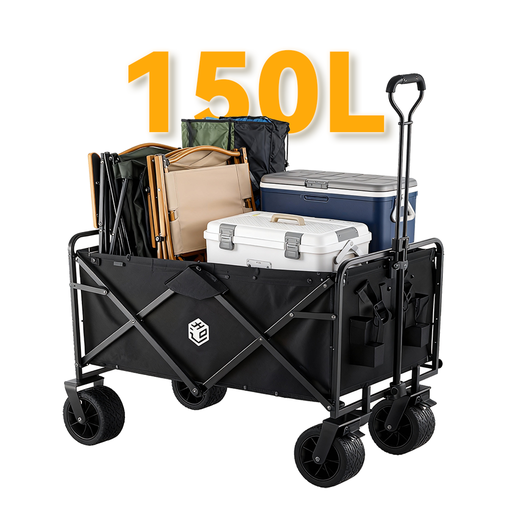
Why This Fits Their Persona: Ideal for users who transport heavy equipment over challenging terrain like sand, gravel, or forest trails. With a 150L volume and 260 kg load capacity, this `camping wagon` can handle a tent, cooler, and more.
Directly addresses the "inadequate wheels" flaw with its extra-wide off-road tires. The reinforced carbon steel frame ensures the high load capacity is reliably supported, even on rough terrain.
Specialised `wagon with wide tires` for maximum off-road capability; reinforced PP base plate for added stability; very high load capacity of 260 kg.
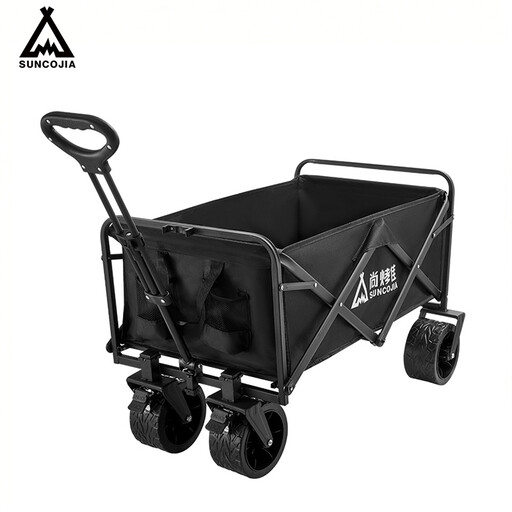
Why This Fits Their Persona: A functional and straightforward solution for occasional transport, like the weekly grocery run or a trip to the recycling bin. Its low weight and simple folding mechanism make it very convenient to handle.
Focuses on the core function: simple transport and space-saving storage. The carbon steel frame provides a solid base for everyday loads, avoiding the instability of the most basic models.
Very large storage volume (350 L according to manufacturer); low self-weight of approx. 10 kg; removable Oxford fabric liner.
We've curated a comprehensive selection of utility wagons, evaluated based on objective criteria like material quality, load capacity, and functionality.
Most models have a removable fabric liner that can be cleaned with a damp cloth and mild soap solution. Let the liner dry completely before folding the wagon. The metal frame should be wiped dry after exposure to moisture to prevent rust. Occasionally check the wheel axles and joints and lubricate them with a suitable lubricant if necessary.
This largely depends on the specific model. Be sure to pay attention to the folded dimensions (or packed size) listed in the product details. Compare these measurements with the available space in your car boot. Compact models are generally designed to fit in most standard vehicle types, but it is advisable to measure if you have a very small car.
The load capacity is given in kilograms (kg) and indicates the maximum weight the wagon can be loaded with. The storage volume is measured in litres (L) and describes how much space is available inside the wagon. A wagon can have a large volume but a low load capacity, making it suitable only for light, bulky goods (e.g., empty boxes). For heavy items like drink crates, a high load capacity is crucial.