
Lieferung heute & morgen

Qualitätsgarantie

Willkommens-Angebote freischalten: KOSTENLOSE Lieferung | Bis zu 80 % RABATT | Kostenlose 30-Tage-JoyPlus-Testphase
App herunterladen
A baby is on the way and the excitement is building, but space is often limited in many homes. A conventional changing table takes up a significant footprint, which is especially lacking in a small nursery or bathroom. Installing a foldable wall-mounted changing table is a smart solution for creating a functional and safe changing station without permanently taking up valuable space.
However, the market is flooded with models whose promises of quality and safety don't always hold up in daily use. Before making a decision, it's crucial to understand the common pitfalls that can quickly turn a practical idea into a purchase you'll regret.
The 3 most common weaknesses of foldable changing tables:
To avoid a regrettable purchase, you should focus your attention on a few, but crucial, technical features. These define the safety and durability of a wall-mounted changing table.
The stability of a wall-mounted changing table depends directly on the material used and its craftsmanship.
Your child's safety is the top priority. A high-quality, space-saving changing table is distinguished by its well-thought-out safety details.
A good foldable changing table must be not only safe but also practical.
Based on the criteria mentioned, we present a product that offers a well-designed solution for parents who value safety, functionality, and design.
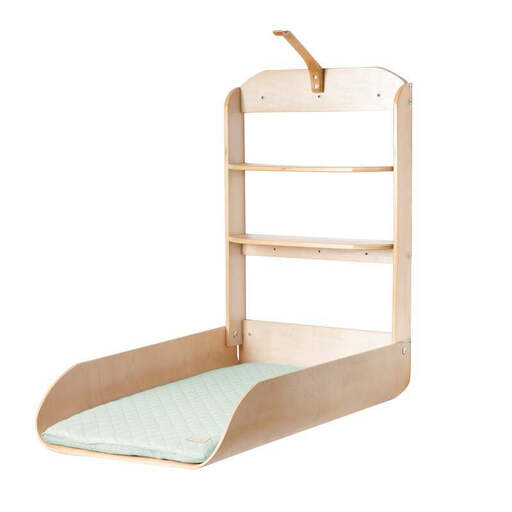
Why this model is a good fit: This model, made from dimensionally stable laminated wood, combines a natural aesthetic with thoughtful safety features. It is a complete solution for parents seeking a reliable and stylish product that integrates well into modern living concepts without compromising on safety.
The laminated wood construction is designed for a load capacity of up to 11 kg. The snap lock allows for practical one-handed operation. The included changing pad features a raised edge (approx. 14 cm) that serves as an effective side barrier.
Two integrated storage shelves provide direct access to changing essentials. The water-repellent and washable changing pad is included in the delivery.
We have compiled a comprehensive, up-to-date list of products that meet these strict selection criteria.
1. How high should a wall-mounted changing table be installed? The ideal installation height is individual and depends on your body height. As a rule of thumb, the surface of the changing pad should be at your elbow height when you stand in front of it. This generally corresponds to a height of 85 to 95 cm from the floor. This ensures an ergonomic and back-friendly posture.
2. Which type of wall is suitable for mounting a foldable changing table? Load-bearing walls made of solid material like concrete or solid brick are most suitable. Special care must be taken with lightweight walls made of plasterboard (drywall). Here, you must use special hollow-wall anchors designed for heavy loads. It may also be advisable to reinforce the wall at the mounting point. Always follow the manufacturer's installation instructions and, when in doubt, consult a professional.
3. Up to what age or weight can a wall-mounted changing table be used? The maximum period of use is determined by the load capacity limit specified by the manufacturer. Values are typically between 11 kg and 15 kg. This generally corresponds to a child's age of about 12 to 24 months. For safety reasons, do not exceed this weight limit under any circumstances. Additionally, regularly check that the wall anchoring is secure.