What to consider when buying
First, check whether your existing device can capture the whole piece of fabric from the camera position available to you. A macro lens or a compact camera with a close-up function is worth considering only if small details don’t appear large enough with your current equipment.
Your existing camera or smartphone
Best for: If you can already capture full views and simple detail shots with suitable framing, first try a stable setup and controlled lighting.
Things to consider: Check whether the distance, overhead controls and close-up performance of your device work for your fabrics. A tripod won’t compensate for an unsuitable shooting angle.
Interchangeable-lens camera with standard zoom
Best for: If you regularly photograph different folds or framing options and may want to change lenses later, a kit with a standard zoom could suit you.
Things to consider: A standard zoom isn’t a macro lens just because it has a short minimum focusing distance. Check the framing from the camera position you’ll actually use.
Interchangeable-lens camera with macro lens
Best for: If you want tiny fibres, woven textures or seams to fill the frame and your existing lens isn’t up to the task, consider a macro lens that fits your camera mount.
Things to consider: Sony says its E 30 mm F3,5 Macro offers a maximum magnification of 1x. At the stated minimum focusing distance of 0,095 m, make sure you also have room for the lighting and your hands. This lens isn’t included in the ZV-E10-II kit with standard zoom mentioned here.
Compact camera with a close-up function
Best for: If you want to photograph small fabric details without changing lenses, a camera with a fixed lens could be an option.
Things to consider: OM Digital Solutions says the Tough TG-7 can take close-ups from as little as 1 cm away. Even so, check the framing for your setup and make sure there’s room for light from the side.
| Buying criterion |
What to look for |
Who it matters most to |
| Capture the whole folded item |
Measure your largest folded item and the distance available between the table and camera. Check with the specific lens that both the subject and the desired margin fit in the frame. |
If I want to photograph my largest folded item from above, the right angle of view comes first; around 36% of consumers prioritise capturing the full view. |
| Assess fabric colours |
Test the same item under your planned lighting, keep the light as consistent as possible and check the white balance. Adobe explains that artificial lighting can cause colour casts. |
When comparing fabric options, I want to be able to assess colours under consistent lighting; around 29% of consumers prioritise judging fabric colour. |
| Magnify fabric details |
Compare the maximum magnification of the lens included and check that there’s enough space between the lens, fabric and light. Focusing distance alone doesn’t tell you the magnification. |
If I want seams or woven textures to appear larger, what matters most is how the specific detail is rendered; around 21% of consumers put fabric details first. |
| Keep total costs down |
First, try using the equipment you already have. Then compare the full kit name and what’s included, as well as any accessories you’ll need for your setup. |
If my existing equipment already does the job, I don’t want to add gear without a specific need; around 14% of consumers give the greatest priority to keeping total costs low. |
Joybuy product selection
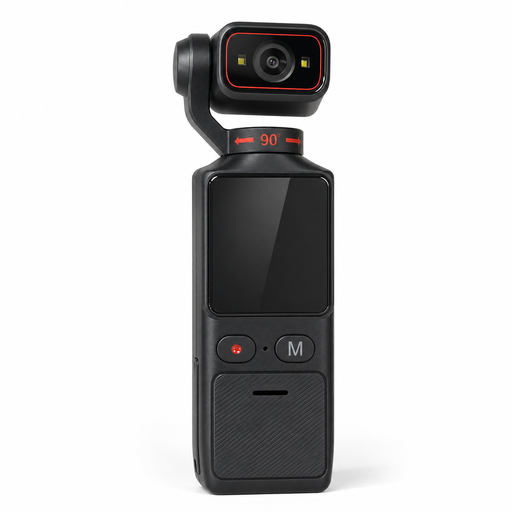
The Joybuy selection listed here includes a pocket camera whose product description specifies a tripod socket, adjustable white balance and exposure.
 No image available
4K pocket camera with electronic image stabilisation and 1.69-inch touchscreen
For a stable position at the table, the tripod socket mentioned in the product description, along with adjustable white balance and exposure, are useful features. Check that the model works with your tripod and gives you the framing you want.
The product specifications list 4K, Wi-Fi, a 180° swivel lens and electronic image stabilisation.
View at Joybuy
Frequently asked questions
Do I need to buy an interchangeable-lens camera straight away to photograph folded clothes?
No. Shopify Germany also suggests using a smartphone you already own to get started. First, check the framing, stability and lighting with the textiles you actually want to photograph.
How can I keep repeated overhead shots sharp and consistent?
Set the camera up securely and try to take the picture without touching it, for example by using a timer. Keep the lighting as consistent as possible between shots and check the white balance under the light you’re using.
Will a kit lens automatically show woven textures clearly?
Not necessarily. Check how well the included lens magnifies the fabric detail you want to show. Sony says its separately listed E 30 mm F3,5 Macro offers a maximum magnification of 1x, but it isn’t included in the ZV-E10-II kit mentioned here.
What extra costs should I consider when buying a kit?
As well as the camera body, check which lens is included and what accessories you’ll need for your setup. Nikon specifically states that the Z50II kit reviewed doesn’t include a charger.
Do the rights to cancel and legal guarantee apply to online purchases in Germany?
For a qualifying online purchase by a consumer from a trader, you generally have a 14-day right to cancel from the date of delivery, subject to statutory exceptions. Under EU consumer protection rules, faulty goods are covered by a statutory minimum guarantee of two years; claims should be made to the seller. The Verbraucherzentrale distinguishes this statutory guarantee from a voluntary warranty. These consumer rules cannot automatically be applied to purchases made for a business or from private individuals without checking first.


