
Lieferung heute & morgen

Qualitätsgarantie

Willkommens-Angebote freischalten: KOSTENLOSE Lieferung | Bis zu 80 % RABATT | Kostenlose 30-Tage-JoyPlus-Testphase
App herunterladen
A folding electric wheelchair can make transport by car easier and provide greater mobility in everyday life. However, choosing the right model is not simply a matter of finding the lowest price or the longest advertised range. Clear, reliable information about weight, battery, seat width, load capacity and safety is what really matters.
That is why the Joybuy Product Recommendation Officer selection focuses on practical criteria and highlights common pitfalls. This makes it easier to assess whether a lightweight electric wheelchair, an electric wheelchair for adults or another mobility aid is right for your individual needs.
A stated range of, for example, 30 or 48 kilometres is a product value measured under specific conditions. Body weight, outdoor temperature, gradients, surface, tyre pressure and travelling speed can all affect the actual distance travelled. Even an electric wheelchair with a lithium battery may require several hours of charging after longer journeys.
So check the following:
With a portable electric wheelchair, you need to distinguish between the weight with and without the battery. A model with removable batteries may be easier to load than a fully assembled vehicle. You should also consider the folded dimensions, available handles and the height of your car boot.
Figures given in pounds and kilograms can also cause confusion. 30 lb is approximately 13.6 kg. If a product name also states 19 kg, buyers should check the manufacturer’s precise net weight, including the battery.
Wider tyres, two motors and greater ground clearance can help when travelling on grass or uneven paths. However, they do not replace information about the maximum gradient, obstacle height and permitted surfaces. Wet sand, mud, snow and steep descents can affect control.
An all-terrain electric wheelchair should therefore only be used within the stated technical limits. Before buying, you should also consider the width, turning circle and available braking equipment.
For travelling and loading into a car boot, the net weight, battery weight and folded dimensions are crucial. A small turning circle is practical for narrow doorways and indoor spaces. At the same time, the seat width must not be too restrictive. Measure doorways, lifts, the boot opening and the available storage space before buying.
Motor power is often stated in watts. For example, two motors rated at 250 watts each provide a nominal total power output of 500 watts. However, wattage alone says nothing about the achievable speed or climbing ability.
Pay attention to:
The maximum load capacity must take into account both body weight and any luggage being carried. Seat belts, electromagnetic brakes, anti-tip protection and puncture-proof tyres may be relevant depending on how the wheelchair will be used. An electromagnetic brake typically stops the vehicle when the control is released; refer to the instruction manual for the precise operating method.
For air travel, a product description such as “airline approved” does not automatically guarantee carriage. Airlines have their own requirements for lithium batteries, watt-hours, dimensions and handover at the gate. Ask the airline directly to confirm carriage before travelling.
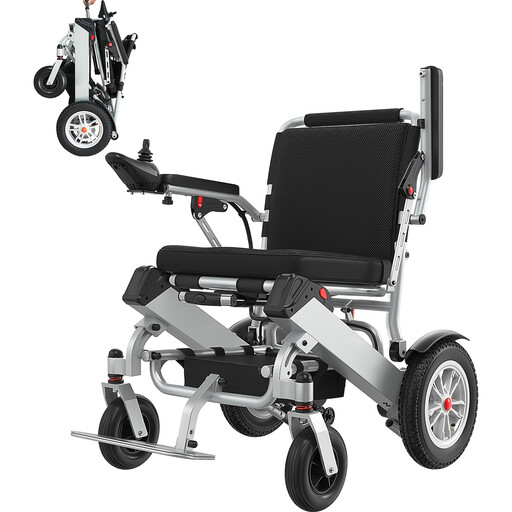
Why this product suits the profile: This model features an aluminium frame, a 10-Ah lithium battery and two 250-W motors. With a net weight of 26 kg including the battery, it is an appealing option for buyers looking for a basic folding model for everyday use and occasional outings.
The specifications state the weight, battery capacity, maximum load capacity of 120 kg, turning circle of 750 mm and maximum obstacle height of 40 mm.
Aluminium frame, electromagnetic brake and stated climbing ability of up to 9°. The battery is specified as a lithium battery.
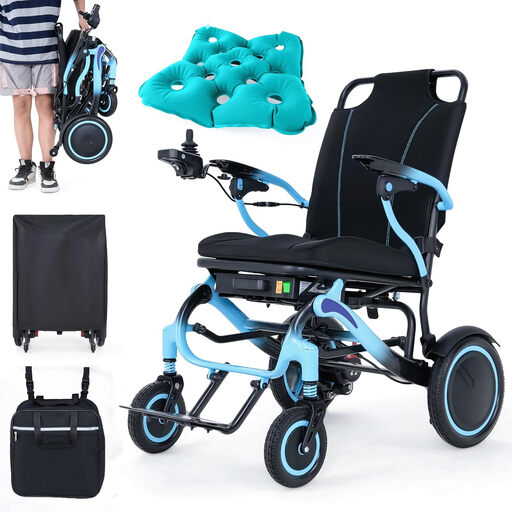
Why this product suits the profile: An LCD display, 360° joystick, two removable 12-Ah lithium batteries and a folding frame appeal to buyers comparing ease of use and transport options.
Before ordering, compare the different weight figures given in the listing, the precise frame material and the battery specifications.
LCD display, two removable 12-Ah batteries, 440-W total motor power and a stated range of at least 30 miles.
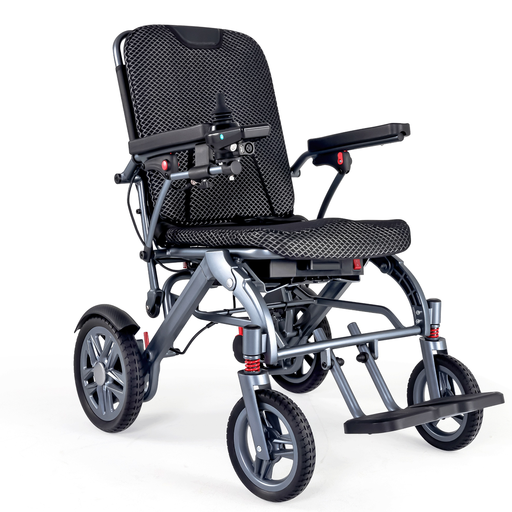
Why this product suits the profile: This model is designed for longer journeys and specifies two 250-W motors, a range of up to 48 km and a load capacity of up to 120 kg. It is suitable for users looking for a practical electric wheelchair with travel in mind.
The range is stated alongside the battery capacity, charging time of 6–8 hours and motor power. Check local conditions before using it on uneven terrain.
Two removable 12-Ah lithium batteries, electromagnetic brake, seat belt and puncture-proof tyres according to the product description.

Why this product suits the profile: If you do not need motorised assistance, a folding walking aid may be worth considering for indoor use, shopping and short journeys.
The walking aid is not marketed with motor or range specifications. This makes it clear that it should not be confused with an electric wheelchair.
Aluminium frame, one-handed folding mechanism, height-adjustable handles and specified brakes.
We have put together a complete, regularly updated list of products that fully meet these strict selection criteria and the safety regulations applicable in the EU.
The weight depends on the frame, motor, battery and accessories. The selected product specifications, for example, state 20 kg, 26 kg or 33 kg. The key point is whether the figure includes the battery. Removable batteries can make lifting easier by allowing you to split the load into several stages.
Battery life depends on charging cycles, storage, temperature and usage. Charge the battery according to the manufacturer’s instructions, avoid storing it for long periods when fully discharged, and protect it from moisture and excessive heat. The range per charge should not be confused with the battery’s total service life.
Running costs mainly come from electricity, wear-and-tear parts and, where necessary, a replacement battery. Power consumption depends on the battery capacity, charge level, weight and distance travelled. Before buying, you should also consider the contents of the package, warranty terms and the prices of a charger and replacement battery.