
Lieferung heute & morgen

Qualitätsgarantie

Willkommens-Angebote freischalten: KOSTENLOSE Lieferung | Bis zu 80 % RABATT | Kostenlose 30-Tage-JoyPlus-Testphase
App herunterladen
A folding electric wheelchair can make everyday life easier if walking is no longer a reliable option, or if you need a powered wheelchair for travel. However, models can vary considerably in weight, battery, seat width, motor power and folded dimensions.
Marketing claims such as ‘all-terrain’, ‘airline-approved’ or ‘48 km range’ should not be considered in isolation. What matters is whether the specifications suit the way you plan to use the wheelchair.
An electric wheelchair’s stated range depends on factors including user weight, outdoor temperature, gradients, terrain, tyre pressure and speed. An advertised range is therefore not a distance you can expect to achieve in everyday use.
If you regularly travel longer distances, you should also check:
An electric wheelchair with a lithium battery can be practical for transport and storage. However, the specific rules for lithium batteries on flights depend on the airline, battery capacity and how the battery is being transported.
A lightweight electric wheelchair is easier to lift into a car boot. Even so, weight capacity, frame construction, seat width and stability all need to work together. For some listings, particularly low weight figures may refer to the wheelchair without its battery.
Before buying, check that the following figures are listed separately:
You should also measure the boot opening. A compact folded size isn’t much use if the wheelchair won’t fit through the boot opening.
An electric wheelchair with a 500 W motor may have two motors rated at 250 watts each. However, the wattage alone doesn’t show how well a model can handle gradients, wet paths or uneven surfaces.
You should also consider:
A model advertised as an all-terrain electric wheelchair should only be used on surfaces specifically approved in the user manual. Sand, mud, snow and steep slopes increase the risk of tipping or slipping.
For travel and frequent storage, portable electric wheelchairs with a low net weight and removable battery can be a good choice. For indoor use, a tight turning radius and a suitable overall width are especially important. Measure doorways, lifts and ramps before buying.
The seat width needs to suit your body and the clothes you plan to wear. A seat that’s too narrow can be uncomfortable, while one that’s too wide can make it harder to manoeuvre in confined spaces.
Battery capacity is often given in Ah. A 12 Ah battery isn’t automatically more powerful than a 10 Ah battery, as voltage and motor energy consumption also play a part. Figures such as ‘30+ miles’ or ‘48 km’ should be understood as manufacturer or listing claims.
For an electric wheelchair for older people and adults, easily accessible charging ports, a clear battery indicator and safe battery transport are also important.
You should be able to operate the joystick with control, and it should have a clear indicator for battery level and speed. An electromagnetic brake may slow the wheelchair when you release the controls; check the user manual for details of how it works.
Before your first journey, practise moving off, reversing, turning and braking on a flat, clear surface. When using the wheelchair outdoors, follow the relevant road and usage regulations. Check the CE marking, the availability of a user manual in German and the conformity information before buying.
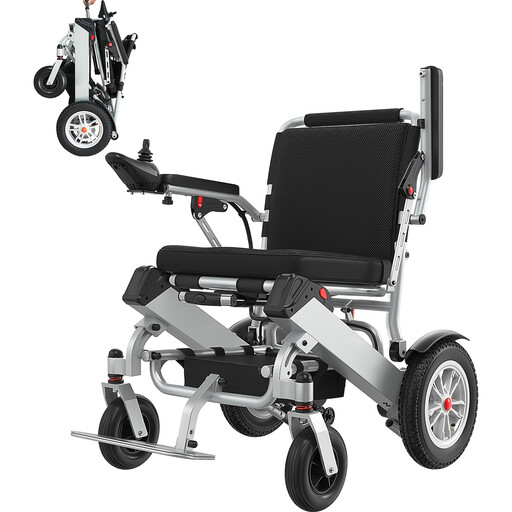
Why this product suits this profile: This model combines a stated net weight of 26 kg with a weight capacity of 120 kg, making it a good option for anyone looking for a relatively easy-to-transport first wheelchair.
The listing clearly states the battery, weight capacity, turning radius and obstacle height. This makes it easier to check the wheelchair’s transport and usage limits.
Aluminium frame, two 250 W motors, electromagnetic brake and a stated obstacle height of 40 mm.
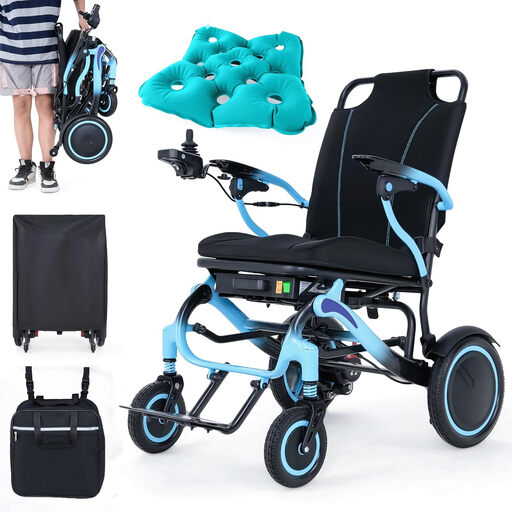
Why this product suits this profile: A good choice for anyone looking for a lightweight model with a display, joystick controls and two removable batteries. The listing states a weight of 19 kg and a capacity of around 120 kg.
The description lists several details you can check, including the number of batteries, charging time, seat width and controls. Confirm the weight figures include the batteries before buying.
Two 220 W motors, LCD display, electromagnetic brake and puncture-proof tyres, according to the product description.
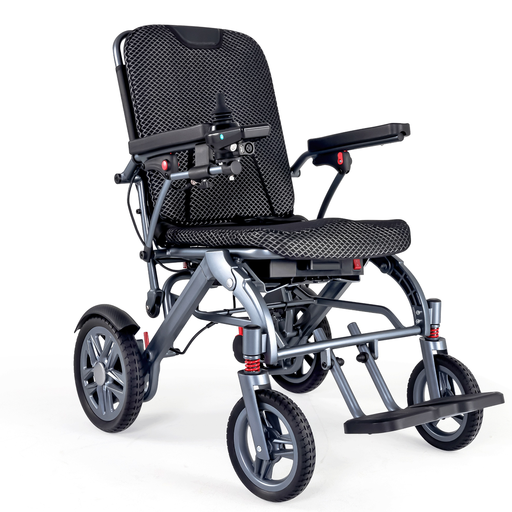
Why this product suits this profile: The listing is aimed at adults and travellers looking to combine two 12 Ah batteries with a stated range of up to 48 km and a low weight.
The listing gives specific details about the number of batteries, motor configuration and charging time. You should still check the claim that it’s approved for air or cruise travel directly with the relevant provider.
Two 250 W motors, removable lithium batteries and a stated electromagnetic brake with joystick controls.
We’ve put together a complete, regularly updated list of products that meet these strict selection criteria and fully comply with the safety regulations in force in the EU.
The distance you can travel on a single charge depends on the battery, load, temperature, terrain and how you drive. The range stated in the listing is a guide. To help prolong battery life, follow the manufacturer’s charging instructions, store the battery in a dry place and avoid extreme temperatures.
Running costs depend on battery capacity, how often you charge it and your electricity price. You may also need to budget for tyres, brakes, the joystick, a replacement battery or maintenance. Check the warranty terms and availability of spare parts before buying.
A model advertised as an airline-approved electric wheelchair isn’t automatically accepted by every airline. The battery specifications, whether it can be removed and the airline’s transport rules all matter. It’s a good idea to get written confirmation from the airline well in advance.