
Lieferung heute & morgen

Qualitätsgarantie

Willkommens-Angebote freischalten: KOSTENLOSE Lieferung | Bis zu 80 % RABATT | Kostenlose 30-Tage-JoyPlus-Testphase
App herunterladen
A folding lightweight wheelchair can make travelling, medical appointments, days out and short everyday journeys easier. For older people, those with limited mobility, family members and carers, low weight is not the only consideration. Weight capacity, seat dimensions, folding mechanism, folded size and intended use are just as important.
Many product descriptions look similar at first glance. However, some important details may be missing or unclear. If you choose based only on the lowest weight or a prominent label such as “travel wheelchair”, you could end up with a model that does not suit the user’s build, vehicle or intended use.
A lightweight transport wheelchair is not automatically suitable for everyone. The net weight tells you how heavy the product itself is. Maximum weight capacity, on the other hand, refers to the user’s permitted weight and, where applicable, any additional luggage.
Also check that the figure in the product title matches the technical specifications. The title of the first model in our selection states a maximum weight capacity of 172 kg. However, the detailed product information lists 158 kg or 350 lb. For your buying decision, rely on the detailed specification. If anything is unclear, contact the retailer to check.
A folding wheelchair may take up less width or length when folded, but it still needs enough storage space. So compare:
A portable travel wheelchair with a bag can be useful for train journeys, days out or holidays. Air travel is also subject to the requirements of the relevant airline. A product description such as “aircraft wheelchair” does not replace notifying the airline in advance.
Compact wheels help keep folded dimensions and weight down. However, they may be less suitable than larger wheels on uneven paths, kerbs or longer outdoor routes. So consider whether the wheelchair will mainly be used indoors, on even paths or outdoors.
A manual wheelchair with small TPR or honeycomb wheels is not the same as an all-terrain model. This is not a judgement on quality; it is a matter of intended use.
The seat should provide enough room while keeping the user stable and supported. Measure the seat width needed when seated, and take into account whether the user will be wearing winter clothing. A seat width of 40 to 41 cm may suit some people, but be too narrow for others.
Seat depth is just as important. A seat that is too short may only partially support the thighs, while one that is too long can affect comfort and freedom of movement. When choosing a wheelchair for an older person, also consider how easy it is to get in and out.
Aluminium alloys can help keep a wheelchair lightweight. Carbon steel may offer different properties for frame construction. The material alone is not what matters; it is the combination of weight capacity, build quality, folding mechanism and stability when unfolded.
Do not exceed the maximum weight capacity. This may also include the contents of a bag. The first model featured here has a stated shopping bag capacity of 5 kg.
Adjustable push handles can be useful for companions of different heights. On the first model, the handle height can be set to five positions between 80 and 93 cm. This may make it easier to handle, but does not replace checking that it suits the individual user and carer.
For transport, a secure locking mechanism, clear instructions and dry storage conditions are also important. Before use, check that all folding parts are locked in place and that the wheels turn freely.
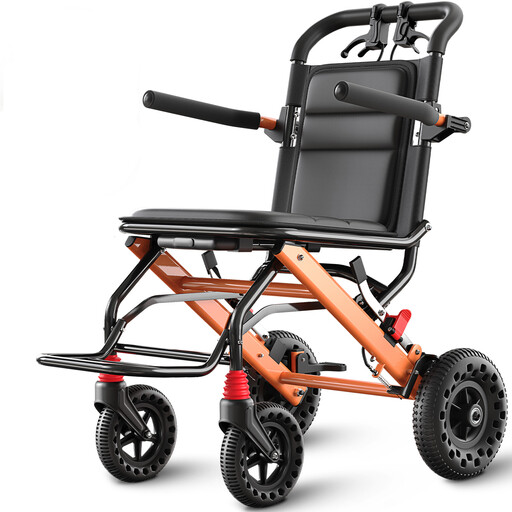
Why this product suits this profile: According to the product information, this model weighs 8,6 kg and has a seat width and depth of 40 cm each. It is aimed at buyers looking for a compact, portable wheelchair for even paths and occasional transport.
The seat dimensions, net weight and wheel sizes are clearly stated. This makes it easier to assess whether the wheelchair is suitable than a description that simply promotes it as “ultra-light” or “mobile”.
8,6 kg net weight, 40 cm seat width and a storage bag included. Maximum weight capacity is stated as 110 kg.
Why this product suits this profile: With a net weight of 8,5 kg, adjustable handle height and a stated weight capacity of 158 kg in the detailed specifications, this model is suited to buyers who prioritise technical details and a higher weight capacity.
The net weight is listed separately from the gross weight of 9,4 kg. The seat dimensions, wheel size and handle height range are also documented. Check the difference between the product title and detailed specification for weight capacity before buying.
8,5 kg net weight, a 41 × 31,5 cm seat and a five-position adjustable handle height of 80 to 93 cm.
Why this product suits this profile: The combination of 6-inch front wheels, 8-inch rear wheels, a bag and a tool kit may be useful for frequent days out or when family members need to transport the wheelchair.
The different wheel sizes and stated folded dimensions of 50,5 × 28 × 76,5 cm make it easier to plan for transport. However, check the wheelchair’s limitations before using it on uneven paths.
Storage bag and tool kit included, plus 6-inch and 8-inch honeycomb wheels according to the product description.
We’ve put together a complete, regularly updated list of products that meet these strict selection criteria and fully comply with the safety regulations in force in the EU.
Before each journey, make sure the folding mechanism is fully locked. Also check:
A folding lightweight wheelchair is not necessarily designed for independent propulsion or longer downhill stretches. If you are unsure about the right seat width, weight capacity or intended use, seek medical or care advice. Always follow the relevant instructions for use and the manufacturer’s guidance.
A low net weight is useful if you need to lift and store the wheelchair often. Models weighing around 8 to 10 kg can be easier to transport. However, weight alone tells you nothing about seat comfort, weight capacity or how the wheelchair handles. Always compare several technical specifications together.
That depends on the folded and packaged dimensions, as well as the size of the vehicle opening. Measure the available storage space and allow for bags or other luggage. The wheelchair’s external dimensions when unfolded are of limited use for this check.
Its lifespan depends on the load, surfaces, care and storage. Clean and dry the wheelchair after use, store it somewhere dry and regularly check the screws, wheels, brakes and joints. If you notice any damage, do not use the product again until the issue has been assessed.