
Lieferung heute & morgen

Qualitätsgarantie

Willkommens-Angebote freischalten: KOSTENLOSE Lieferung | Bis zu 80 % RABATT | Kostenlose 30-Tage-JoyPlus-Testphase
App herunterladen
A folding shopping trolley should transport your shopping reliably, be easy to pull and take up as little space as possible after use. In practice, however, some models disappoint with small wheels, unstable joints or a bag whose stated capacity does not match the actual storage space. The differences become particularly noticeable when carrying drinks, travelling over cobblestones or tackling stairs.
That is why it is worth looking at the technical specifications before buying, rather than relying on general advertising claims.
A large bag capacity does not automatically mean that the frame is designed for heavy loads. A shopping trolley with a 25 kg load capacity may be able to handle this weight when used as a sack truck or handcart, while the fabric bag itself may be intended for a lower weight. The key question is whether the manufacturer states the load capacity for the entire trolley, the frame or use as a handcart.
Many bags are made from coated Oxford fabric. According to product descriptions, this material can protect against dust and light rain. That does not automatically mean the construction is permanently waterproof. Seams, zips and the base of the bag may still allow water to enter. If you transport food in changeable weather, look for a protective flap and a water-repellent coating.
A shopping trolley with stair-climbing wheels can overcome steps and kerbs differently by design from a two-wheeled model. However, the three-wheel mechanism changes the pulling angle and how heavy the load feels. On narrow staircases, wet steps or with a very heavy load, controlled handling is still required. The term ‘stair climber’ should therefore not be understood as a promise that every staircase can be tackled effortlessly.
For regular shopping trips, the maximum load is an important point of comparison. According to the manufacturers’ specifications, models with a 20 to 25 kg handcart load capacity are also suitable for parcels, crates of drinks or water containers, provided the load is distributed evenly across the platform. A powder-coated steel frame or galvanised steel can offer structural advantages in terms of corrosion protection. Stable joint connectors, a robust axle and a base that is as wide as possible are also important.
A shopping trolley with a bag should suit your usual shop:
600D Oxford polyester is often used as a hard-wearing fabric. A protective flap helps keep the contents enclosed while the trolley is being pulled. Side pockets for an umbrella or shopping list are also useful, as is a zipped rear compartment for keys, a purse and a smartphone.
EVA wheels are generally quiet on pavements and in supermarket aisles. Larger wheels can offer advantages on uneven ground. A foldable shopping trolley should fold down without much effort and then be easy to store flat – for example behind a door, under the bed or in the boot.
For older people, students and working professionals, the trolley’s own weight is particularly relevant. A lightweight shopping trolley weighing around 1.15 kg is easier to carry, but may have a lower load capacity than a heavier steel-frame model. You should weigh up whether mobility or load-bearing strength is the higher priority.
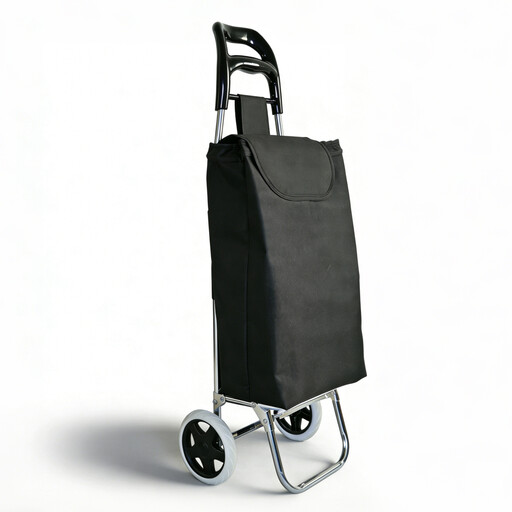
Why this product suits this profile: With a stated weight of 1.15 kg, it is easy to carry, store and take along in the car. The bag holds 25 litres and can be removed when using the frame as a handcart.
The specifications distinguish between the trolley’s own weight, bag capacity and handcart load capacity. The water-repellent bag is not generally described as completely waterproof.
1.15 kg own weight; 2-in-1 use with a 20 kg handcart load capacity and quiet EVA wheels.
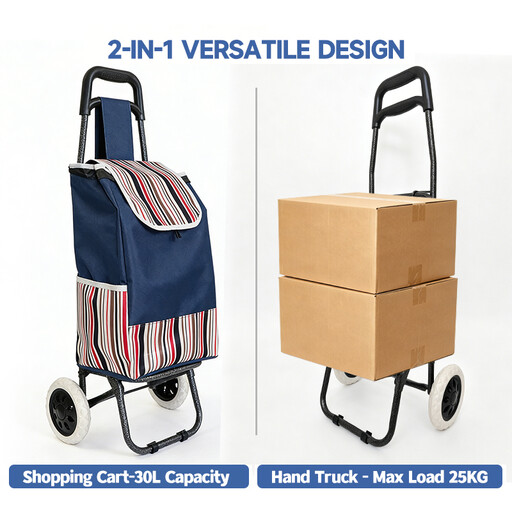
Why this product suits this profile: The 16 mm steel frame, galvanised solid axle and stated handcart load capacity of 25 kg are designed for frequent transport.
The frame, axle, bag capacity and load capacity are listed separately. The water-repellent Oxford bag also has a protective flap.
30 litres of storage; removable bag; EVA wheels and a 25 kg handcart load capacity according to the product specifications.
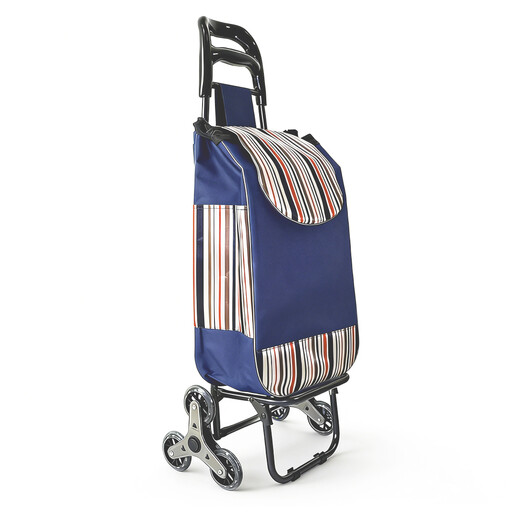
Why this product suits this profile: The six PU wheels with a three-wheel mechanism are designed for paths with steps, kerbs and uneven paving. The larger capacity is suitable for bigger shops.
The stair-climbing function is based on a specifically described three-wheel construction. The 38-litre bag capacity and 30 kg handcart load capacity are also listed separately.
38-litre bag; six PU wheels; 30 kg handcart load capacity and flat folding according to the product specifications.
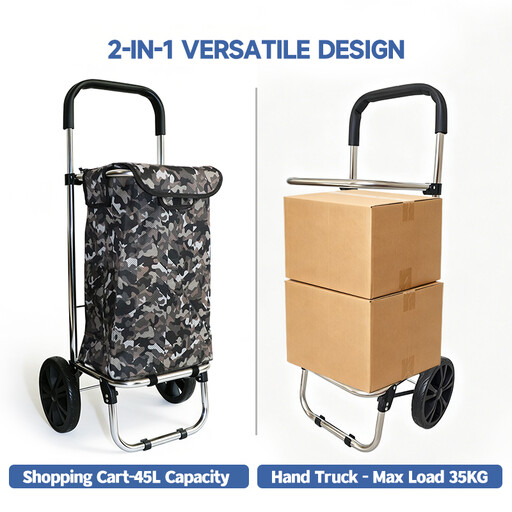
Why this product suits this profile: The stated height of 96 cm and padded handle support an upright pulling position. The large compartment is designed for shopping trips, laundry and travel.
The stainless steel frame, solid axle and bag dimensions are clearly specified. The bag is described as water-repellent against dust and light rain.
Approx. 45 litres of capacity; 96 cm total height; two EVA wheels and removable bag according to the product description.
We have put together a complete, regularly updated list of products that fully meet these strict selection criteria and the safety regulations applicable in the EU.
Its lifespan depends on the frame, axles, joints, wheel material and load. Keeping the load evenly distributed and within the manufacturer’s specifications, storing the trolley in a dry place and regularly checking the screws and wheels can help reduce wear. If the joints are damaged or an axle is bent, the trolley should not be used with any further load.
No. The six wheels assist movement over steps, but do not replace safe handling. Step height, the weight of the load, staircase width and the surface all affect how easy the trolley is to use. For very heavy loads, a lift or a second person may be advisable.
This type of trolley normally requires no electricity and therefore has no ongoing energy costs. Possible follow-up costs include replacement wheels, damaged bags or wear to the joints. Before buying, check whether spare parts and care instructions are available.