
Lieferung heute & morgen

Qualitätsgarantie

Willkommens-Angebote freischalten: KOSTENLOSE Lieferung | Bis zu 80 % RABATT | Kostenlose 30-Tage-JoyPlus-Testphase
App herunterladen
A folding transport trolley can make it much easier to move shopping, camping equipment, gardening materials or crates of drinks. However, models vary considerably in load capacity, handling and storage space. A large capacity stated in litres alone, for example, says little about whether the trolley can be handled safely on gravel, kerbs or sloping ground.
A trolley with a stated load capacity of 200 kg is not automatically suitable for every loading situation. The even distribution of weight, centre of gravity and ground surface are also important. Heavy items should be placed as low and centrally as possible. With a high centre of gravity, even a sturdy wheeled transport trolley can tip when turning or on uneven ground.
The stated volume should also be read critically. 300 litres describes the available interior space, not necessarily the practically usable area for long or angular items. Therefore, check the external dimensions and the length of the loading surface.
Some trolleys can be folded but remain relatively wide or heavy. For storage in a cellar, garage or boot, the folded dimensions are therefore crucial. With a folding hand trolley, it should also be clear whether the wheels, fabric bag or handle can be removed.
A simple folding mechanism reduces the risk of the trolley being left unused in everyday life. Before buying, check whether it has a locking mechanism and whether it stands securely when unfolded.
Small plastic castors may be sufficient on level ground, but they are only suitable to a limited extent for beaches, lawns or gravel. An outdoor trolley needs wider wheels and sufficient ground clearance. Swivelling front wheels improve manoeuvrability, while fixed wheels can track more reliably when pulling the trolley over longer distances.
Brakes are particularly important when loading and unloading. A parking brake prevents the trolley from moving by itself on slightly sloping ground. However, it is not a substitute for careful use on steep slopes.
For light shopping, a shopping trolley with a load capacity of around 35 kg is often sufficient. A folding sack truck with a capacity of 80 to 100 kg is more suitable for parcels, crates of drinks or smaller gardening tasks. For camping equipment, firewood or larger loads, models with a stated load capacity of 150 to 200 kg may be suitable.
Check whether the maximum load applies to sack truck, platform or tipping operation. With a 2-in-1 model, different values may be specified depending on the mode of use.
The bag on a folding utility wagon is often made from Oxford fabric. The material thickness, seams and base determine how suitable the bag is for heavy or angular items. A steel or aluminium frame affects weight and stability. Aluminium is generally lighter, while steel can add more weight in a comparable construction.
Removable bags are practical for everyday use because they can be cleaned separately. After cleaning, the material should be allowed to dry completely before the trolley is folded. This reduces the risk of odours and material damage.
Measure the storage space at home and the boot before buying. A folding trolley with a large interior can be more than a metre long when set up. Width is particularly important for narrow paths or lifts.
For a foldable sack truck, the height of the telescopic handle, the size of the loading surface and the unladen weight are also important. A very lightweight transport trolley is easier to carry, but may run less steadily when heavily loaded. A platform trolley is suitable for boxes and crates, while a trolley with a covered bag keeps loose items together more effectively.
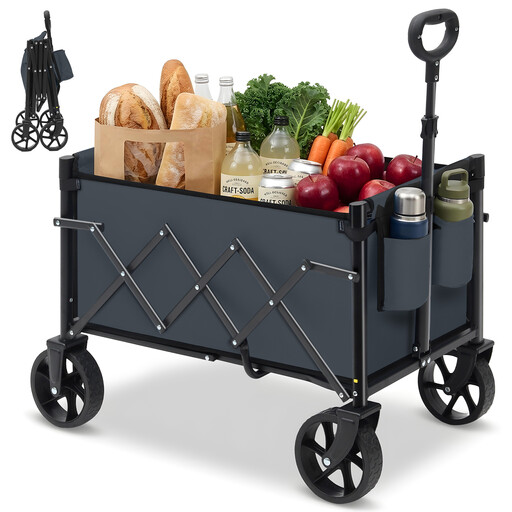
Why this product suits this profile: This model combines an 80 kg load capacity with an unladen weight of 4.8 kg, making it suitable for shopping, picnics and everyday transport.
The load capacity and unladen weight are clearly stated. The wheels can also be removed for storage.
One-hand folding, a three-way adjustable handle and a self-standing design.

Why this product suits this profile: This camping wagon offers 127 litres of storage space, a stated load capacity of 200 kg and dual front brakes for loading and unloading.
In addition to the load limit, the storage capacity, folding time and braking equipment are clearly specified. The wagon must be fully locked before loading.
127-litre interior, stated load capacity of 200 kg and folding frame.
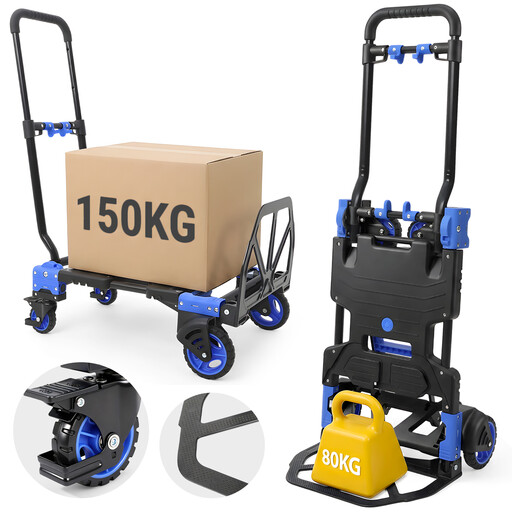
Why this product suits this profile: This model switches between a folding sack truck and a platform trolley. It is designed for parcels, crates and changing transport tasks around the home or office.
The load capacity varies by mode: 80 kg in sack truck mode and 150 kg as a platform trolley. A parking brake is integrated.
Aluminium frame, height-adjustable handle, TPR wheels with double bearings and compact folding.
We have put together a complete, regularly updated list of products that fully meet these strict selection criteria and the safety regulations applicable in the EU.
For normal shopping, 35 to 80 kg is often sufficient. For gardening, camping or crates of drinks, models with a capacity of 100 to 150 kg are a sensible choice. A load capacity of 200 kg may be suitable for heavy loads, but requires even loading and an appropriate ground surface.
This depends mainly on the wheels. Wide off-road wheels distribute weight more effectively across sand and soft ground. Narrow castors can sink in. Also check whether the manufacturer specifically states that the trolley is suitable for outdoor use, and clean the running gear and fabric bag after use.
A fixed lifespan cannot be given in general. It depends on the load, ground surface, storage and care. Dry storage, regular inspection of the connections and observing the load capacity can help reduce wear. If the wheels have noticeable play or the seams are damaged, the trolley should no longer be heavily loaded.