
Lieferung heute & morgen

Qualitätsgarantie

Willkommens-Angebote freischalten: KOSTENLOSE Lieferung | Bis zu 80 % RABATT | Kostenlose 30-Tage-JoyPlus-Testphase
App herunterladen
A folding trolley can make it much easier to move shopping, crates of drinks, parcels, garden accessories or camping equipment. Models can vary considerably in their frames, wheels, folded dimensions and maximum load, however. A low price or a high load rating alone doesn’t tell you how practical a trolley will be for everyday use.
Before you buy, it’s worth checking these points in particular:
For a folding shopping trolley, a load capacity of 20 to 35 kg is often enough, depending on how you plan to use it. If you want to carry crates of drinks, parcels or tools, look for a folding hand truck with a higher load capacity.
It’s important to distinguish between:
Distribute the load evenly and don’t exceed the stated maximum. Place heavier items at the bottom wherever possible to keep the centre of gravity low.
A wheeled hand trolley should suit the routes you actually use. TPR or EVA wheels are usually quiet on smooth surfaces. Wider wheels can offer greater stability on grass, gravel or paving. A stair-climbing shopping trolley with six wheels is designed to handle steps and kerbs better than a standard two-wheeled trolley. That doesn’t mean every staircase can be tackled without effort or without carefully lifting and guiding the trolley.
A parking brake is useful to stop the trolley from rolling away on slopes or while you’re loading it. It isn’t a substitute for keeping a firm hold on the trolley while it’s moving.
Before you buy, measure the space where you plan to store the trolley, such as your boot, cellar or utility room. A product can be large when open and still fold down compactly. Details such as a 5.7 cm folded width, a flat-folding design or removable wheels are therefore more useful than general claims such as “space-saving”.
An adjustable-height handle makes it easier to find a comfortable position for different heights. For a folding shopping trolley, also consider the bag capacity, water-repellent material and a secure cover. Water-repellent doesn’t necessarily mean waterproof.
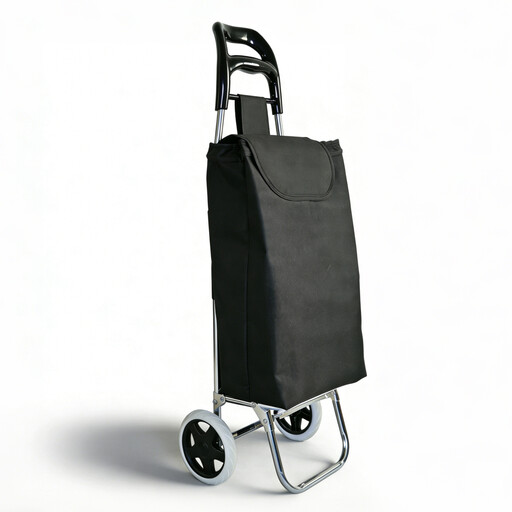
Why it suits this buyer: Weighing just 1.15 kg and featuring a 25-litre bag, it’s a practical choice for everyday shopping, commuting and storage in a smaller home.
The maximum load of 20 kg in hand-truck mode is clearly distinguished from use with the bag. This makes it easier to compare the load capacity with what you actually need to carry.
Weighs 1.15 kg, with a 25-litre Oxford bag and the option to convert it into a hand trolley.
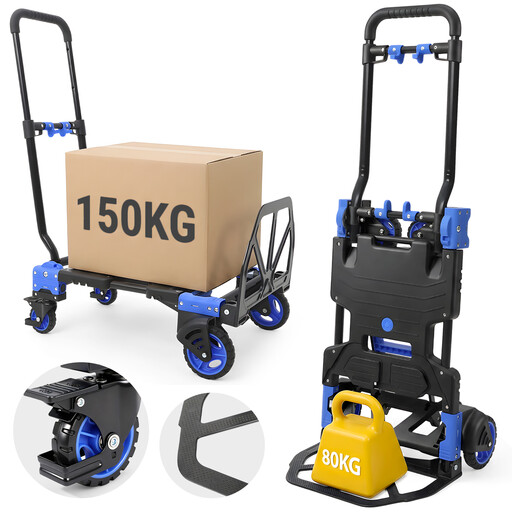
Why it suits this buyer: This model combines hand-truck and platform functions, making it a practical option if you want one product for moving parcels, crates and household items.
The load capacity is stated separately for each mode: 80 kg in hand-truck mode and 150 kg as a platform trolley.
Aluminium frame, adjustable-height handle, parking brake and double-bearing TPR wheels.

Why it suits this buyer: The six-wheel design is a good option if you regularly need to tackle kerbs, steps and uneven paths.
The six PU wheels are designed for steps and kerbs, while the maximum load in hand-truck mode is clearly limited to 25 kg.
25-litre bag, folds flat, reinforced frame and six bearing-mounted PU wheels.
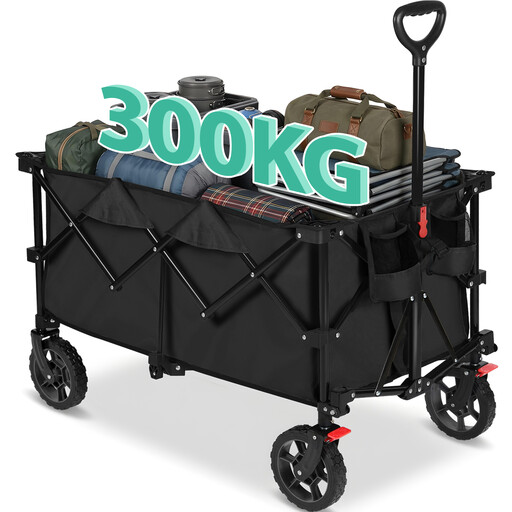
Why it suits this buyer: Its generous 200-litre capacity makes it suitable for camping gear, garden accessories and larger loads on paved paths, grass or sand.
The 300 kg maximum load and the storage capacity are stated separately. Even so, take particular care to consider the weight and surface when the trolley is fully loaded.
200-litre capacity, painted steel frame, adjustable handle and one-handed folding mechanism.
We’ve put together a comprehensive, regularly updated list of products that meet these strict selection criteria and fully comply with the safety regulations applicable in the EU.
For everyday shopping, 20 to 35 kg is often enough, depending on your needs. For crates of drinks, parcels or garden accessories, consider models with a capacity of 80 kg or more. The key is to check whether the figure applies to hand-truck, platform or trolley mode.
No. Its special wheel arrangement can make it easier to get over steps, but you’ll still need to guide it carefully. On high, narrow or uneven steps, reduce the load and follow the manufacturer’s instructions.
Its lifespan depends on the load, surfaces, number of times it’s folded and how well it’s maintained. A sturdy frame, strong axles and free-running wheels are all important. Keeping within the load capacity and intended uses can help reduce wear on the joints, wheels and fabric parts.