
Lieferung heute & morgen

Qualitätsgarantie

Willkommens-Angebote freischalten: KOSTENLOSE Lieferung | Bis zu 80 % RABATT | Kostenlose 30-Tage-JoyPlus-Testphase
App herunterladen
A folding trolley can make it much easier to move shopping, gardening tools, camping gear or moving boxes. However, not every model is right for every task. Product photos showing large wheels and high weight limits don’t, on their own, tell you how well a trolley will perform in everyday use.
Before you buy, take a closer look at load capacity, folded dimensions, wheel design and how you plan to use it. This can help you avoid common buying mistakes, such as choosing a compact folding trolley that tips over on uneven ground, or a hand truck whose maximum load only applies in a particular configuration.
A figure such as 150 kg trolley capacity may seem straightforward at first. However, it could apply to the platform configuration, while the trolley may have a much lower capacity in hand truck mode. How you distribute the weight matters too: a concentrated load can affect stability more than several items spread evenly across the trolley.
So, check:
A folding pull-along wagon or camping trolley with a large interior isn’t automatically practical. The usable internal length, the height of the sides and the folded dimensions all matter too. A very long trolley can be awkward to store in a cellar, car boot or hallway.
For food and smaller shopping trips, a capacity of around 75 litres is often enough. If you’re carrying tents, garden waste or bulky equipment, 127 or 300 litres may be more suitable. Just make sure the larger capacity fits the space you have available for storage.
A hand trolley with wheels behaves differently on a smooth floor than it does on paving, grass or gravel. As well as wheel size, consider the bearings, tyre width, manoeuvrability and whether the trolley has a parking brake. 360-degree swivel wheels make it easier to manoeuvre, while larger, wider wheels may be better on uneven ground.
Also check whether the wheels can be removed and whether dirt, sand or grass can be cleaned off easily.
A steel-frame trolley is designed to handle heavy loads, while an aluminium frame combines a lower overall weight with different structural characteristics. A garden trolley for sacks, tools or planting materials needs different features from a wheeled shopping trolley for everyday use.
If a product has more than one function, check the figures for each one separately. According to the product details, the aluminium 2-in-1 hand truck carries 80 kg in hand truck mode and 150 kg in platform mode. So the 150 kg figure doesn’t apply to every way of using it.
Folding trolleys are often made with steel, aluminium and 600D Oxford fabric. However, the material alone doesn’t tell you everything about quality. Also look for:
Make sure a fabric trolley is dry before folding it away. For a folding sack truck, the platform, telescopic handle and wheel bearings are particularly important.
Measure the storage space available in your car, cellar or shed. A low overall weight makes a trolley easier to carry, but shouldn’t come at the expense of its intended load capacity. Height-adjustable handles, one-handed folding and a self-standing design are useful features.
When carrying a heavy load, keep it as low as possible and secure it with straps or suitable accessories. A trolley isn’t designed to be used as a seat, ladder or children’s ride-on toy.
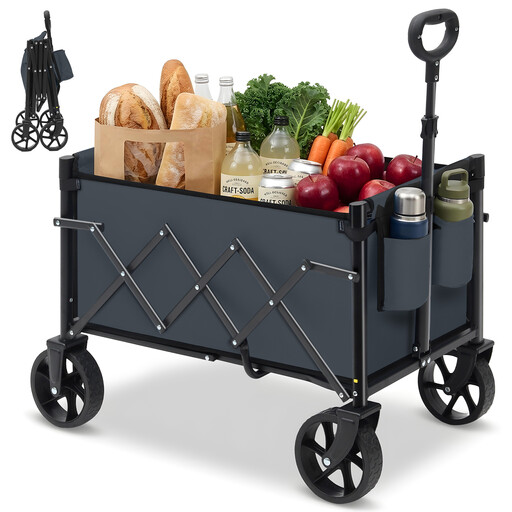
Why this product suits this type of user: This trolley is designed for anyone looking for a lightweight folding trolley for shopping, picnics and everyday carrying tasks. According to the product details, it weighs 4.8 kg and folds down compactly.
Its maximum load of 80 kg is clearly stated. The compact folded size and removable wheels make it easier to store.
Weighs 4.8 kg, with a handle that adjusts to three heights and a self-standing design.
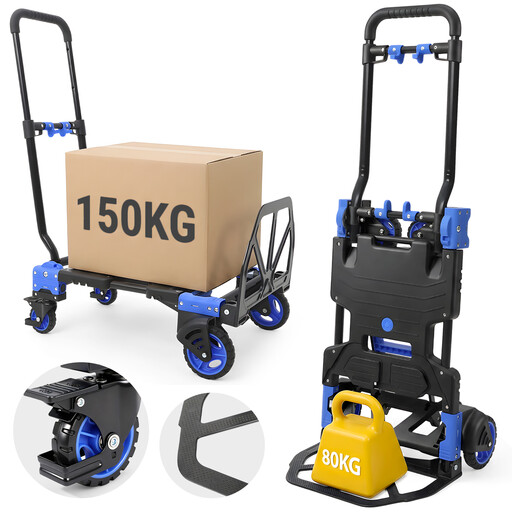
Why this product suits this type of user: Combining a hand truck with a platform trolley, this model is suitable for moving house, as well as use in cellars, offices and gardens. Its aluminium frame and height-adjustable handle make it versatile.
The load limits are listed separately for each configuration: 80 kg as a hand truck and 150 kg as a platform trolley. The built-in parking brake is designed to keep it in place on slopes.
2-in-1 functionality, TPR wheels that swivel through 360 degrees and one-handed folding.
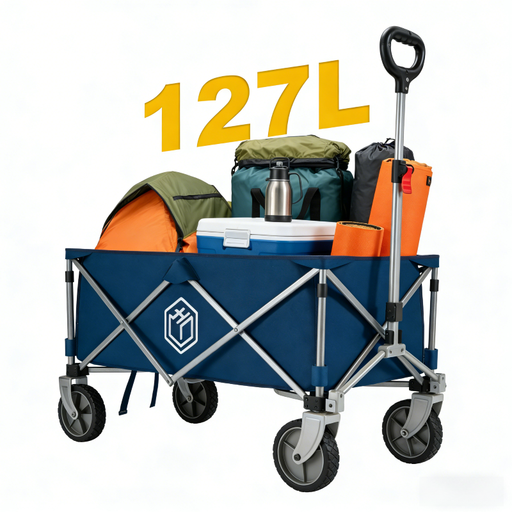
Why this product suits this type of user: Designed for camping, the beach, the garden and larger outdoor equipment, this folding wagon has a stated capacity of 127 litres and a maximum load of 200 kg.
Its high load capacity is paired with a clearly stated volume. The safety guidance recommends distributing the load evenly and using the trolley on as level a surface as possible when carrying heavy loads.
127-litre interior, folding design and suitable for camping, picnics, the beach and the garden.
We’ve put together a complete, regularly updated list of products that meet these strict selection criteria and comply fully with the safety requirements in force across the EU.
Before loading the trolley, make sure the folding mechanism is fully locked into place. Distribute heavy items as low and centrally as possible. With a hand truck, secure longer items as well, so they don’t shift while you’re pulling or pushing it.
After use, we recommend that you:
600D Oxford fabric may be suitable for outdoor use, but it doesn’t remove the need for dry storage. If you notice any damage to the frame, wheels or seams, don’t continue to load the trolley.
For shopping and light outings, 60 to 80 kg is often enough. For gardening, moving house or heavy camping gear, a capacity of 100 to 200 kg may be more suitable. What matters is whether the figure applies to the whole trolley, a particular configuration or a specific platform position.
Not necessarily. Large, wide wheels can be an advantage on grass, gravel or paving, but they take up more storage space. Swivel wheels are often more practical in narrow hallways or on smooth floors. The right combination depends on the surface and the folded dimensions.
Its lifespan depends on the load, the surface it’s used on, how well it’s maintained and how it’s stored. Sticking to the maximum load capacity, distributing the weight evenly and storing the trolley in a dry place can reduce wear on the frame, seams and wheel bearings. You should also check the specific warranty terms on the relevant product page.