
Lieferung heute & morgen

Qualitätsgarantie

Willkommens-Angebote freischalten: KOSTENLOSE Lieferung | Bis zu 80 % RABATT | Kostenlose 30-Tage-JoyPlus-Testphase
App herunterladen
For many DIY enthusiasts and mobile tradespeople, a folding workbench is the ideal solution. It saves space in the garage, can be transported to the job site, and provides a stable work surface. However, the market is flooded with models whose promises often don't hold up in practice. Incorrect material specifications and exaggerated advertising claims can quickly lead to a purchase that brings more frustration than satisfaction.
As your Joybuy Product Recommendation Officer, I'll help you recognise the common pitfalls and make an informed decision. We will focus on the facts that truly matter, so you can find a workbench that reliably supports your projects.
Many products look convincing at first glance but reveal their weaknesses only during use. Pay close attention to these three points to avoid disappointment:
To make the right choice, don't be swayed by marketing buzzwords; instead, focus on verifiable technical specifications. These three parameters are crucial for a durable and functional workbench for DIY enthusiasts.
Stability is the most critical factor. It is primarily determined by the material and design of the frame.
A mobile workbench must not only be easy to transport but also adaptable.
A workbench is only as good as its ability to hold workpieces securely.
Not every DIY enthusiast has the same needs. Here are some recommendations tailored to specific user profiles.
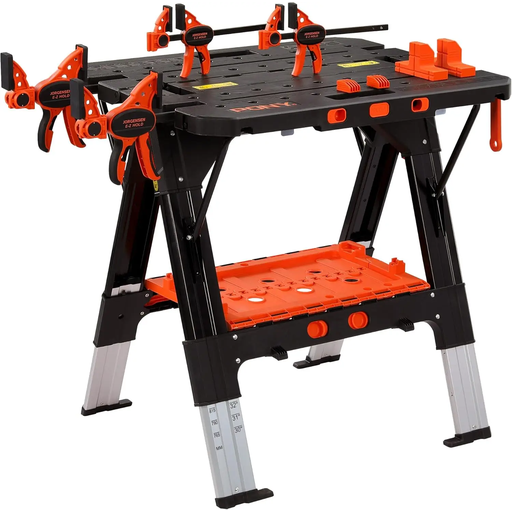
Why This Fits Their Persona: Ideal for DIYers who need a flexible solution for the garage, garden, or workshop and want both a stable work surface and a heavy-duty sawhorse in one device.
The robust aluminum leg frame ensures high stability and prevents wobbling under load. The 2-in-1 function offers real added value instead of just a weak compromise.
Six height settings (765-890 mm) for ergonomic work. High load capacity of 227 kg as a workbench and 454 kg as a sawhorse. Includes quick-action clamps and clamping jaws.
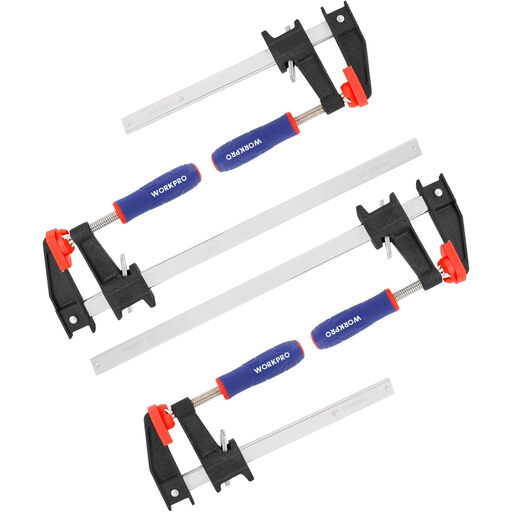
Why This Fits Their Persona: Perfect for users who own a solid workbench but need higher, more reliable clamping force for precise glue-ups and assemblies than integrated systems can provide.
This set solves the problem of inadequate clamping systems. Instead of relying on weak integrated clamps, it offers a dedicated solution with high clamping force for a secure hold.
High clamping force of 272 kg for stable fixation. Soft plastic protective caps prevent damage to the workpiece. Set includes two sizes (150 mm & 300 mm) for versatile applications.
A good workbench is the foundation, but the right accessories make all the difference. Discover our full range of high-quality clamping tools that will take your projects to the next level.
The specified load capacity is an important guideline, but pay attention to the context. A high static load capacity (e.g., 300 kg) means the workbench can hold this weight at rest. More relevant for practical use is its stability under a dynamic load, i.e., when actively working on a workpiece. A solid frame construction with cross-bracing is more crucial here than a high number on paper.
For occasional, brief tasks, a fixed height may be sufficient. However, if you work at the workbench regularly or for extended periods, height adjustment is highly recommended. It promotes an ergonomic posture, which helps prevent back pain and muscle strain. Additionally, you can optimally adjust the working height for different activities—a lower position for sawing, a higher one for fine assembly work.
Not every folding workbench is suitable for use as a sawhorse. A true folding sawhorse is specifically designed to securely support long workpieces like boards or beams and to withstand high lateral forces. Look for models explicitly designated as 2-in-1 solutions (workbench and sawhorse). These typically feature a more robust structure and a higher load capacity in sawhorse mode.