
Lieferung heute & morgen

Qualitätsgarantie

Willkommens-Angebote freischalten: KOSTENLOSE Lieferung | Bis zu 80 % RABATT | Kostenlose 30-Tage-JoyPlus-Testphase
App herunterladen
A folding electric wheelchair can make everyday life easier when it meets your personal requirements. For adults and older people, factors such as a low price or advertised range are not the only things that matter. The actual weight with the battery, folded dimensions, controls and suitability for the intended surface are all key considerations.
As a Joybuy Product Recommendation Officer, I assess market information against clear, verifiable criteria. The following advice can help you avoid common purchasing mistakes when choosing an electric wheelchair for adults.
Some manufacturers state the weight of the frame without the battery. However, when loading the wheelchair into a car or storing it at home, what matters is the weight of the wheelchair when fully ready for use. Any removable battery must also be taken into account when lifting it.
Before buying, check:
A model weighing 18 to 20 kg can be much easier for a companion to handle than a 40 kg wheelchair. However, you should always assess the actual weight using the product specifications, rather than relying solely on marketing terms such as ‘ultra-light’.
The stated range of a folding battery-powered wheelchair depends on several factors. These include the user’s weight, inclines, outside temperature, tyre pressure, surface and use of the motor power. A manufacturer’s stated range of 48 km therefore cannot automatically be applied to every everyday situation.
Pay attention to:
An electric wheelchair with a lithium battery may be easier to transport because of its lower battery weight. However, air travel is subject to the requirements of the relevant airline and regulations governing lithium batteries. A product description stating ‘airline-approved’ therefore does not replace prior confirmation from the airline.
Depending on its design, an all-terrain electric wheelchair may be suitable for grass, firm paths or slight unevenness. Sand, mud, snow, pronounced side slopes and wet descents present additional challenges. Motor power alone says little about the wheelchair’s actual stability.
You should therefore check:
A powered wheelchair with two motors should also only be used within the limits specified by the manufacturer. When using it on public roads, you must also follow the applicable traffic rules and local requirements.
For indoor use, a suitable seat width and small turning radius are often more important than high motor power. Measure doorways, lifts and the intended storage space. Bear in mind that the wheelchair’s overall width may be greater than its seat width.
A lightweight electric wheelchair is particularly useful if it regularly needs to be lifted into a car boot. However, lower weight may be associated with a lower maximum load or fewer features. The specifications should therefore always be considered together.
Folding models often feature two motors rated at 220 or 250 watts each. Motor power affects starting off and handling inclines, but it is not the only measure of quality. The controls, brakes, tyres and overall weight are equally important.
A maximum speed of 6 to 8 km/h is documented for the models mentioned. On pavements, in shopping centres and indoors, the speed should be adjusted to suit the surroundings.
A removable battery makes charging easier if the wheelchair itself cannot be parked close to a power socket. When travelling, you should also clarify whether the battery must be transported separately and which documents or labels the airline requires.
Range, charging time and battery capacity should not be assessed in isolation. An electric travel wheelchair must also be capable of being folded, carried, secured in a vehicle and reassembled at your destination.
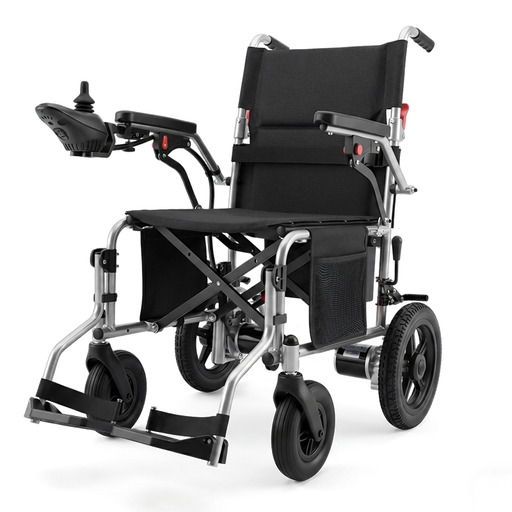
Why this product suits this profile: The documented dimensions of 1040 × 630 × 890 mm, net weight of 23.45 kg and maximum speed of 6 km/h provide a clear basis for everyday use and occasional transport.
The product data clearly state the net weight, package dimensions, motor power and drive type. This makes it easier to assess transport and use than a purely promotional claim would.
Two motors rated at 250 W each, a steel frame and a folding design; the stated battery capacity is 13 Ah.
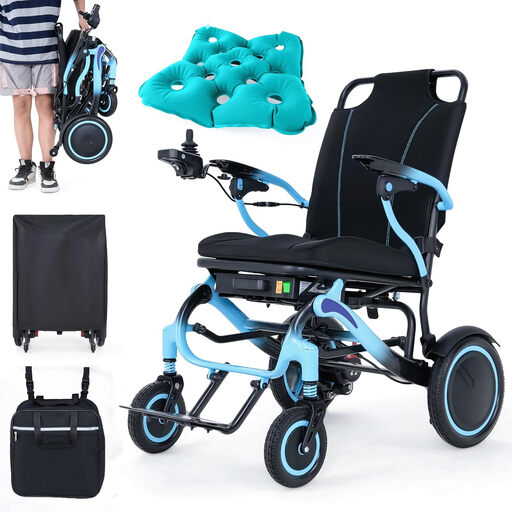
Why this product suits this profile: According to the product description, this model is equipped with two removable 12 Ah lithium batteries, an LCD display and a 360-degree joystick. These features are useful for people who want to keep transport details and battery status clearly in view.
The battery is described as removable. This can make charging and transport easier. The actual frame material should be checked against the specific item details before purchase, as the description contains differing material specifications.
Stated weight of 30 lb, LCD display, two motors with a combined output of 440 W and an electromagnetic brake.
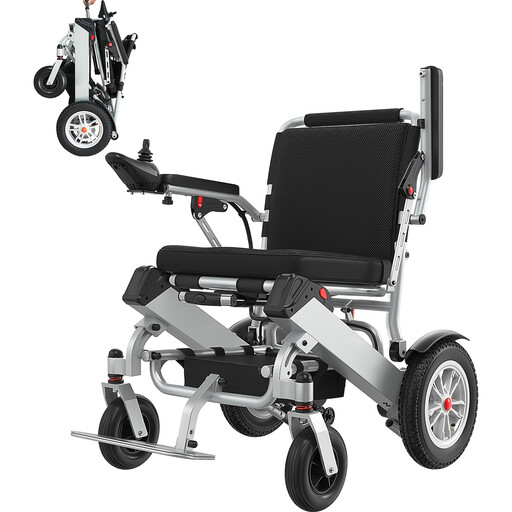
Why this product suits this profile: For regular outdoor trips, the stated values for obstacle height, incline and load capacity are particularly relevant. This model provides specific technical parameters for these factors.
The product data specify a maximum obstacle height of 40 mm, a maximum incline of 9° and a load limit of 120 kg. These details make it possible to plan how and where the wheelchair can be used more accurately.
Aluminium alloy frame, two 250 W motors, electromagnetic brake and a net weight of 26 kg including the battery.
In addition to the purchase price, an electric wheelchair may incur costs for electricity, wear-and-tear parts, maintenance and replacement batteries. Actual electricity costs depend on battery capacity, charge level and the electricity tariff. For a long service life, we recommend:
If you have physical limitations, you may wish to discuss the seating position, load capacity and ease of operation with the relevant specialist service or healthcare professional. A product description cannot replace an individual suitability assessment.
We have put together a complete, regularly updated list of products that fully meet these strict selection criteria and the safety regulations applicable in the EU.
That depends on how it will be transported. If you regularly lift the wheelchair into a car boot, compare the weight including the battery with the weight of the individual components. For indoor use only, seat width, turning radius and ease of operation may be more important than exceptionally low weight.
Range depends on battery capacity, load, inclines, temperature and surface. Manufacturer specifications are guidelines. When choosing a model, you should also check charging time, battery replacement, replacement-part availability and whether the battery can be charged away from the wheelchair.
This must be confirmed with the airline before every journey. Important factors include the battery type, capacity, whether it can be removed and the applicable transport regulations. Even if a model is described as suitable for air travel, you should obtain written confirmation of the specific airline requirements.