
Lieferung heute & morgen

Qualitätsgarantie

Willkommens-Angebote freischalten: KOSTENLOSE Lieferung | Bis zu 80 % RABATT | Kostenlose 30-Tage-JoyPlus-Testphase
App herunterladen
A folding stool can serve several purposes around the home: as a step stool for upper shelves, as additional seating or as a storage stool in the living room or bedroom. However, the product name alone says little about its actual suitability. The decisive factors are the construction, stated load capacity, footprint and folded dimensions.
Particularly with budget-friendly offers, certain common marketing claims can lead to disappointing purchases. By checking the key technical specifications before buying, you can more easily find a suitable space-saving stool for your home.
A stated load capacity often refers to a static load, not to every possible use case. Additional forces are generated when stepping onto the stool. In addition, a stool rated for up to 300 kg may be designed for sitting but not for use as a step stool. Buyers should therefore distinguish between seating stools, footstools and step aids.
A product can fold down and still take up considerable space. For small homes, the folded depth is particularly important. A foldable stool that is only a few centimetres deep can be stored behind a door, under a bed or inside a narrow cupboard.
Anti-slip steps and rubber feet help provide a secure stance, but they cannot compensate for an uneven, wet or slippery floor. Before using a folding step or a foldable step ladder, always check that the locking mechanism is fully engaged.
For a seating stool, the maximum static load capacity is the key figure. When used as a step stool or ladder, frame stability, locking mechanisms and the size of the step surface are also important. A stable stool rated for up to 300 kg may be a practical choice for households with several users, provided the stated load capacity explicitly applies to seating.
The load limit must not be exceeded. When using a step aid, users should also never climb above the highest designated step. Figures such as 150 kg or 300 kg are product specifications, not recommendations to push the limit during everyday use.
Steel frames offer a different construction from aluminium or plastic models. Aluminium can reduce the product’s own weight and make it easier to carry. Plastic models are often easy to clean and suitable for short, low-height access tasks.
Important details include:
The PROBUILDER model is listed as complying with EN 14183. This standard applies to portable steps and step stools. For other products, buyers should check the specific product and safety information provided rather than assuming that a particular standard applies across the board.
For household use, the working height is just as relevant as the storage requirements. A two-step stool is suitable for reaching higher cupboards, but it is not intended for tasks involving lateral pressure or substantial overreaching.
Before buying, it is worth checking the following:
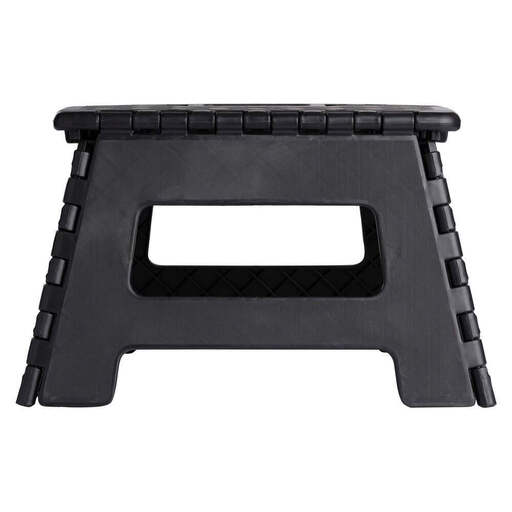
Why it is suitable: For occasional tasks in the kitchen, utility room, garage or while camping, this compact step stool offers a low platform height of 22 cm.
The folded dimensions are 32 × 4.5 × 35 cm. The 150 kg load limit and the instruction not to use the stool as a substitute for a ladder clearly define its intended use.
PP construction, carry handle, anti-slip standing surface and foldable design. According to the product information, the model is intended for private use.
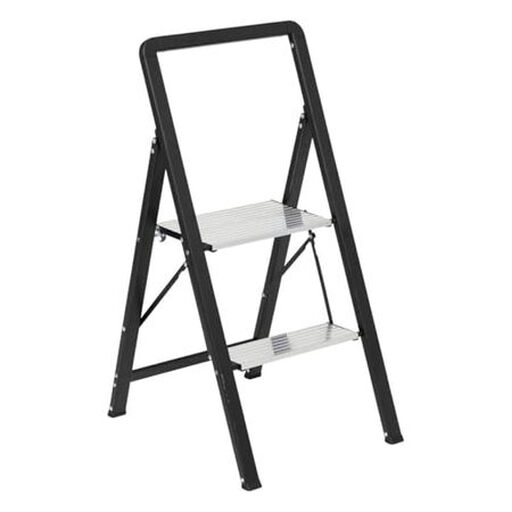
Why it is suitable: This lightweight aluminium model is ideal for anyone who wants to move a two-step access aid regularly between the kitchen, basement and living areas.
A guard rail, locking mechanism, anti-slip steps and feet are listed as specific features. Before use, the surface must still be level and dry, and the joints should be checked.
A net weight of 2.9 kg, a height of 83 cm, a maximum load capacity of 150 kg and a folding design that requires no assembly.

Why it is suitable: This storage ottoman is ideal for the living room, bedroom or hallway when you want seating and organisation combined in a single piece of furniture.
The product information explicitly states a maximum static load of 300 kg. The lid must be fully seated before anyone sits down; the stool is not designated as a step aid.
Interior storage for blankets, cushions or books, MDF panels, reinforced metal corners and foldable storage measuring 38 × 110 × 38 cm.
Our complete selection includes additional folding stools in a range of dimensions and materials, with different load capacities and applications for the home.
Service life depends on the material, frequency of use, load and maintenance. Before every use, check the hinges, locking mechanism, feet and step surfaces for cracks, looseness or signs of wear. Damaged models should no longer be used.
Only if the product is explicitly designed as a step aid or step ladder. A storage ottoman is not automatically suitable for climbing. With a step stool, users must observe the stated height, maximum load capacity and safety instructions.
A folding stool normally consumes no energy during use. Maintenance is generally limited to wiping it with a damp cloth and regularly inspecting the moving parts. Storing it in a dry place can help protect both the material and the mechanism.