For sewing at a shallow table
If your machine, connections and fabric all need to fit on a table with limited depth, the machine’s actual footprint matters more than a high stitch count.


For folk-dance skirts on a shallow table, don’t choose a machine solely because it’s described as ‘compact’. Measure the usable space and check the machine’s full footprint, including cables, foot control and any extension table. Long panels need proper support, while pleats and thick waistband seams call for a test stitch using your actual fabric layers. A mechanical machine may be enough for simple seams. Speed or presser-foot pressure settings can be useful if you often work with changing fabric layers, but they’re no substitute for testing the machine with your fabric.
If your machine, connections and fabric all need to fit on a table with limited depth, the machine’s actual footprint matters more than a high stitch count.
When sewing pleated or gathered skirt panels, you’ll want to sew waistband seams and joins between multiple fabric layers with care.
Long fabric pieces need room to move. An extension table can help, but it also needs to fit on your limited table space.
First, measure the depth of your available table. Then work out how you’ll fit the fabric support, waistband layers and the basic features your pattern requires.
The buying considerations below are for anyone looking for a sewing machine for folk-dance skirts to use on a shallow table.
| What matters when buying | What to check | Who is this especially important for? |
|---|---|---|
| Fitting on a shallow table | Check the usable table space and the machine’s footprint in the position you’ll use it; allow for cables and the foot control too. | If space is limited, I need the machine and its connections to fit on the table. This is the main buying consideration for around 36% of consumers who prioritise table depth. |
| Pleats and multi-layer waistband seams | Check the presser-foot clearance and pressure settings on the specific model, then test it with your own fabric layers. | When pleats and several layers meet at the waistband, I want to try out how the fabric feeds first. Around 29% of consumers prioritise these kinds of joins. |
| Handling long skirt panels | Consider the space in front of and beside the needle, as well as the dimensions of any extension table you might use. | When working with long panels, I want to guide the fabric securely without pulling it at the needle. This matters to around 21% of consumers. |
| A straightforward set of basic features | Make a note of the seams and fastenings you need, then check the stitches, controls and included presser feet for the exact model. | If I mainly want to sew simple skirt seams, easy-to-use controls matter more than a large choice of programmes. Around 14% of consumers put this first. |
A compact description doesn’t tell you whether the machine, its connections and the fabric you’re working with will fit within your available table depth.
Measure your table and work area, and check the machine’s footprint in the position you’ll use it.
A free arm makes certain circular seams easier, but it won’t support a long skirt panel. A compatible extension table may be available as an optional accessory and will need extra space.
Check separately whether an extension table is included, whether it’s compatible and how much room it needs.
These features don’t prove that the machine will handle your particular combination of waistband fabric, interfacing and pleats without difficulty.
Test the layers you plan to sew using offcuts and suitable accessories before relying on the result.
The M30A and 1522 offer different features for a range of sewing tasks. Neither, on its own, confirms that the machine will fit on a particular table.
The N 1235/61 and N 1235 Pro offer different control options within the model range mentioned.
The bernette 35 is a mechanical free-arm machine with three adjustment dials.
The Joybuy models below are domestic sewing machines for basic sewing and hemming. A compact product description doesn’t confirm that a machine will fit your table or suit long skirt panels or folded waistband layers.
 No image available
Could be suitable for simple hems and circular pieces; check first that the fabric support is adequate for your skirt panels.
12 stitch types, single- and twin-needle options, and two speed settings; a sewing kit is mentioned in the product name.
 No image available
The listed uses include simple seams and hems. Testing a sample seam on your own skirt fabric is still important.
The product name lists two speeds, forward and reverse sewing, a foot pedal, hand control, LED light, thread cutter and accessories. The description’s claim of up to six layers applies to lightweight denim, not other fabrics or layers.
 No image available
Could be suitable for simple clothing alterations and repairs; check how it handles fabric before sewing long skirt panels.
The product name lists 12 stitches, dual power supply, LED light, pink colour and accessories.
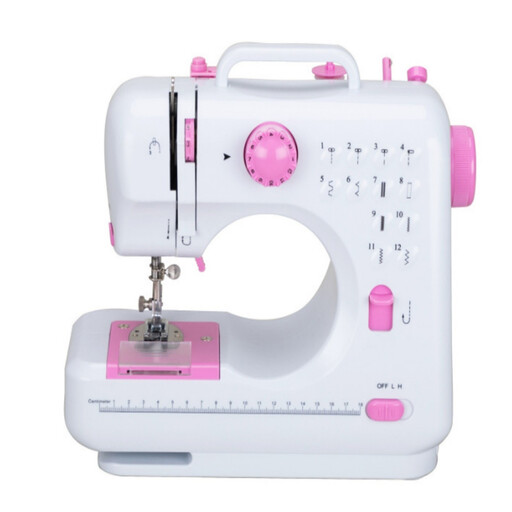 No image available
Could be suitable for hems and simple clothing projects. If you’re sewing pleats or multi-layer waistband seams, test your fabric layers using offcuts.
The product name lists dual power supply, LED light and pink colour.
 No image available
The basic features described may only be suitable for simple household sewing; check them against the seams in your pattern.
The description lists a fixed stitch with no adjustable stitch width or length and no reverse sewing. It also lists a foot pedal and operation from mains power or four AA batteries.
No, not on its own. A free arm makes certain circular seams easier, but you’ll also need to plan how to support and guide long skirt panels. Check whether an extension table will fit on your table, or consider how else you can support the fabric.
First, test the actual fabric layers using offcuts and check the settings on your specific model. Don’t forcefully pull the fabric at the needle: Janome’s guidance warns that this could bend or break the needle. Follow your machine’s instructions for cleaning and safety.
If you’re considering an extension table or specialist presser foot, check that it’s compatible with your model and whether it’s included. For a typical online purchase made by a consumer in Germany, there is generally a 14-day right to cancel from the date the goods are received, as explained by the Verbraucherzentrale. Your statutory rights against the seller and a voluntary guarantee are separate entitlements.
Check the CE marking on the specific machine, the manufacturer’s details and a German instruction manual with any required warnings. The Bundesnetzagentur lists these points in connection with its market surveillance. A CE marking is based on the manufacturer’s own declaration of responsibility; it isn’t an independent quality mark.