First, check whether your amplifier or powered speakers need a phono or line-level output, then plan for a level spot with some space between the turntable and the speakers. If you want to keep things simple while cooking, a fully automatic model could be a good fit. If you prefer to make the adjustments yourself, a manual model is another option, but you’ll need to handle the controls and setup.
Which turntable is right for you?
Listeners with an existing hi-fi system
If you want to listen to folk LPs through powered speakers or an amplifier, check that their inputs match the turntable’s phono or line-level signal. Audio-Technica and Sony describe these connection options for certain models.
Listeners who want music on while cooking
If you want to start a record with minimal fuss and avoid having to return the tonearm yourself at the end, check the automatic functions of the specific model. Sony lists automatic start, stop and return for the PS-LX310BT; Dual describes the CS 329 as fully automatic.
Listeners short on space
If space in your kitchen-diner is limited, plan where the turntable will go and leave some room between it and the speakers. Audio-Technica recommends placing the AT-LP120XUSB on a level surface and advises against positioning it on or near speakers.
What should you look for?
For playing folk LPs in a kitchen-diner, the key things to consider are the right connection, ease of use, a suitable location and future maintenance.
| What matters |
What to check before buying |
Who is it important to? |
| Compatible connection to your system |
Match your system’s input with the turntable’s phono/line output and check the switch setting. |
If I want to use my existing speakers or amplifier, the signal path needs to be compatible. Around 33% of consumers put compatibility with their existing system first. |
| Easy operation |
Check start, stop and tonearm return separately; distinguish between stylus and cartridge replacement. |
If I want to listen to music while cooking without constantly handling the tonearm, I look for specific automatic functions. Around 25% of consumers prioritise ease of use. |
| A suitable location |
Check that the intended spot is level and leaves some space between the turntable and speakers. |
If there’s little free space in my kitchen-diner, I need a suitable spot for the turntable that’s still easy to reach. Around 25% of consumers see placement as their main concern. |
| Stylus replacement and maintenance |
Check the exact stylus and cartridge model, as well as which replacement parts are suitable for the device. |
If I want to use the turntable for a long time and replace the stylus later, it’s important to know exactly what can be replaced. Around 17% of consumers put maintenance and compatible replacement parts first. |
Avoiding common buying mistakes
-
Treating a line input as a phono input
Phono and line-level signals use different connections. Some models let you switch the preamp on or off, so the setting needs to match your system’s input.
First check your system’s inputs, then the chosen turntable’s output and switch setting. If your setup doesn’t offer a compatible signal path, you may need a suitable phono preamp.
-
Assuming “automatic” tells you everything
The term alone doesn’t tell you which tonearm functions the specific model handles. Sony lists automatic start, stop and return for the PS-LX310BT.
Check start, stop and tonearm return individually against the steps you’d like to avoid while listening and cooking.
-
Placing the turntable right next to a speaker
For the AT-LP120XUSB, Audio-Technica notes that vibration and sound pressure can have an impact. It recommends a level surface with some space between the turntable and speakers.
Plan where the turntable will go before deciding between a wired or wireless connection. A different location may also mean needing a longer cable.
-
Confusing the stylus with the cartridge
A replaceable stylus doesn’t automatically mean the cartridge can be replaced too. Manufacturer specifications vary by model.
For your chosen turntable, check separately whether the stylus, cartridge or headshell can be replaced.
Brands and models to consider
Audio-Technica
The range includes everything from the automatic AT-LP70XBT to the manually operated AT-LP120XBT-USB.
- According to Audio-Technica, the AT-LP70XBT can be used with other VM95 styli.
- The AT-LP70XBT’s cartridge is integrated into the tonearm. The manufacturer lists adjustable anti-skating for the AT-LP120XBT-USB, but not as a feature across all models.
Sony
The PS-LX310BT is worth considering if you’re looking for automatic start and return, as well as a selectable phono or line output.
- Sony lists automatic start, stop and return, as well as phono and line outputs, for this model.
- According to Sony, the PS-LX310BT’s headshell is not replaceable.
Dual
The CS 329 is an option if you’re looking for automatic tonearm movement and minimal fuss.
- Dual describes the CS 329 as automatically swinging the tonearm into position, lowering it and lifting it again.
- A spare parts list covers certain model ranges; it doesn’t mean that every part will always be available for every model.
Technics
According to Technics, the SL-1500C is designed for a wired hi-fi system and has an integrated phono equaliser.
- Technics lists a supplied cartridge and a built-in phono equaliser.
- These are manufacturer specifications, not an independent assessment of sound quality.
Pro-Ject
The Debut Carbon EVO is a manually operated alternative for listeners who want to position the tonearm themselves.
- Manual operation can suit a more hands-on listening experience.
- Check the specifications of the specific model and allow for the steps you’ll need to take during setup and operation.
Turntables at Joybuy
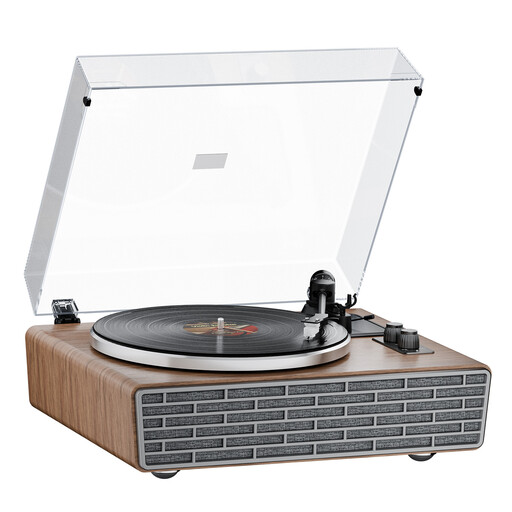
This selection includes fully automatic turntables and models with built-in speakers. Before choosing, check whether you want to connect your existing system or listen without it.
 No image available
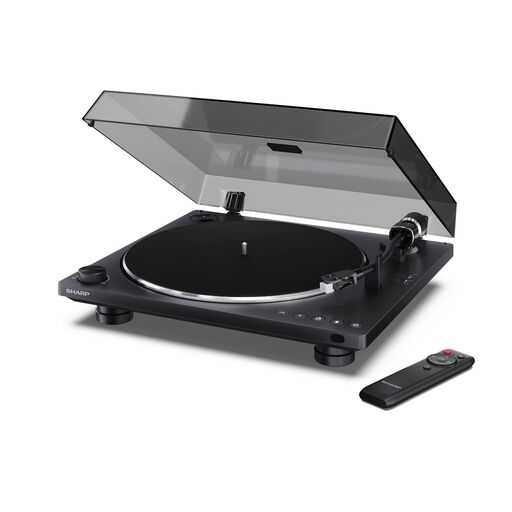
SHARP RP-TT95 Bluetooth Turntable
Fully automatic operation is a good fit if you want to keep handling to a minimum when putting on a record and when it finishes.
Bluetooth connects to compatible speakers or headphones; RCA outputs have a phono/line setting. The product title mentions USB-C recording and an Audio-Technica cartridge.
View at Joybuy
 No image available
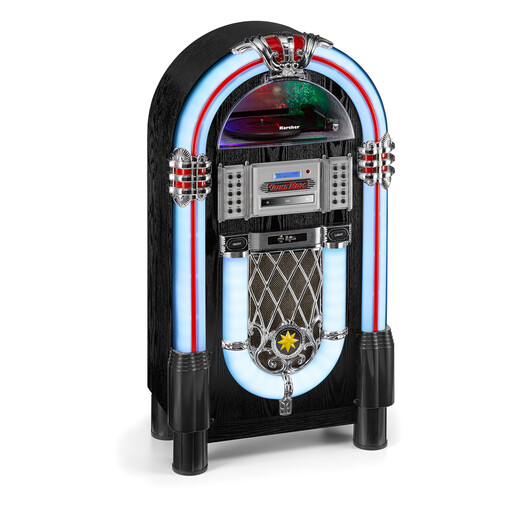
KARCHER 6608D Jukebox with Turntable
The built-in stereo speakers let you play records without separate speakers.
According to the product description, the turntable supports 33, 45 and 78 U/min. It also lists CD, DAB+/FM radio, and USB and SD card playback.
View at Joybuy
 No image available
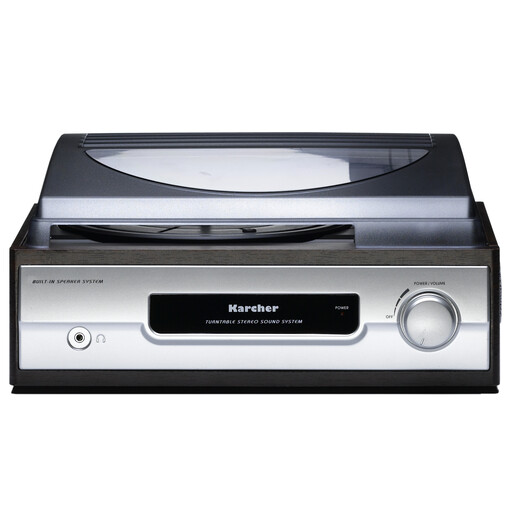
KARCHER KA 8050 Retro Turntable
The built-in stereo speakers let you listen without separate speakers.
Features include auto-stop, a headphone socket and an RCA line output. Dimensions are 32 × 28 × 14 cm.
View at Joybuy
 No image available
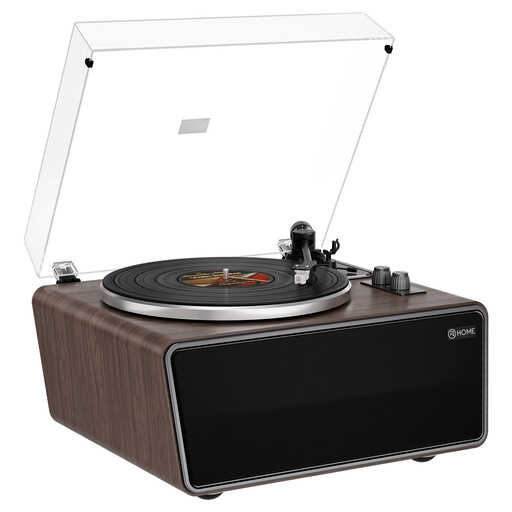
XJ-HOME XJ-H01 All-in-One Turntable
Four built-in speakers let you listen without separate speakers.
Features include an AT-3600L-MM cartridge, phono/line RCA outputs, and playback at 33 1/3 and 45 U/min.
View at Joybuy
 No image available
XJ-HOME XJ-H02 Bluetooth Turntable
The four built-in speakers let you listen without separate speakers; Bluetooth is also included.
The product description lists an AT-3600L cartridge, RCA phono and line outputs, and playback at 33⅓ and 45 U/min.
View at Joybuy
Frequently asked questions
Do I need a phono preamp as well as a turntable?
It depends on your system’s inputs and the output of the specific turntable. Switchable phono/line connections are documented for the Sony PS-LX310BT and Audio-Technica AT-LP70XBT. Before connecting them, make sure the switch setting matches the input you’re using.
What should I consider when positioning the turntable?
Place the turntable on a level surface and leave some space between it and the speakers. In the AT-LP120XUSB manual, Audio-Technica advises against placing it on or near speakers to avoid the effects of vibration and sound pressure.
How do I keep records and the stylus clean?
Use suitable cleaning tools and follow the care instructions for your specific system. Audio-Technica describes using a brush to remove dust from records and a stylus brush to clear dust and fluff from the stylus.
What are my rights if a product develops a fault after purchase in Germany?
When you buy goods as a consumer, you have statutory rights against the seller if they are faulty. The Verbraucherzentrale outlines the general two-year statutory warranty period and explains how it differs from a voluntary guarantee. Additional rules extending the statutory warranty period have applied to certain repair cases since 31 July 2026. Check separately which conditions apply to your individual case.
Can I put an old turntable in the general rubbish?
No. The German Environment Agency explains that electrical waste in Germany must be disposed of separately and must not go in household rubbish. Find out about the designated collection and return options.


