Who is this choice relevant to?

Listeners with existing passive speakers

If you want to keep using your speakers, compare their impedance and connection requirements with the information in the amplifier’s manual. NAD Electronics Support recommends checking the specifications for the specific model.

Listeners with a regular listening spot

If you listen closely to vocals and acoustic instruments, speaker positioning and your listening spot play an important role in an open-plan room. Genelec points out that room acoustics and speaker placement affect what you hear from your listening spot.

Listeners with several music sources

If you switch between streaming, CD and vinyl, check that each source has a suitable input and that the specific model explicitly supports the features you need. Bluetooth, a digital input and built-in network streaming are different ways of playing music.

What should you look for when buying?

Traditional stereo integrated amplifier

A good fit if: Your passive speakers and existing source devices are compatible with the connections on the specific model.

The trade-off: Digital inputs or Bluetooth don’t necessarily mean that network streaming is built in. Yamaha lists optical and coaxial inputs on the A-S301, while Denon lists Bluetooth and MM phono among the features of the PMA-600NE.

Streaming stereo amplifier

A good fit if: You want to use your passive speakers mainly with supported network services, without setting up a separate streaming device.

The trade-off: Check each service and input you want individually. The WiiM Amp Pro lists HDMI ARC and a line input; the line input is not specified as an MM phono input.

What matters What to check when buying Who it matters most to
Speaker compatibility Compare the impedance and connection requirements of your speakers and amplifier in the respective manuals. If I want to keep my passive speakers, it’s essential that their requirements are compatible with the specific amplifier. Around 31% of consumers put speaker compatibility first.
Listening spot and room Decide where you could position the speakers and choose a main listening spot; assess room calibration features afterwards. If I want to assess vocals and instruments from my listening spot in an open-plan room, I pay particular attention to speaker placement and reflections. Around 25% of consumers prioritise the room and listening spot.
Music sources Make a note of the services and source devices you need, then check the inputs and controls on the exact model. If I play music from several digital or analogue sources, I want the connections and playback features to suit my devices. Around 19% of consumers put music sources first.
Quiet or private listening If needed, check for a headphone socket and easy operation at low volume; follow applicable rules and the terms of your tenancy or building. If I want to be considerate in my home or listen through headphones, having a suitable option for quiet or private listening matters to me. Around 13% of consumers prioritise this for home use.
Turntable Check the cartridge type and whether you have a phono preamp; don’t confuse a line input with an MM phono input. If I want to connect my turntable, I check that the amplifier and cartridge have a suitable phono connection. Around 12% of consumers put vinyl connectivity first.

Common buying mistakes

  • Choosing by the highest wattage alone

    Power ratings are only comparable when you also take impedance and measurement conditions into account. A single wattage figure doesn’t tell you whether the amplifier is compatible with your speakers.

    Compare the full power-rating conditions and speaker specifications in the manuals for both devices.

  • Assuming Bluetooth, a digital input and network streaming are the same thing

    These features represent different ways of playing music. The services and inputs available depend on the specific model.

    Check each service and input you want individually, and look for the full model name. The NAD C 3030 and C 3030S are different models.

  • Mistaking a line input for an MM phono input

    A turntable without a suitable built-in preamp needs an appropriate phono connection. A line input is not automatically an MM phono input.

    Before buying, check which cartridge and preamp your turntable uses.

  • Treating room correction as a substitute for good speaker placement

    Speaker position, reflections and your listening spot all affect playback. Genelec points out that calibration may not fix every acoustic issue.

    First, check possible speaker positions and choose a listening spot; then consider calibration features as an additional adjustment option.

Key brands at a glance

Yamaha

The A-S301 is a traditional integrated amplifier for compatible analogue or digital source devices.

  • Yamaha lists optical and coaxial inputs, adjustable loudness and 2 × 60 W RMS at 8 Ω over 20 Hz–20 kHz.
  • These specifications don’t confirm built-in network streaming or guarantee a particular sound in your own living space.

Denon

The PMA-600NE combines a traditional amplifier design with digital inputs, Bluetooth and MM phono.

  • Denon lists 45 W per channel at 8 Ω, as well as Bluetooth and MM phono.
  • Bluetooth isn’t the same as built-in network streaming, so check that the inputs suit your sources.

WiiM

The Amp Pro is a compact network amplifier for passive speakers and supported streaming services.

  • WiiM lists features including 60 W per channel at 8 Ω, HDMI ARC, a line input, EQ and room correction.
  • The line input is not specified as an MM phono input. Room correction doesn’t replace checking speaker position and your listening spot.

Cambridge Audio

The AXA35 is aimed at listeners looking for an integrated amplifier with an analogue focus and a phono input.

  • Cambridge Audio lists 35 W per channel and a phono input; its support page specifies 8-Ω speakers.
  • According to Cambridge Audio, the USB socket on the back is for charging only. Connecting a Bluetooth adapter won’t make the amplifier Bluetooth-enabled.

Marantz

The PM6007 combines an MM phono input with analogue, optical and coaxial digital inputs.

  • Marantz lists 45 W per channel at 8 Ω over 20 Hz–20 kHz and an MM phono input.
  • The manufacturer’s overview doesn’t list HEOS or HDMI for this model.

NAD

The C 3030 offers connections for music and a TV, as well as a headphone socket.

  • NAD lists Bluetooth, phono, HDMI eARC, a headphone socket and a managed subwoofer output.
  • The C 3030 is different from the separately named C 3030S, which also offers BluOS.

Joybuy product selection

This Joybuy product selection is for listeners who want to use passive speakers with a compact stereo amplifier and Bluetooth or RCA playback.
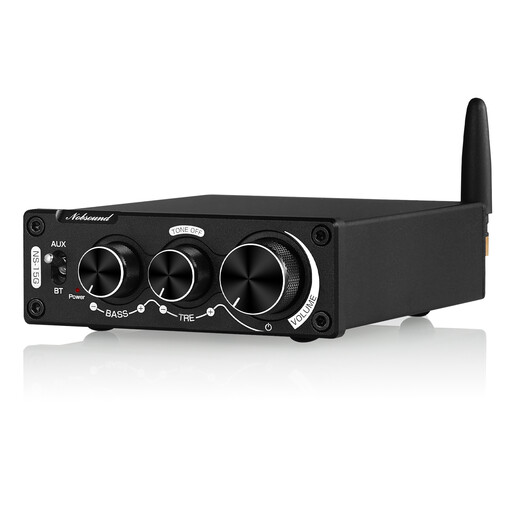
Nobsound 200 W mini Bluetooth digital amplifier for stereo speakers

Nobsound 200 W Mini Bluetooth Digital Amplifier

May be suitable for compatible passive speakers and playback over Bluetooth or from a wired RCA source device.

Specified for speakers with 4–8 Ω impedance; check that your speakers are compatible before connecting them.

The product description lists Bluetooth 5.0, stereo RCA inputs, 2.0-channel operation, and bass and treble controls.

The stated dimensions are 92 × 108 × 30 mm. The warning advises using only the supplied compatible power adapter.

View at Joybuy

Frequently asked questions

Can I connect my existing speakers to any stereo amplifier?

Not necessarily. Compare your speakers’ impedance and connection requirements with the information in the manual for the specific amplifier. For example, Cambridge Audio specifies 8-Ω speakers for the AXA35.

What’s the difference between a streaming amplifier and a traditional integrated amplifier?

A streaming amplifier can provide access to supported network services directly, while a traditional integrated amplifier needs to work with compatible external source devices and its specified inputs. Check the services and connections you want on the exact model; Bluetooth alone doesn’t mean network streaming is built in.

Can room calibration help if vocals sound unclear from my listening spot?

It can offer an additional way to adjust the sound, but it won’t necessarily solve every room issue. First, check speaker position, your listening spot and reflections; Genelec describes these as factors that affect what you hear.

Can I connect a turntable to a line input?

It depends on whether your turntable already outputs a suitable pre-amplified signal. A line input is not an MM phono input, so check your cartridge and whether you have a phono preamp before choosing an amplifier.

Are quiet hours for music the same in every home in Germany?

No single specific time applies to every home. For neighbour noise caused by people’s behaviour, the German Environment Agency refers to rules set by federal states and local authorities, as well as building regulations. Check which rules apply where you live.