Folk listeners with a regular listening spot
You want to hear how vocals and acoustic instruments are placed in the soundstage, and you can position two speakers to suit your seat.


For focused listening to vocals and acoustic instruments from one main listening position, a separate stereo pair is the better starting point, provided you have space for two speakers and the necessary connections. If you move between your living and dining areas, or space is limited, a single connected speaker may be more practical. In either case, check the signal path, positioning and volume at the places where you actually listen.
You want to hear how vocals and acoustic instruments are placed in the soundstage, and you can position two speakers to suit your seat.
You also listen as you move between the living and dining areas. That makes speaker placement and the sound at the spots you actually use more important than a general room-size recommendation.
You may want to start with a compact streaming speaker, or prefer an active pair without a separate amplifier. The connections available and the option to expand your setup later will help you decide.
The key considerations are where you listen and how your music source connects to the speaker. Think about your preferred listening spot as well as any other places you use regularly.
| Consideration | What to check when buying | Most relevant to |
|---|---|---|
| Vocals and stereo soundstage | Check whether you can position two speakers separately and how they’ll be placed in relation to your listening spot. | If I mostly listen to folk music in one spot, I want to hear the vocals and instruments positioned to my left and right. Around 31 % of consumers would put the stereo soundstage first. |
| Positioning in an open-plan space | Consider the available surfaces and sockets; with two speakers, check how they connect and how far apart they need to be. | I want to listen from both the sofa and the dining table, so I need to find suitable places for the speakers. Around 25 % of consumers would prioritise positioning in an open-plan space. |
| Music source and connections | Check that your source’s signal path is compatible with the connections and streaming services supported by the specific model. | If I want to play music from devices I already own, I need a compatible signal path. For around 19 % of consumers, how they connect their source would be the main consideration. |
| Volume and consideration for others | Check how easily you can adjust the volume and, where available, the sound settings. | I want to be able to control the volume in my home, particularly when other people are nearby. Around 13 % of consumers would put consideration for others first. |
| What’s included and accessories | Check whether the offer includes one speaker or a pair, and whether you’ll need accessories for your source or speaker positioning. | If I’m planning a complete setup, I want to know what equipment and accessories I’ll need. Around 12 % of consumers would consider what’s included first. |
A single speaker doesn’t offer the same separate positioning as a pair. If you’re using an analogue source, you may also need to buy a separate Line-In Adapter for the Sonos Era 100.
Decide whether you need one speaker or two, which source you want to connect and how far apart the speakers should be.
According to KEF, the two speakers in the KEF LSX II LT are connected to each other by a cable. So a wireless music connection doesn’t necessarily tell you how the speakers connect to one another.
Check the specific model to see where the power connections are and what connection is required between the speakers.
Room acoustics and speaker placement affect what you hear from the sofa or dining table. A power rating doesn’t describe how music will sound at your particular listening spot.
Try familiar recordings at your usual volume in the places where you actually listen.
With the LSX II, LSX II LT and LS50 Wireless II, KEF offers active speaker options for separate stereo setups.
The Era 100 is a compact connected speaker that you can pair with a second Era 100 if you want.
The R1280DBs is an active speaker pair for anyone considering Bluetooth and direct inputs.
The Authentics 300 is a portable single speaker with Wi-Fi, Bluetooth and a built-in battery.
The SC-CX700 is an active Hi-Fi stereo system for buyers looking to bring streaming together with other music or TV sources.
This selection includes Bluetooth and stereo speakers, a passive speaker pair and a soundbar as an alternative setup.
 No image available
An option if you’re looking for a portable stereo setup with Bluetooth or a 2,4-GHz station.
The product title mentions Bluetooth, a 2,4-GHz station and stereo playback.
 No image available
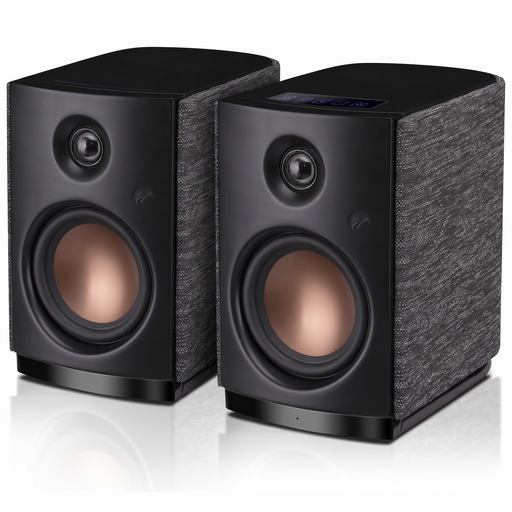
This active speaker pair is worth considering if you’re looking for separate speakers with direct connections for your music sources.
The product title mentions 40W, Bluetooth, HDMI ARC, optical, RCA, AUX and USB inputs.
 No image available
These active bookshelf speakers are an option for a compact stereo setup at home.
The product title mentions Bluetooth 5.0, a 4-inch woofer and 62W RMS.
 No image available
This passive speaker pair suits a separate stereo setup if you already have a compatible amplifier.
The product title mentions 8 Ohm and a recommended amplifier power of 10–120 W. You’ll need a suitable external amplifier to use them.
 No image available
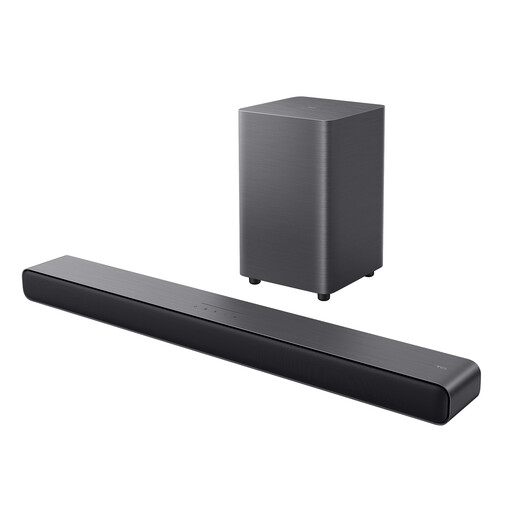
A soundbar could be an alternative if you don’t want to position two separate speakers around your listening spot.
The product title mentions 2.1-channel playback, 220W, Bluetooth 5.3, HDMI eARC, USB and an optical input. The two full-range drivers are built into the soundbar.
Start by positioning them for your preferred listening spot, then check how they sound in places you use regularly, such as the dining table. Genelec explains that room acoustics and speaker placement affect what you hear, so no arrangement can guarantee the same sound everywhere.
For Line-In, Sonos lists a Line-In or Combo Adapter, sold separately. Also check which output your source has; the speaker’s USB-C port doesn’t mean an analogue input is included.
For goods bought from a trader in the EU, Your Europe states that you have at least two years of legal guarantee from the date you receive them. For a typical online distance purchase, you generally have a 14-day cooling-off period. Check the specific terms and distinguish your statutory rights from a manufacturer’s voluntary warranty.
There isn’t one time that applies to every home across Germany. The German Environment Agency notes that rules on neighbourhood noise may be set out in state law, local regulations or house rules. Check the requirements where you live and avoid playing music at a volume that disturbs others.