People with limited kitchen space
During a renovation, you need a space that’s genuinely usable and well ventilated. Compare the dimensions and placement instructions for the specific model rather than focusing only on the number of trays.


First, measure the space you can actually use and check that heat and steam can escape freely. If you regularly dry larger quantities, the stated drying area matters. If space is limited and you only need to dry smaller quantities, a compact stackable dehydrator or a suitable oven you already own may fit your routine better. Temperature controls and a timer can help with planning, but they don’t replace checking the slices.
During a renovation, you need a space that’s genuinely usable and well ventilated. Compare the dimensions and placement instructions for the specific model rather than focusing only on the number of trays.
If you regularly dry larger quantities, compare the usable rack area and how much you can sensibly spread out in each batch. The Federal Centre for Nutrition points out that drying smaller quantities and checking them as they dry are important.
If you need to use your worktop and socket for several tasks during the renovation, temperature and timer settings can make it easier to plan. On their own, though, they don’t tell you when the slices are sufficiently dry.
A good fit if: you have little space available during the renovation and usually dry small to medium quantities. Check the external dimensions, space between trays and whether air can escape freely where you plan to put it.
The trade-off: More trays don’t automatically mean more usable drying area; timer ranges also vary between models.
A good fit if: you regularly dry lots of slices in each batch and have a suitable place to keep the appliance permanently.
The trade-off: A larger drying area takes up more worktop and storage space. It doesn’t guarantee that closely packed slices will dry evenly without being checked.
A good fit if: you only need to dry a few slices now and then, and your particular oven can provide the low temperature and moisture extraction needed.
The trade-off: The Federal Centre for Nutrition describes oven drying with the door slightly open as energy-intensive. Check the manual and make sure the appliance is suitable for the space you plan to use.
| What matters | What to check before buying | Who should pay particular attention? |
|---|---|---|
| Space and positioning | External dimensions, access to a socket, and the placement and ventilation instructions for the specific model. | During the renovation, I want to know whether the appliance will fit in the space I have in mind and whether heat and steam can escape freely. Around 36% of consumers put available space and safe positioning above all else. |
| Usable area per batch | Compare the dimensions of the supplied racks and the space between trays with the usual quantity of evenly sliced fruit you plan to dry. | If I regularly dry lots of slices, the area where I can lay them out with enough space between them matters to me. Around 29% of consumers say batch size is their top priority. |
| Temperature and running time | Check the temperature range and increments, as well as the timer limit and how the specific model switches off. | When I’m sharing kitchen time, I want to be able to plan the drying process without relying on the timer alone. Around 21% of consumers put predictable operation above all else. |
| Cleaning and storage | Check whether the racks can be removed and what cleaning method the manual recommends. Once cool, store dried food in a dry, dark and airtight place. | After drying, I want to remove any fruit residue easily and store the slices appropriately. Around 14% of consumers put cleaning and subsequent storage at the top of their list. |
The number of racks alone doesn’t tell you how much usable drying area there is. Air circulation is also important for citrus slices. Extra batches can also mean the appliance takes up precious kitchen space for longer.
Compare the stated drying area and space between trays with the amount you usually dry, rather than looking only at the number of levels.
If there isn’t enough room for all the slices to be laid out properly at once, you may need to dry extra batches, taking up the space for longer.
The instructions for the Rommelsbacher DA 350 require heat and steam to escape freely and warn against placing the appliance beneath furniture that is sensitive to heat or moisture. Don’t assume these requirements apply to other models without checking.
Measure the space you have in mind and read the placement instructions for the exact model you’re considering.
If the space you have in mind doesn’t meet the ventilation requirements, you may need to find somewhere else to put the appliance.
Drying time depends on factors including the size and thickness of the slices. Setting a running time doesn’t, on its own, confirm that the food is sufficiently dry.
Slice the fruit as evenly as possible and check it while it dries. Let it cool before storing.
Depending on the size of the slices and how the drying progresses, you may need to dry them for longer.
The DA 350 and DA 650 differ in their stated drying area and features.
According to the manufacturer, the DH 450 is a stackable food dehydrator with adjustable temperature and a timer.
According to the manufacturer, the KÜCHENminis Snack to go food dehydrator has a compact design.
The stainless steel food dehydrator with six separate trays is worth considering if you’re comparing models where each rack can be loaded separately.
This selection includes food dehydrators whose product details mention drying fruit. Compare the listed features with the space you have, the batch size you usually need and the placement instructions for each model.
 No image available
The product details list fruit as suitable for drying and include eight racks for drying multiple slices per batch.
650 W; temperature settings from 35–85 °C; timer up to 48 hours; touch display.
 No image available
The product details list fruit as suitable for drying and include ten trays for larger batches.
850 W; adjustable temperature; timer up to 48 hours; ten presets.
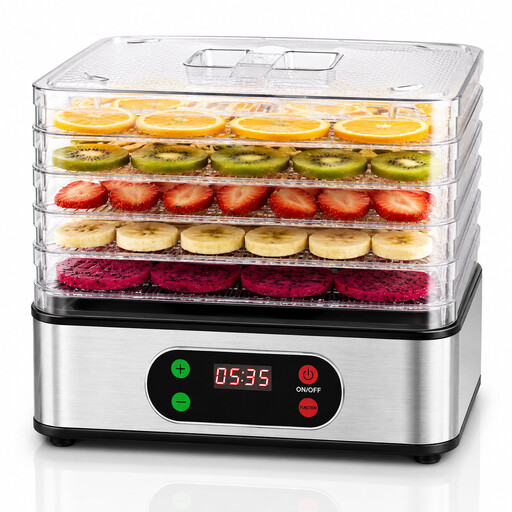 No image available
The product description lists fruit as suitable for drying; you can set the timer to help plan the process.
350 W; timer from 0,5 to 72 hours in 30-minute increments.
An oven may be an option for small quantities dried occasionally, provided your particular appliance can maintain low temperatures and extract enough moisture. The Federal Centre for Nutrition describes drying at 40–50 °C with the door slightly open, but says this method is energy-intensive. Check your oven’s manual.
That depends on the placement instructions for the specific model. The manual for the Rommelsbacher DA 350 warns against placing it beneath furniture that is sensitive to heat or moisture and requires heat and steam to escape freely. Don’t assume these instructions apply to other models without checking.
Don’t rely on the timer alone; check the slices as they dry. The Federal Centre for Nutrition suggests that dried food can still be slightly pliable, but no juice should come out when it’s pressed firmly. Let the slices cool and store them in a dry, dark and airtight place. This isn’t a guarantee of a specific shelf life for citrus slices.
For using citrus peel in cooking or baking, the consumer advice centre recommends organic fruit and advises washing it. It explains that ‘untreated’ doesn’t mean no pesticides were used while the fruit was growing.
Parts intended to come into contact with food must meet EU requirements for food contact materials, including Regulation (EC) No 1935/2004. Electrical appliances must also comply with the relevant requirements. The Federal Network Agency points out that the CE mark and required manufacturer information are mandatory. The CE mark is not an independent quality seal. Check the information on the specific appliance.