Start by choosing a food dehydrator based on the space you have and the usable rack area for your citrus slices. If you plan to use it regularly, a stackable model can provide several racks without taking up much space. For the occasional small batch, a suitable oven may be an alternative. Air circulation, temperature control, a timer and checking for residual moisture are also important.
Who is a food dehydrator suitable for?
Small kitchen, regular drying
If you want to dry citrus slices regularly, compare the appliance’s external dimensions with the space available and check how much usable rack area there is for your slices. Rommelsbacher publishes specific external dimensions and a total drying area for the DA 350.
Controlled drying for drinks and food
If you want slices to dry as evenly as possible, pay attention to how thickly you cut them, air circulation, and whether you can set the temperature and running time. The University of Minnesota Extension highlights air circulation and low heat as important factors in drying.
Occasional small batches
If you only dry a few slices now and then, check whether your oven can provide low temperatures and sufficient air circulation. This can help you decide whether another kitchen appliance suits the way you’ll use it.
What should you look for when buying one?
First compare the space available and the rack area with the amount you usually dry. Then check the temperature controls, cleaning requirements and how often you’ll use the appliance.
| What matters when buying |
What to look for |
Who is it important to? |
| Space and rack area |
Check the external dimensions against the space you have, and assess the usable area of each rack separately. What matters is how many slices can fit with space between them. |
If I regularly dry citrus slices in a small kitchen, I want to know whether the appliance and my usual batch are a good fit. Around 36% of consumers put space requirements first. |
| Even drying |
Compare the temperature controls, timer and air circulation. Cut the slices as evenly as possible and check for residual moisture before storing them. The University of Minnesota Extension highlights slice thickness and air circulation as important factors in drying. |
If evenly dried slices matter to me, I want to be able to control the temperature and check the drying results. Around 29% of consumers prioritise controlled drying. |
| Cleaning and handling |
Check the rack material and whether the racks can be removed. The permitted cleaning method depends on the instructions for the specific appliance. |
If I need to remove damp fruit from the racks after drying, I look for an appliance that’s easy to handle and suits the way I clean in my kitchen. Around 21% of consumers put easy care first. |
| Use and costs |
Consider how often you’ll use it, the actual running time and your electricity tariff separately. A wattage rating is not the same as measured electricity use per batch. The University of Minnesota Extension notes in general that oven drying often takes longer and uses more energy; this is not a measurement for your oven or for citrus slices. |
If I only dry small batches occasionally, I want to weigh up the cost of buying and running another appliance against using my oven. Around 14% of consumers prioritise cost and frequency of use. |
Common mistakes when buying and drying
-
Assuming compact means enough drying space
The external dimensions don’t tell you how many citrus slices will fit on the racks with space between them. A small footprint could mean you need to run extra batches to dry the amount you want.
Check the space available, the rack area and the size of your usual batch separately before choosing an appliance.
If there isn’t room for all your slices at once with space between them, you may need to run extra batches, keeping your worktop occupied for longer.
-
Confusing rated power with the electricity used for a batch
The 350 W power rating given for the Rommelsbacher DA 350 is not a measured figure for the electricity used to dry a batch of citrus. Actual running time and power consumption are among the factors that matter.
To estimate your own costs, multiply the measured kilowatt-hours per batch by your price per kilowatt-hour.
-
Assuming “untreated” automatically refers to the peel
The Verbraucherzentrale points out that “untreated” may refer to treatments applied after harvesting and does not rule out treatments during growing.
If you want to use the peel, the Verbraucherzentrale recommends organic citrus fruit for culinary use. Wash the fruit before slicing.
Key brands at a glance
Rommelsbacher
The DA 350 is a stackable option, with stated dimensions and drying area that you can compare directly with the space available.
- Rommelsbacher lists five height-adjustable trays, a drying area of 0,42 m², a temperature range of 35–75 °C, a 36-hour timer and external dimensions of 31,50 × 33,70 × 25,30 cm for the DA 350.
- You’ll need to judge whether the racks are large enough for your slice size and batch. These specifications don’t demonstrate any particular advantage for drying citrus fruit.
WMF
The KÜCHENminis Snack to go food dehydrator is a stackable option that the manufacturer describes as compact.
- WMF lists five racks, a temperature setting of 30–70 °C and a timer of up to 24 hours.
- The compact description is no substitute for checking the external dimensions and usable rack area against your available space and usual batch size.
Stöckli
The Dörrex range is an option for shoppers comparing adjustable temperature settings and different rack designs.
- For model 0076.70M, Stöckli lists three metal racks, a 12-hour timer and a diameter of 33,50 cm.
- Check the specifications for the exact model number you’re considering; details for different versions aren’t necessarily interchangeable.
Graef
With the DA506 and DA510, Graef offers pull-out tray models as an alternative design to stackable food dehydrators.
- Graef’s manufacturer shop lists the DA506 with six trays and the DA510 with ten.
- The number of trays alone doesn’t tell you whether an appliance will fit in a small kitchen. Check the external dimensions and the drying area you need separately.
Food dehydrators at Joybuy
The Joybuy products below are food dehydrators. For each model, compare the listed settings with your needs and check that the external dimensions are suitable for the space you have.
 No image available
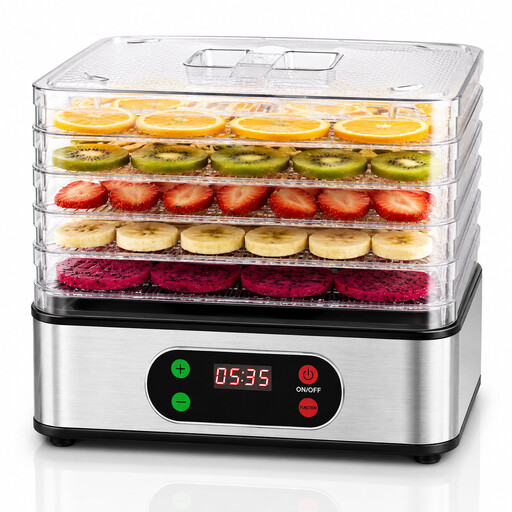
Food dehydrator with LED display, 35–70 °C
The adjustable temperature and timer give you settings to compare with your planned drying time.
Temperature range: 35–70 °C. Timer: 0,5–72 hours in 30-minute increments. Rated power: 350 W. Described as BPA-free.
Joybuy
 No image available
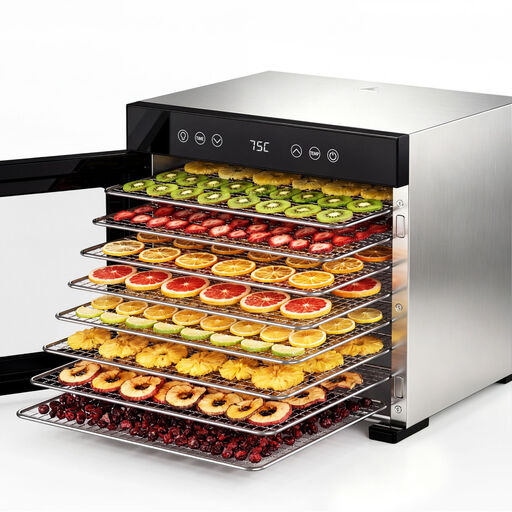
Havenwell food dehydrator with 8 stainless steel racks
The temperature settings and timer are useful features to compare if you want to set the temperature and running time for your planned batches.
8 stainless steel racks. Temperature range: 35–85 °C. Timer: up to 48 hours. Rated power: 650 W. Touchscreen display and interior light.
Joybuy
 No image available
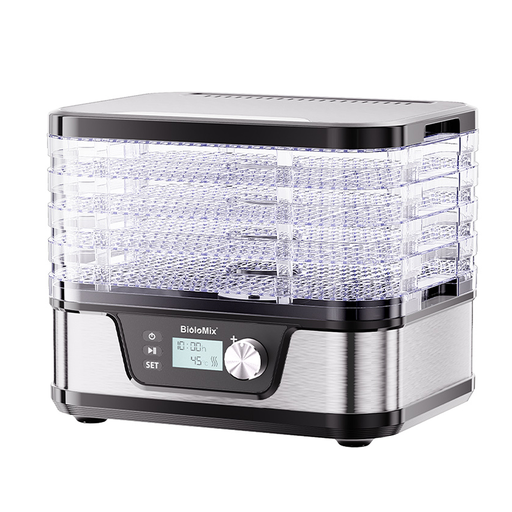
BioloMix BFD1300 food dehydrator
The adjustable temperature and timer give you options to suit your planned drying process.
5 trays. Temperature range: 35–75 °C. Adjustable timer. Described as a 24-hour timer. 360° hot-air circulation listed as an appliance feature.
Joybuy
Frequently asked questions
Can I dry and use citrus slices with the peel on?
If you want to use the peel, the Verbraucherzentrale recommends organic citrus fruit for culinary use. It points out that “untreated” does not rule out treatments during growing. Wash the fruit before preparing it.
How can I tell whether dried citrus slices are dry enough?
Check the slices for residual moisture after drying, as their thickness and moisture content affect drying time. If water condenses during conditioning, dry the pieces again. Utah State University Extension notes that pieces on dehydrator racks don’t always dry evenly.
What are my rights in Germany if the appliance develops a fault after purchase?
The statutory guarantee is generally the seller’s responsibility and lasts for two years from delivery. It is separate from any voluntary manufacturer’s warranty. The Verbraucherzentrale explains this period for statutory claims relating to defects.
Is the CE mark an independent quality seal?
No. According to information from the European Union, the manufacturer uses the CE marking to declare that the product meets the relevant EU requirements. There is no central EU body that generally issues a test certificate for this purpose. Check the details for the specific appliance and the requirements that apply.


