What should you look for when buying?
The percentages below relate to consumers grouped according to their main priority when drying mushrooms in a kitchen with just one hob.
| Priority |
What to look for when buying |
Who is it especially important for? |
| Space for the appliance |
Check the external dimensions against the available space and the installation instructions; allow the clearance needed for ventilation. |
If I have limited worktop space, the appliance needs to fit in a suitable spot with enough room around it. Around 36 % of consumers put finding a suitable space first. |
| Amount of mushrooms per batch |
Compare the total drying area and shelf dimensions of the specific model; check the space between shelves if you’re loading pieces of different thicknesses. |
If I harvest mushrooms regularly or in larger quantities, I want to gauge whether the usable area will suit my batches. Around 29 % of consumers prioritise how much they can dry in one batch. |
| Settings and control |
Check the temperature range and timer of the specific model; inspect the dried food before storing it. |
If I want to plan the process, adjustable temperature and running time are useful – but they don’t replace checking the result. Around 21 % of consumers prioritise control and monitoring of the drying process. |
| Purchase and running costs |
Factor in how often you’ll use it, how easy the shelves are to clean, its actual energy consumption and your electricity tariff. |
If you only dry food occasionally, you may not want another appliance to store or clean regularly. Around 14 % of consumers give greatest weight to the purchase price and ongoing costs. |
Brands to consider
The product ranges below offer different points of comparison for footprint, drying area and settings. The specifications refer to the models listed.
WMF
The KÜCHENminis Snack to go food dehydrator is an option for smaller kitchens and batches. WMF lists five shelves, a temperature range of 30–70 °C and a timer of up to 24 hours.
- Adjustable temperature and a timer are useful for planning a drying cycle.
- The number of shelves alone doesn’t tell you the usable area or the batch size the appliance can handle.
Rommelsbacher
For the DA 350, the manufacturer lists a total drying area of 0.42 m², five shelves and a temperature range of 35–75 °C.
- The stated drying area and height-adjustable shelves give you specific points to compare for larger batches or pieces of different thicknesses.
- The total drying area isn’t the same as the space the appliance takes up; check its dimensions and the clearance it needs.
COSORI
The stainless-steel food dehydrator described on the German manufacturer’s website has six trays.
- The material and number of trays are specific features you can compare for the version described.
- The number of trays alone doesn’t show the usable drying area or prove that it’s suitable for the size of your harvest.
Klarstein
For the Flavour Dry, Klarstein lists six removable racks, a temperature range of 35–75 °C and a timer of up to 24 hours.
- The temperature and running-time specifications help you compare the available settings.
- Check the external dimensions and how much space the specific appliance needs when set up.
Stöckli
F.A.Z. Kaufkompass included the Dörrex 0076.72M in a food dehydrator test; make sure you check the exact version listed.
- The exact model name helps you distinguish the version tested from other Dörrex models.
- Test results for the foods and conditions assessed can’t automatically be applied to every type of mushroom or kitchen.
Food dehydrators at Joybuy
The Joybuy models below are electric food dehydrators with temperature and running-time settings; some also have several tiers. Compare their features with the size of your batches and check that the appliance dimensions will fit your kitchen.
 No image available
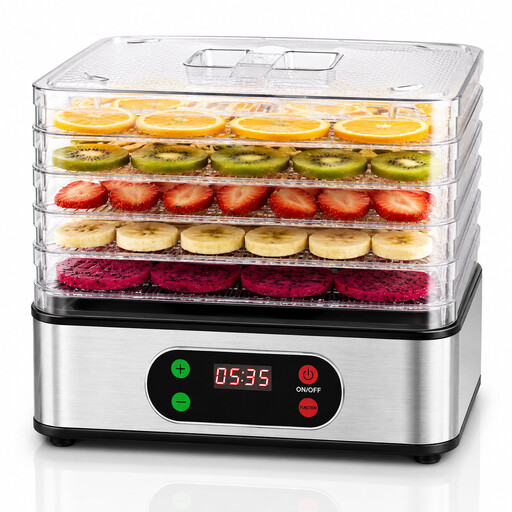
Food dehydrator with LED display, 35–70 °C and timer from 0.5–72 hours
For anyone who wants to set the temperature and running time to plan drying cycles.
The product title lists 35–70 °C, a timer from 0.5–72 hours in 30-minute increments and 350 W. The product description states that there is 3.5 cm between the tiers.
View at Joybuy
 No image available
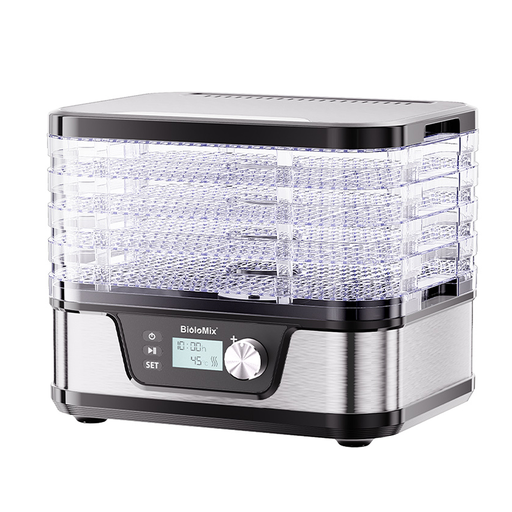
BioloMix BFD1300 food dehydrator
For anyone who wants to use several tiers and adjust the temperature and running time.
The product title lists five trays, 35–75 °C, an adjustable 24-hour timer and 360° hot-air circulation.
View at Joybuy
 No image available
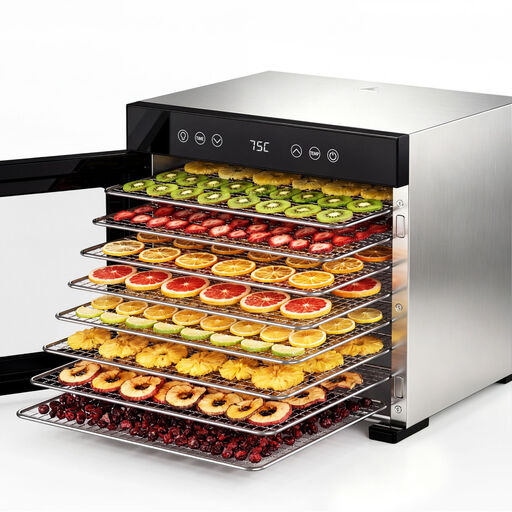
Havenwell food dehydrator with eight stainless-steel racks
For anyone comparing models with several racks and adjustable temperature and timer settings.
The product title lists eight stainless-steel racks, 35–85 °C, a 48-hour timer, a touchscreen display and an interior light.
View at Joybuy
Frequently asked questions
Can a food dehydrator leave your only hob free?
Yes, as long as you have a suitable separate space for it and a power connection that meets the instructions for the specific appliance. Check the external dimensions and installation guidance; having only one hob doesn’t mean you have only one socket.
When can you store dried mushrooms?
Check that the mushrooms are dry before storing them, and keep them somewhere they won’t absorb moisture. The Federal Institute for Risk Assessment lists inadequate drying and improper storage as conditions that can encourage mould growth; setting a timer doesn’t prove that the mushrooms are sufficiently dry.
Does drying make foraged or otherwise unsafe mushrooms safe to eat?
No. The Federal Institute for Risk Assessment warns of the danger of confusing wild mushrooms with poisonous varieties, and the German Society for Mycology points out that even prolonged cooking does not destroy all mushroom toxins. Only use mushrooms that have been positively identified as edible, and follow the preparation requirements for the particular type. Drying is not the same as cooking.
How much does it cost to run a drying cycle?
To work out the electricity cost, you need the actual energy used during the cycle and your tariff; the wattage alone won’t tell you the cost per batch. The Federal Centre for Nutrition generally describes drying food in an oven as energy-intensive, but that doesn’t provide a cost comparison for an individual household.
How should you dispose of an old food dehydrator in Germany?
Electrical waste should be taken to an authorised collection or take-back point, not put in household rubbish. The Federal Ministry for the Environment explains the conditions for retailer take-back: if you’re not buying a new appliance, retailers are required to take back appliances only if none of their external dimensions exceeds 25 cm.


