If you regularly dry small batches of tomato slices, a compact appliance with adjustable temperature and removable parts that are easy to clean is a sensible place to start. For occasional experiments, your existing oven may be enough; the Federal Centre for Nutrition describes it as a tried-and-tested, but energy-intensive, method. More drying space is most worthwhile if you genuinely plan to process larger quantities or other foods, and have room to use and store the appliance.
Which option is right for you?
For small individual portions
If you regularly dry just a few tomatoes for snacks or meals, pay particular attention to the space the appliance takes up and how manageable each batch is. WMF describes its KÜCHENminis model as a compact option with stackable racks.
For regular batches to store
If you dry tomatoes more often, consider temperature control, usable rack area and suitable storage. The National Center for Home Food Preservation recommends letting dried food cool completely before packing it away.
For occasional experiments
If you want to try drying food before deciding whether it suits your routine, your existing oven could be an alternative to buying another appliance. The Federal Centre for Nutrition describes oven drying as a tried-and-tested, but energy-intensive, method.
What should you look for when buying?
Compact food dehydrator
A good fit if: You dry small portions regularly and have a dedicated spot for the appliance.
The trade-off: Each batch is limited in size, so check the usable rack area of the specific model.
Larger food dehydrator
A good fit if: As well as individual portions, you regularly process larger quantities or other foods.
The trade-off: Extra capacity needs space both when in use and when stored away.
Your existing oven
A good fit if: You only want to try drying food occasionally and would rather not buy another appliance.
The trade-off: The Federal Centre for Nutrition describes this method as energy-intensive.
| What matters |
What to check when buying |
Who is this especially important to? |
| Space and batch size |
Compare the appliance dimensions and usable rack area; check how many slices fit on the racks with space between them. |
If I’m only drying a few tomatoes, I don’t want an unnecessarily large appliance, but I still need enough room for my portion. Around 36% of consumers prioritise small batches and a compact footprint. |
| Monitoring the drying process |
Check the temperature control and timer; see whether the racks can be removed for inspection. |
If I want to keep an eye on how my tomato slices are drying, I look for easily accessible controls and racks. Around 29% of consumers put control over the drying process first. |
| Cleaning up after juicy tomatoes |
Check whether the racks and drip trays can be removed, and what the instructions say about cleaning them. |
If juicy tomatoes leave residue during drying, I want to be able to clean the parts easily afterwards. Around 21% of consumers prioritise easy cleaning. |
| Purchase and running costs |
Compare how often you expect to use it with using your existing oven; measure the energy used for one batch in kWh to work out electricity costs. |
If I only plan to dry food occasionally, I want to weigh up whether buying another appliance makes sense for me. Around 14% of consumers focus on purchase and running costs. |
Common buying and usage mistakes
-
Automatically choosing the model with the most tiers for small portions
The number of racks alone doesn’t tell you how much you’ll typically dry. The models described range from five stackable racks to ten drawers.
Before choosing extra capacity, think about how many tomatoes you usually dry and how much space you have available.
A larger appliance may take up more space both on your worktop and in storage.
-
Assuming the timer proves the tomatoes are dry
Drying time depends on factors including the size and thickness of the pieces. A timer alone therefore can’t tell you whether the tomatoes are dry enough.
Check the pieces yourself, let the dried food cool completely before packing it away, and check for moisture during storage. The Federal Centre for Nutrition describes pieces that are slightly pliable and release no juice when pressed firmly as a way to test whether they are dry.
-
Assuming the wattage equals the electricity cost per batch
The stated rated power isn’t a measurement of the electricity used for a complete batch.
Measure the energy used per batch in kWh and compare it with your electricity tariff. The Federal Centre for Nutrition describes drying food in an oven as an energy-intensive method.
-
Storing tomatoes in oil in the same way as dry-packed tomatoes
Tomatoes dried in oil with garlic and/or herbs need to be stored differently from dried food kept dry.
Oregon State University Extension recommends refrigerating this mixture and using it within four days, or freezing it for longer storage.
Key brands at a glance
WMF
The KÜCHENminis Snack to go food dehydrator is described as a compact option for smaller batches.
- According to WMF, the model has five stackable racks, an adjustable temperature of 30–70 °C and a timer of up to 24 hours.
- The advertised space saving is a comparison with similar WMF products; it doesn’t demonstrate any particular efficiency when drying individual portions.
Rommelsbacher
The DA 350 and DA 650 offer different drying areas and numbers of tiers to suit different quantities.
- According to the manufacturer, the DA 350 has five tiers, a stated drying area of 0,42 m², a temperature range of 35–75 °C and a 36-hour timer. For the DA 650, the manufacturer lists seven trays and a drying area of 0,5 m².
- The area figures are supplied by the manufacturer and aren’t independently measured tomato capacities. The DA 650’s larger capacity may not be necessary for small quantities.
Severin
The manufacturer describes the OD 2940 as suitable for drying fruit, vegetables and herbs.
- For particularly juicy tomatoes, Severin recommends draining them before drying or removing the seeds and juice.
- Check the rack area and temperature control of the specific product if these features are important to your choice.
GRAEF
With its stated drying area and number of drawers, the DA510 is more suited to larger quantities.
- GRAEF lists ten drawers and a drying area of 1,08 m²; according to the manufacturer, the drawers can be removed individually.
- Compared with a compact option, ten drawers and the stated drying area take up more space. Check the temperature limits in the instructions for the specific model.
Food dehydrators at Joybuy
This selection includes food dehydrators for vegetables and smaller drying projects; temperature control and running time may vary by model.
 No image available
Havenwell food dehydrator with 8 stainless steel racks
For anyone who wants to dry vegetables and adjust the temperature and running time.
8 stainless steel racks; 650 W; adjustable temperature of 35–85 °C; timer of up to 48 hours; touch display and interior light.
View at Joybuy
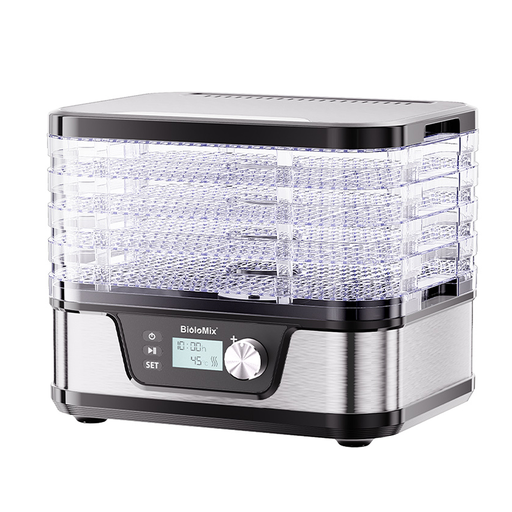 No image available
BioloMix BFD1300 food dehydrator with 5 trays
For anyone looking for a food dehydrator with adjustable temperature and a timer.
5 trays; temperature range of 35–75 °C; timer of up to 24 hours; stated 360° hot air circulation.
View at Joybuy
Frequently asked questions
How should I prepare tomato slices for drying?
Cut the tomatoes into slices of an even thickness if possible, and leave space between the pieces to allow air to circulate. For very juicy tomatoes, Severin recommends removing the seeds and juice where necessary. Check the food as it dries.
How can I tell whether the tomatoes are dry enough to store?
The Federal Centre for Nutrition describes pieces that are slightly pliable and release no juice when pressed firmly as a way to test whether they are dry. Let the tomatoes cool completely before packing them away; the National Center for Home Food Preservation points out that warm food can release moisture inside its container. Check stored pieces for moisture and discard any mouldy food.
Can I store dried tomatoes with herbs or garlic in oil at room temperature?
Oregon State University Extension advises against storing this mixture at room temperature: dried tomatoes in oil with garlic and/or herbs should be refrigerated and used within four days, or frozen for longer storage. This is food safety advice, not a statement about German sales regulations.
How can I calculate the electricity cost of a drying cycle?
Measure the electricity used for the specific batch in kWh and multiply it by your price per kWh. The rated power in watts alone doesn’t show the actual energy used for a complete cycle.
Who should I contact in Germany if my food dehydrator is faulty?
The seller, not the manufacturer, is generally responsible for the statutory warranty. The Verbraucherzentrale states that new goods are covered for two years from delivery. A manufacturer’s voluntary guarantee is separate.


