Hosts with a set mealtime
If you want to serve tomato slices with dinner at a planned time, the key things to consider are how much drying time you have and how dry the slices actually need to be.


If you only slice your tomatoes in the afternoon, a food dehydrator isn’t a reliable way to have fully dried slices ready for dinner: Colorado State University gives a drying time of 6–12 hours for ¼–⅜-inch slices at 60 °C, and you’ll need to check the result. If you can start early, choose a model based on the usable drying area you need, then compare temperature controls, timer, storage space and cleaning.
If you want to serve tomato slices with dinner at a planned time, the key things to consider are how much drying time you have and how dry the slices actually need to be.
If you’re preparing lots of slices, you’ll need enough space to spread them out without overlapping. How many you need for your guests depends on your plans.
If you tend to dry smaller amounts, you can compare compact stackable models based on the space you have and how easy they are to use.
First, work out when you want to eat. Then consider the usable drying area you need, followed by your requirements for controls, storage space and cleaning.
| Consideration | What to look for | Who is this important to? |
|---|---|---|
| Ready in time for dinner | Work out how much drying time you have and check whether the temperature and timer are adjustable. Colorado State University gives a drying time of 6–12 hours for ¼–⅜-inch tomato slices at 60 °C. | If I only slice the tomatoes in the afternoon, I need a realistic timetable and a backup plan for a set mealtime. Around 36% of consumers prioritise serving time. |
| Space for the batch | Compare the tray dimensions and total usable area. Arrange the slices in a single layer and make sure you don’t obstruct the airflow. | For a meal with family or friends, I want to spread out as many slices as possible in one batch, without overcrowding them. Around 29% of consumers prioritise batch size. |
| Control over the drying result | Look for adjustable temperature settings and trays that are easy to access. Check the slices towards the end; a timer alone doesn’t confirm that they’re dry. | I’d rather be able to check the slices individually than have as many tiers as possible. Around 21% of consumers prioritise control over the drying process. |
| Storage space and cleaning | Compare the external dimensions, the number of trays included and the cleaning instructions for the specific model. | For the occasional small batch, I want a model that’s easy to store and has trays that are simple to handle. Around 14% of consumers prioritise space and upkeep. |
For certain thin tomato slices at 60 °C, Colorado State University gives a drying time of 6–12 hours. This isn’t a guarantee for every batch; you’ll need to check how dry the slices are.
Start early and check the slices as they dry. If time is tight, plan to prepare them another way.
Tomato slices should be arranged individually, with enough space for air to circulate around them. The number of tiers alone doesn’t tell you how much usable space you’ll actually have.
Compare the tray dimensions and usable area with the amount you want to prepare.
The German Federal Institute for Risk Assessment warns against storing home-made vegetables in oil, because of the potential risk of botulism.
Store fully dried tomatoes using suitable dry-storage guidance, and don’t make untested preserved tomatoes in oil for storage.
The details below apply to the specific models and versions mentioned, not necessarily to every product from each brand.
The DA 650 is worth comparing for larger batches: Rommelsbacher lists seven trays and a drying area of 0.5 m².
The ED 6 is described as having six stainless-steel trays, each measuring 37 × 30 cm, making it worth comparing for larger batches.
The KÜCHENminis Snack to go is a stackable-tray alternative if compact storage and smaller batches are important to you.
The dörrex with timer and plastic trays, item 0076.70, is a version supplied with three trays.
The following Joybuy models are suited to drying sessions planned well in advance, ranging from a compact appliance to models with several tray levels. Even a high tray count is no substitute for spreading out the tomato slices and checking them as they dry.
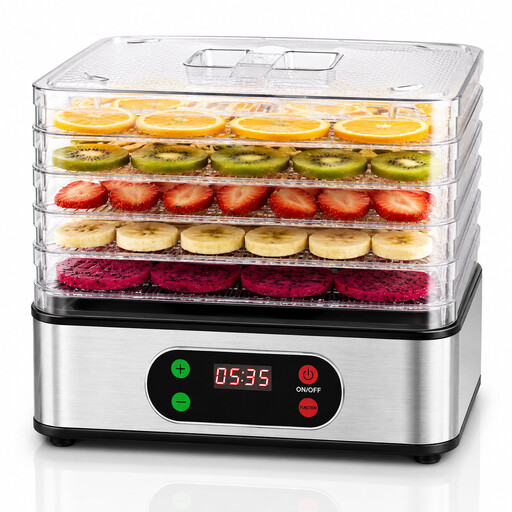 Image unavailable
The compact design suits kitchens where worktop space is at a premium.
The timer can be set from 0.5 to 72 hours in 30-minute increments. The stated temperature range is 35–70 °C; the appliance is also listed as having 350 W of power and removable, dishwasher-safe parts.
 Image unavailable
The ten trays provide several levels for a planned batch. Tomato slices should still be arranged individually, with room for the air to circulate.
Features listed include variable temperature control, a 48-hour timer, ten programmes and 850 W of power.
 Image unavailable
The eight trays provide several levels for a planned batch. It’s still important to space out the tomato slices and leave the airflow unobstructed.
The stated temperature range is 35–85 °C. The product name also lists a 48-hour timer, a touchscreen display, interior lighting and 650 W of power.
You shouldn’t count on it. Colorado State University gives a drying time of 6–12 hours in a food dehydrator for slices around ¼–⅜ inches thick at 60 °C; preparation and cooling take extra time. Start well in advance or plan another way to prepare them for a set mealtime.
Slice the tomatoes evenly and arrange the slices individually on the trays. For this preparation, Colorado State University describes ¼–⅜-inch slices at 60 °C; check them more often towards the end and look for the crisp result described. Let them cool completely before storing.
Don’t treat dry storage and preserving tomatoes in oil as the same thing. The German Federal Institute for Risk Assessment advises against making and storing home-made vegetables in oil for later use in a domestic setting. This risk warning is not a claim that there is a general legal ban.
EU rules on materials that come into contact with food apply to food-contact materials, including food-processing appliances. Electrical appliances covered by the Low Voltage Directive must also meet its safety and market-placement requirements. The European Commission describes the scope as covering appliances operating at 50–1,000 V AC; under Directive 2014/35/EU, distributors must check the CE marking, among other things, before making a product available. This doesn’t tell you how quickly or evenly a particular appliance will dry tomatoes.
Check the electricity used based on your actual drying time, and whether replacement trays are available for the specific model. You can’t work out a general electricity cost from the rated power alone, as the running time also matters. Stöckli sells additional trays separately; the described 0076.70 model comes with three plastic trays.