Those planning ahead
You want to store dried tomatoes for meals on different days, and make sure they’re dry enough to keep well.


For small batches and limited worktop space, a compact stackable dehydrator may be the better choice. If you regularly want to dry more tomato slices at once, give greater weight to drying area and tray access. Adjustable temperature and a timer help you plan, but you’ll still need to check how dry the slices are and store them in a dry, airtight container.
You want to store dried tomatoes for meals on different days, and make sure they’re dry enough to keep well.
You prepare tomato slices regularly and want to keep a close eye on the temperature, air circulation and drying progress.
You dry larger quantities of tomatoes in batches and value usable space and easy-to-handle trays more than having the smallest possible appliance.
| What matters | What to look for | Who is it important to? |
|---|---|---|
| Dry tomatoes to store | A timer and easy-to-reach trays make it easier to check on the drying process. Also make sure you have dry, airtight containers ready. | When I prepare tomatoes for several meals, I want to check how dry they are before storing them. Around 33% of consumers prioritise having dried tomatoes ready to store. |
| Even drying | Look for good air circulation, adjustable temperature and accessible trays. Slices cut to a similar thickness are easier to check. | When I want to dry juicy slices as evenly as possible, the process and being able to check on them matter to me. Around 27% of consumers have this as their main consideration. |
| Drying area per batch | Compare the drying area and number of trays with the quantity you usually prepare, and leave space between the slices for air to circulate. | When I prepare lots of tomatoes at once for future meals, I need enough room for the slices. Around 20% of consumers focus mainly on batch size. |
| Space and ease of use | Measure the space where you plan to use and store the appliance, and check how easy the trays are to load, remove and clean. | When space is limited in my kitchen, I want an appliance that’s easy to position and use. Around 20% of consumers put space and ease of use first. |
Drying time also depends on the size and thickness of the tomato pieces. So when the timer runs out, that doesn’t necessarily mean they’re dry enough to store.
Check the slices before letting them cool and storing them in an airtight container. The Federal Centre for Nutrition says dehydrated food is ready when it’s still slightly pliable and no juice comes out when pressed firmly.
A stated area tells you about the appliance, not how many tomato slices you can dry in one go. The slices need space between them for air to circulate.
Compare the stated area with the batches you usually prepare and leave room between the slices. Larger quantities may need to be dried in several batches as a result.
These mixtures need to be stored differently from tomatoes kept dry.
Store dried tomatoes without oil to begin with. For tomato-and-oil mixtures with herbs or garlic, Oregon State University Extension recommends refrigeration and using them within four days, or freezing them for longer storage.
The DA 350 and DA 650 models have stackable tiers to suit different needs for drying area and running time.
The DA506 is worth considering if you want pull-out trays and a larger stated drying area.
The KÜCHENminis Snack to go is a compact stackable dehydrator for smaller batches.
The manufacturer’s FAQ for the OD 2940 model specifically covers dehydrating juicy tomatoes.
This selection is for anyone who wants to prepare several batches of tomato slices with adjustable temperature and a timer.
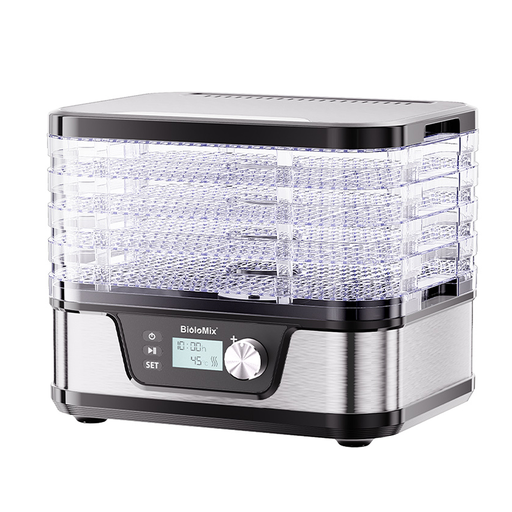 No image available
The five tiers, adjustable temperature range and timer are useful when planning several batches.
Temperature: 35–75 °C.
Timer: 24 hours.
360° air circulation, as stated in the product name.
The Federal Centre for Nutrition says dehydrated food is ready when it’s slightly pliable and no juice comes out when pressed firmly. Cut the pieces as evenly as possible, check them as they dry and let them cool before storing them in a dry, airtight container.
No. For tomato-and-oil mixtures like these, Oregon State University Extension recommends refrigeration and using them within four days, or freezing them for longer storage.
Leave space between the slices for air to circulate, and check juicy slices as they dry. Before buying, check the cleaning instructions for the specific model; stainless steel trays don’t necessarily mean that every part of the appliance is dishwasher-safe.
Your statutory rights against the seller are separate from a voluntary manufacturer’s guarantee. The German consumer advice centre explains the difference; check any additional guarantee terms separately.
Mains-powered appliances covered by the relevant harmonised EU rules must meet the applicable conformity requirements, including the required CE marking. Parts that come into contact with food must meet the relevant EU requirements for food-contact materials. The European Commission and Your Europe explain these rules; CE marking is not an independent quality mark.