If you need the oven for cooking at the same time as others, a separate food dehydrator can dry apple rings independently. The process takes several hours and needs checking, so choose a model based on the space you have, the usable drying area for a single layer and a timer that suits your routine – not just its rated power or a promised finish time.
Who is a food dehydrator suitable for?
People who share a cooking schedule
If others need the oven for meals, a separate appliance lets you run the dehydrator without getting in their way. You’ll need a suitable place to set it up, a timer you can plan around and the ability to check the apple rings. The Federal Centre for Nutrition notes that drying time depends, among other things, on the size and thickness of the pieces.
People who process larger quantities of apples
If you regularly dry lots of slices, check the usable drying area and how easy it is to access the shelves. The Consumer Advice Centre describes drying large quantities in a food dehydrator as a process that takes several hours, and says it’s important to arrange the food in a single layer.
People short on worktop space
If the appliance can only stay on the worktop occasionally, its external dimensions matter, as does how easy it is to store the racks and appliance. Information from manufacturers about stackable tiers can help you compare models; also check that there’s enough room around the appliance to load and unload it.
What should you look for when buying?
First, see how the drying process fits around your shared cooking schedule. Then consider the capacity you need and the space available for the appliance.
| Priority |
What to check when buying |
Who it matters most to |
| Drying cycle and cooking schedule |
Check the timer range and whether the specific model has an automatic shut-off. |
If I need to fit a drying cycle around shared mealtimes, I want to keep the oven free while still being able to check whether the rings are ready. Around 36% of consumers have this as their main priority. |
| Quantity of apples per cycle |
Consider the usable drying area alongside the need to arrange the slices in a single layer. |
If I regularly process lots of slices, I want to know how many will fit in a single layer across the shelves. Around 29% of consumers focus mainly on the quantity they can process. |
| Worktop space and storage |
Check the external dimensions and the space needed to load and unload the appliance; if it has stackable racks, consider where you’ll store them. |
If the worktop is shared, I need a suitable place to run the appliance and a practical way to put it away afterwards. Around 21% of consumers have worktop space as their main priority. |
| Occasional use |
Think about how often you’ll dry food and whether you’ll need the oven for meals at the same time. |
If I only dry apple rings occasionally, I want to weigh up whether my existing oven will suit my routine or whether a separate appliance would be more practical. Around 14% of consumers start by considering this type of use. |
Avoid common buying mistakes
-
Assuming the timer guarantees the apple rings are ready
The set time alone won’t tell you whether the pieces have dried sufficiently. The Federal Centre for Nutrition lists size and thickness as factors; the juice content can also affect how long drying takes.
Slice the rings as evenly as possible, spread them out in a single layer and check how dry they are before storing them. The Federal Centre for Nutrition describes fully dried fruit as slightly pliable, with no juice coming out when pressed firmly.
-
Comparing only the number of racks
The number of racks alone doesn’t tell you how many apple slices will actually fit in a single layer. The external dimensions and access to the shelves also matter in a shared kitchen.
Compare the usable area with the amount you want to lay out per cycle, and check the space available at the intended location.
-
Assuming the wattage tells you how much energy a drying cycle uses
The rated power doesn’t tell you the actual energy consumption of a complete drying cycle.
If energy use matters to your decision, check whether comparable figures are available for a complete cycle rather than estimating consumption from the wattage alone.
Brands and models to help you choose
WMF
The KÜCHENminis Snack to go is a stackable model for kitchens where a more compact appliance is a priority.
- WMF says the model has five stackable racks and a timer of up to 24 hours.
- The manufacturer’s description ‘quiet’ isn’t based on a comparable noise measurement. Make sure the space it needs and the timer range suit your routine.
ROMMELSBACHER
The DA 650 is a shelf-style appliance for buyers looking for multiple trays and a specified drying area.
- ROMMELSBACHER lists seven trays, 0.5 m² of drying area and a timer of up to 99 hours.
- The manufacturer notes that apples dry at different rates depending on their juice content, and that stated times are only a guide.
CASO Design
The DH 450 is a stackable appliance with adjustable-height tiers and a longer timer range.
- CASO Design lists five tiers, a temperature range of 30 to 70 °C in 5-°C increments and a timer from 0.5 to 48 hours. According to the manufacturer, two drying sheets are included.
- These settings don’t guarantee a particular drying time. The slices need to be arranged in a single layer and checked during the process.
GRAEF
The DA510 is a shelf-style appliance for larger quantities, where drying area and easy access to individual shelves are important.
- GRAEF lists ten plastic racks and a drying area of 1.08 m².
- Before setting it up, check that its external dimensions and space requirements suit your kitchen. A larger drying area doesn’t automatically mean a shorter drying cycle.
Stöckli
The Dörrex range includes stackable appliances. Check the specifications for each model rather than assuming they apply to other versions.
- For model 0076.70M, Stöckli lists three metal racks and a 12-hour timer.
- These specifications apply to model 0076.70M and don’t automatically apply to the differently designated model 0076.72M.
Food dehydrators at Joybuy
A food dehydrator with multiple tiers for drying cycles you can plan around. Before buying, check that its dimensions and settings suit your kitchen and routine.
 No image available
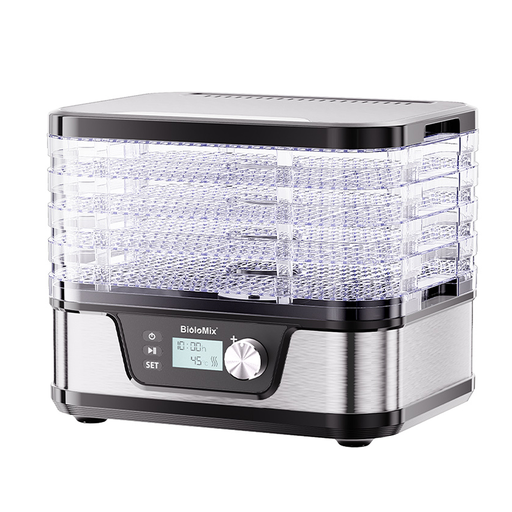
BioloMix BFD1300 food dehydrator, 5 trays
According to the product description, the timer can be set for up to 24 hours, which can help you plan a longer drying cycle.
Five trays; temperature setting from 35 to 75 °C; 360° hot air circulation, according to the product description.
Before buying, check that the drying racks are intended for contact with food and that the appliance meets the relevant electrical requirements. The CE mark is the manufacturer’s declaration that the appliance meets applicable EU requirements, not an independent certification mark.
View at Joybuy
Frequently asked questions
Are the apple rings ready when the timer ends?
No. The timer ending doesn’t confirm that the apple rings are sufficiently dry. The Federal Centre for Nutrition recommends checking how dry they are: fully dried food is slightly pliable and releases no juice when pressed firmly. The thickness and texture of the pieces affect how long they take to dry.
How should I prepare apple rings for an even drying cycle?
Slice the apples as evenly as possible and space the pieces out in a single layer across the tiers. Check their progress and turn the rings if needed; you can’t determine a set drying time from these steps alone.
How should I store dried apple rings?
Store sufficiently dried rings in a well-sealed container. The Consumer Advice Centre recommends storing dried fruit in a well-sealed container; how long a batch you’ve dried at home will keep depends on its condition and how it’s stored.
Which labelling should I look for when buying in Germany?
For electrical appliances covered by the relevant EU regulations, the manufacturer uses the CE mark to declare that the appliance meets applicable requirements; it isn’t an independent certification mark. Drying racks that come into contact with food must meet the requirements applicable to their material. The Federal Office of Consumer Protection and Food Safety says that a statement of intended use or the glass-and-fork symbol should be used as a label where the intended use isn’t already obvious.
Who should I contact if a new appliance is faulty?
The seller is generally responsible for statutory consumer rights. A voluntary guarantee offered by the manufacturer or retailer is separate; the remedy available in an individual case depends on the fault and the relevant legal requirements. The Consumer Advice Centre explains the difference between statutory rights and a guarantee.


