Herb gardeners stocking up for the week
You want to preserve harvested herbs in portions as a dry seasoning for lunches prepared in advance. The right trays, careful monitoring as the herbs dry and suitable storage all matter.


A food dehydrator of your own is most worthwhile if you regularly want to preserve garden herbs as a dry seasoning for several lunch boxes. Choose the design to suit your harvest, available space and tray layout. For small or occasional surpluses, freezing portions may be more practical. Dried herbs are not a like-for-like replacement for delicate herbs you want to use fresh.
You want to preserve harvested herbs in portions as a dry seasoning for lunches prepared in advance. The right trays, careful monitoring as the herbs dry and suitable storage all matter.
You tend to dry smaller quantities and need to decide whether the benefits of an extra kitchen appliance justify the space it takes up.
Sometimes you need space for several layers of herbs or sprigs, but you don’t want to set up an unnecessarily large appliance for a small harvest.
A good fit if: You dry smaller quantities of herbs and have limited space. According to WMF, its KÜCHENminis model has five fine-mesh trays and a temperature setting of 30 to 70 °C.
Bear in mind: Allow space to remove the tiers and check the herbs as they dry.
A good fit if: You switch between flat leaves and taller sprigs. Rommelsbacher lists five adjustable-height tiers, 0,42 m² of drying area and a temperature range of 35 to 75 °C for the DA 350.
Bear in mind: Check how your herbs are drying rather than assuming there’s one set drying time for every type.
A good fit if: Your harvest regularly fills several layers. Graef lists ten plastic trays and 1,08 m² of drying area for the DA510.
Bear in mind: The larger footprint takes up more space and may be unnecessary for small individual batches.
A good fit if: You only have leftover herbs occasionally or prefer to use delicate herbs fresh in your lunches. The Federal Centre for Nutrition also recommends freezing chopped herbs in portions.
Bear in mind: Freezing takes up freezer space. The Federal Centre for Nutrition describes drying herbs in the oven as energy-intensive.
| What you need | What to look for | Who is it important to? |
|---|---|---|
| Dry delicate herbs gently | Check the adjustable temperature range, fine-mesh trays and the instructions for drying each type of herb. | If I want to keep delicate leaves as a dry seasoning, I pay particular attention to the trays and temperature settings. Around 33 % of consumers put herb quality first. |
| Drying area to suit your harvest | Compare the usable area and tier layout with the size of your usual harvest, as well as the space available for using and storing the appliance. | If my harvest varies considerably, I want enough space for several layers without having to set up a large appliance for small quantities. Around 25 % of consumers prioritise having the right amount of drying space. |
| Easy to use as part of your weekly routine | Check whether the trays can be removed and whether the timer and cleaning instructions fit your routine. | If I dry herbs between harvesting and preparing lunch, I want to be able to load them, check on them and put the appliance away easily. Around 25 % of consumers prioritise a straightforward weekly routine. |
| Benefits compared with the effort | Think about how often you actually harvest herbs and whether fresh or frozen-in-portions herbs are enough for your lunches. | If I only have surplus herbs occasionally, I want to know whether having my own appliance is worth the extra space and effort to use it. Around 17 % of consumers put this consideration first. |
Also check that the drying trays are suitable for their intended food contact. The label ‘BPA-free’ alone does not prove that they are.
For herbs, the trays and temperature settings are among the things that matter. Rommelsbacher advises lowering the temperature if the smell becomes too strong while drying herbs.
Compare the temperature range and trays, and follow the instructions for your herbs instead of looking only at the maximum power.
The Federal Centre for Nutrition recommends adding delicate herbs such as basil or parsley shortly before serving. Dry seasoning therefore doesn’t always serve the same purpose as fresh herbs.
Decide based on the lunch dish whether you want a dry seasoning or should use fresh herbs.
A large drying area may be unnecessary for a small, occasional harvest and takes up space all year round.
Estimate the size of your usual harvest and check whether freezing portions would be enough for you.
The KÜCHENminis model is a compact stackable option for smaller quantities of herbs.
The DA 350 combines fine-mesh trays with adjustable-height tiers for leaves and sprigs.
The DA510 is a larger tray-style option for bigger harvests.
The range includes various food dehydrators, including a model with five trays and a stainless steel model with six racks.
In its manufacturer FAQ, Severin specifically describes the OD 2940 as an appliance for drying herbs.
The Joybuy products below are food dehydrators for herbs, with multiple trays or racks. Before buying, check that the trays for your chosen model are suitable for their intended food contact.
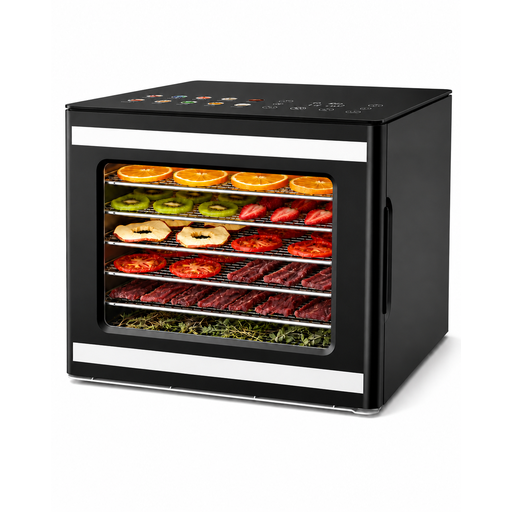 No image available
Six trays give you several levels to spread out herbs for lunches prepared in advance.
Six removable stainless steel trays.
 No image available
Ten trays provide several levels for larger batches of herbs; check first that the appliance will fit in your available space.
Adjustable temperature, timer of up to 48 hours and 10 programmes.
 No image available
Eight drying racks provide space for several layers of herbs; compare the capacity with the size of your usual harvest.
Temperature setting of 35 to 85 °C, timer of up to 48 hours and 650 W.
For a dry seasoning mix, the Federal Centre for Nutrition lists herbs including rosemary, thyme, basil and oregano. According to the Federal Centre for Nutrition, delicate herbs such as basil or parsley are best added shortly before serving. Chopped herbs can also be frozen in portions.
Store dried herbs in an airtight container in a dark place. The Federal Centre for Nutrition recommends using a dark glass jar for a herb mix.
Check that the trays are suitable for their intended food contact. Materials intended to come into contact with food must meet the relevant EU requirements; the label ‘BPA-free’ alone does not prove that they are suitable.
According to the European Union, CE marking is only required for products where relevant harmonised EU rules explicitly require it. The mark is not an independent quality seal and, on its own, does not prove that the drying trays are suitable for herbs.