For small, frequent batches of herbs, look for a compact footprint, fine-mesh trays and an adjustable temperature. If you’re drying a larger harvest, usable drying area and easy-to-handle trays matter more. A timer makes planning easier, but it doesn’t replace checking that the herbs are fully dry or storing them somewhere dry and away from light. The German Federal Centre for Nutrition (BZfE) recommends processing smaller quantities and ensuring good airflow.
Who is a food dehydrator suitable for?
Small herb harvests and limited space
If you regularly harvest small quantities and want to dry them for future meals, a machine that’s easy to store and trays suitable for delicate leaves can be useful. WMF specifies fine-mesh trays for its KÜCHENminis model; the BZfE also suggests freezing chopped herbs as an alternative.
A garden with larger harvests at certain times
If you sometimes have lots of sprigs to dry, check the usable drying area and whether the trays can be arranged to suit what you’re drying. The BZfE recommends drying smaller quantities to ensure good airflow; Rommelsbacher specifies adjustable-height trays for the DA 350.
Delicate leaves and flexible cooking times
If you dry different herbs or small leaves, adjustable temperature settings and suitable trays can make it easier to choose the right setup. WMF and Steba describe these features on their models; the BZfE advises using dried herbs sparingly at first.
What should you look for when buying one?
| What you need |
What to check before buying |
Who should pay particular attention? |
| Drying herbs to suit their needs |
Check the adjustable temperature range and whether the dehydrator has fine-mesh trays or a herb mat. |
If I dry different herbs and small leaves, I want to choose a suitable temperature and tray. Around 36% of consumers prioritise adjustable settings for drying herbs. |
| Room for larger harvests |
Compare the drying area and tray height with your usual harvest; the area alone doesn’t guarantee a particular capacity. |
If I have lots of sprigs to dry at once, I need room to spread them out loosely. Around 29% of consumers prioritise handling larger or variable harvests. |
| Planning the drying process |
Check the timer range and controls; you’ll still need to check the herbs and store them somewhere dry. |
If I’m preparing herbs for future meals, I want to fit the drying cycle into my kitchen routine. Around 21% of consumers prioritise a drying process they can plan around future cooking. |
| Storage space and running costs |
Check the external dimensions; don’t assume the rated power tells you how much electricity a cycle will use. |
If I need to put the machine away between harvests and want to keep an eye on electricity costs, I compare its footprint and energy consumption figures. Around 14% of consumers prioritise a compact design and manageable running costs. |
Common misconceptions
-
Assuming the number of trays guarantees a certain capacity
The number of trays doesn’t tell you how many garden herbs you can dry evenly in one cycle. The BZfE highlights the importance of good airflow and drying smaller quantities.
Compare the usable area and tray height with your usual harvest. Spread the herbs out loosely and check their progress as they dry.
-
Assuming the timer proves the herbs are completely dry
Drying time depends on factors including what you’re drying; a timer doesn’t check how dry the herbs are.
Check the herbs before putting them into storage, and keep fully dried herbs somewhere protected. For a homemade herb mix, the BZfE recommends an airtight, dark glass jar.
-
Converting the rated power directly into electricity costs per portion
The stated wattage doesn’t show the actual energy used for a particular drying cycle.
To compare costs for yourself, you’ll need the measured kilowatt-hours used per cycle and your electricity tariff.
Notable brands and models for herbs
WMF
The KÜCHENminis model is worth considering for small batches and delicate ingredients.
- WMF specifies five fine-mesh trays, a temperature setting of 30–70 °C and a timer of up to 24 hours.
- These features alone don’t confirm that it has enough space for a large harvest or that it operates particularly quietly.
Rommelsbacher
The DA 350 has several height-adjustable trays, making it suitable for drying different types of produce.
- The manufacturer specifies five trays, 0,42 m² of drying area, a tray height of 20 or 40 mm, a temperature range of 35–75 °C and a 36-hour timer.
- The stated drying area doesn’t tell you how many herbs you can process in one cycle.
Steba
The ED 5 is worth considering for small leaves if you’d like a herb mat included.
- Steba specifies a herb mat, five trays, a temperature range of 40–70 °C and a timer from 1–36 hours.
- Its stated temperature range starts higher than those specified for the WMF and Rommelsbacher models. This alone doesn’t guarantee a particular flavour result.
COSORI
The model described combines several trays with an adjustable temperature.
- COSORI specifies five trays, a temperature range of 35–75 °C and a timer function.
- These manufacturer’s specifications don’t prove independently measured drying consistency for herbs.
Severin
The manufacturer also lists herbs as suitable for drying in the OD 2940.
- The manufacturer’s FAQ lists herbs as suitable for drying.
Food dehydrators for herbs at Joybuy
The following Joybuy listings specifically mention herbs as suitable for drying. They differ in features including the number of trays and stated temperature ranges.
 No image available
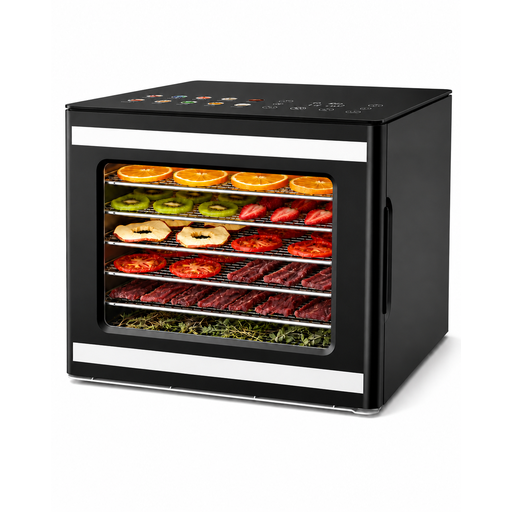
HavenWell food dehydrator with 6 stainless steel trays
An option if you want to dry small to medium quantities of herbs and adjust the temperature.
Six removable stainless steel trays; manual temperature control from 35–75 °C. Stated dimensions: 32 × 33,2 × 25,6 cm.
Joybuy
 No image available
Havenwell stainless steel food dehydrator with 10 stainless steel trays
An option if you want to spread produce across several layers and plan the drying time.
Ten stainless steel trays, variable temperature settings and a timer of up to 48 hours.
Joybuy
 No image available
Havenwell food dehydrator with 8 stainless steel drying racks
An option if you want to use several drying racks and an adjustable temperature range.
Eight stainless steel drying racks, 35–85 °C and a timer of up to 48 hours.
Joybuy
Frequently asked questions
Do I need to buy a food dehydrator for small amounts of delicate herbs?
Not necessarily. The BZfE suggests chopping fresh herbs and freezing them with a little water in ice cube trays. If you specifically want to store dried herbs for seasoning, freezing won’t achieve that.
How should I store home-dried garden herbs for future meals?
Only store the herbs once they’re sufficiently dry. For a homemade mix, the BZfE recommends an airtight, dark glass jar. Its guidance that the mix will keep for “many months” applies to that mix and isn’t a guarantee that every batch will keep for that long.
Can I use the same amount of dried herbs as fresh ones?
Not as a general rule. The BZfE notes that dried herbs often have an intense flavour and recommends using them sparingly at first.
What rights do I have when buying a food dehydrator online?
For distance purchases from a trader, the EU consumer portal generally describes a 14-day cooling-off period from delivery and a minimum two-year legal guarantee from receipt of the goods. The right to cancel and the legal guarantee are separate rights; these rules don’t apply in the same way when you buy from a private seller.
What does the CE marking tell me about an electrical appliance?
According to the European Commission, by affixing the CE marking, the manufacturer declares that the product meets the relevant requirements. It isn’t an independent quality mark for drying performance, so check the marking and documentation for the specific listing.


