Gardeners with delicate herb leaves
If you’re harvesting basil or mint, bear in mind that moist leafy herbs need to dry quickly. Penn State Extension highlights the risk of mould if drying takes too long.


For a small amount of relatively dry herbs, air-drying in a clean, dry, well-ventilated room may be enough. For moist leafy herbs or a larger harvest, a food dehydrator with suitable temperature control and enough usable space is worth considering. The key factors are the conditions in your holiday home, the size of your actual harvest, and the space available to use and store the appliance – more trays alone do not guarantee even drying.
If you’re harvesting basil or mint, bear in mind that moist leafy herbs need to dry quickly. Penn State Extension highlights the risk of mould if drying takes too long.
If you want to dry herbs in your holiday home and store the appliance between visits, measure the available worktop and storage space first. The dimensions of a specific model will help you plan where it can go.
If you have a lot of herbs to process during a short stay, the usable area where you can spread them out loosely is important. Models such as the Rommelsbacher DA 650 have seven trays and 0.5 m² of drying space, according to the manufacturer.
When: If you have limited worktop space and want to dry small to medium quantities quickly, including moister leafy herbs.
Trade-off: Less usable space may mean running several batches. A timer is no substitute for checking how dry the herbs are or storing them in dry conditions.
When: If you have a large amount of garden herbs to process during a stay and enough room to use and store the appliance. The Rommelsbacher DA 650 has seven trays and 0.5 m² of drying space, according to the manufacturer.
Trade-off: The DA 650 takes up space and weighs 6,40 kg, with a footprint of 29 × 43 cm. This can make it less convenient to store, and filling the trays tightly still won’t guarantee even drying.
When: If you have small bunches of less moist herbs, such as thyme or sage, and a clean, dry, well-ventilated place to hang them.
Trade-off: Humid air or water-rich leafy herbs can slow drying and increase the risk of mould. Penn State Extension’s advice cannot account for the conditions in your holiday home.
When: If you want to portion fresh herbs for future meals and have a suitable freezer. Germany’s Federal Centre for Nutrition describes freezing finely chopped herbs with a little water in ice-cube trays.
Trade-off: This method requires freezer space and electricity, and won’t give you herbs that can be stored dry.
Penn State Extension notes that moist leafy herbs can go mouldy if they take too long to dry. Whether air-drying is suitable therefore also depends on the humidity and the space available in your holiday home.
| What you need | What to check before buying | Who is it most important for? |
|---|---|---|
| Drying moist leafy herbs | Temperature range and air circulation; whether you can spread the herbs loosely across the racks. | If I’m drying moist herbs such as basil, I don’t want to leave them for a long time in unsuitable room conditions. Around 36% of consumers would prioritise drying moist herbs. |
| Worktop space and storage | Check the appliance’s dimensions and weight against the available worktop and storage space; if needed, check the cable length and whether the tiers can be stacked. | In a small holiday-home kitchen, I want to be able to position the appliance comfortably while it’s running and put it away afterwards. Around 29% of consumers would make the space it takes up their main buying concern. |
| Processing several harvests | Compare the number and usable area of the trays; make sure the herbs can be spread out loosely and their dryness checked. | If I have a lot to process during a short stay, I need enough room to spread the herbs out separately and loosely. Around 21% of consumers say the size of their harvest is the deciding factor. |
| Purchase and running costs | Weigh up how often you’ll use it and whether you’ll need accessories; to compare electricity costs, use the actual energy in kWh per comparable batch. | If I only have small harvests occasionally, I want to weigh up the cost of buying and running an appliance against the options I already have. Around 14% of consumers would name overall costs as their main concern. |
The number of trays doesn’t tell you how well tightly packed herbs will dry. They need enough air circulation to carry away moisture.
Compare the usable rack area and spread the herbs out loosely, rather than judging an appliance by the number of tiers alone.
Penn State Extension notes that water-rich herbs can go mouldy if they take too long to dry.
Check the room’s humidity and ventilation. If conditions aren’t suitable, choose a method that allows the herbs to dry quickly and follow the appliance instructions.
A figure in watts isn’t the measured energy used to dry a batch of herbs. Running time, how full the appliance is and its controls all affect actual consumption.
Only compare running costs using measured or reliably calculated kWh for a comparable batch.
According to CASO Design, the DH 450 combines several height-adjustable tiers with an adjustable temperature. Its dimensions and weight are useful for planning where to keep it.
According to WMF, the KÜCHENminis Dörrautomat Snack to go is designed for smaller kitchens, with fine-mesh racks that stack on top of one another.
According to Rommelsbacher, the DA 650 is designed for larger quantities, with the drying area listed by the manufacturer.
According to the manufacturer, the Flavour Dry has six removable racks, temperature control and a timer.
Severin lists the OD 2940 in its own FAQ as an appliance for drying fruit, vegetables and herbs.
This selection includes food dehydrators for herbs, from options with just a few trays to models with more tiers and adjustable temperature settings.
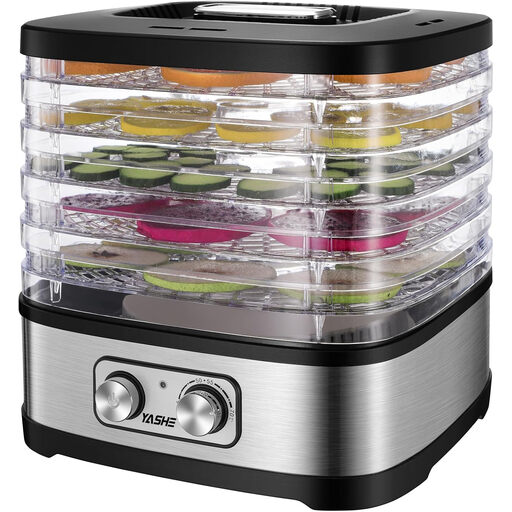 No image available
For drying herbs across several tiers, with an adjustable temperature to suit your harvest.
As listed in the product name: 5 trays; 35–70 °C; 240 W.
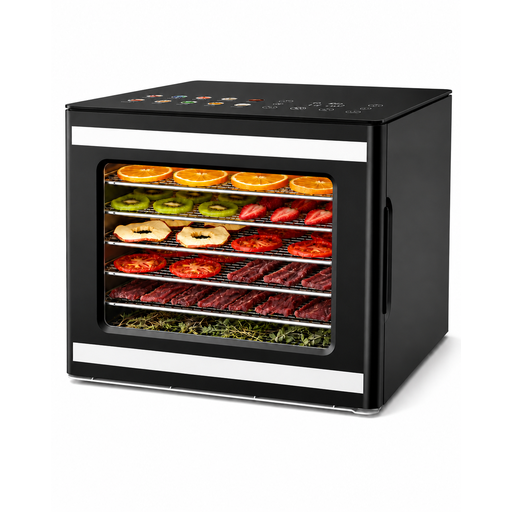 No image available
An option if you want several removable trays for drying herbs.
As listed in the product name: 6 stainless steel trays.
 No image available
For drying several batches of herbs, if you have room for an appliance with ten trays.
As listed in the product name: 10 stainless steel trays; adjustable temperature; 48-hour timer; 850 W.
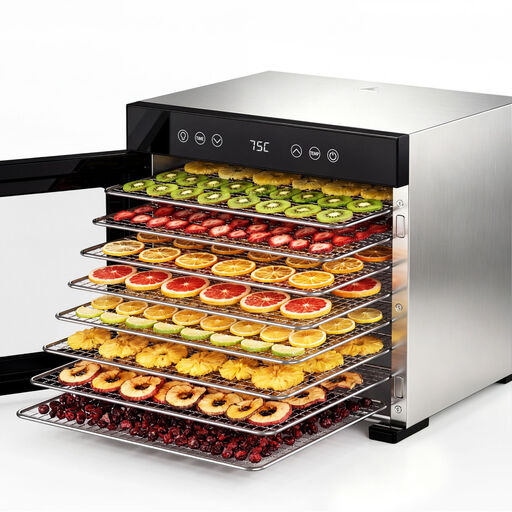 No image available
If you want to dry several batches of herbs, check whether this model with eight racks will fit in your kitchen and storage space.
As listed in the product name: 8 stainless steel drying racks; 35–85 °C; 48-hour timer; 650 W.
Small bunches of less moist herbs, such as sage or thyme, can be air-dried in a dry, well-ventilated room. Moister leafy herbs such as basil should dry quickly to avoid going mouldy. Penn State Extension describes these conditions, but you’ll need to take the air in your holiday home into account.
Remove any damaged or dirty parts, check the herbs for insects and, after rinsing them, remove as much surface water as possible. Penn State Extension recommends storing fully dried herbs in airtight containers in a cool, dry, dark place. Somewhere next to the sink or cooker may not be suitable because of the moisture.
No. Watts indicate the stated electrical power, not the actual energy used for a batch. To compare costs, you’ll need the energy consumed in kWh for a comparable batch and your electricity price.
Germany’s consumer advice centre distinguishes between your statutory rights against the seller and a voluntary guarantee. If a product is faulty, you may first be entitled to a remedy, such as a repair or replacement. Any guarantee should also be checked against its specific terms and conditions.
According to the European Union, the manufacturer is responsible for ensuring that its product meets the applicable EU requirements and bears the CE marking; this marking is not an independent quality seal. Germany’s Federal Environment Agency notes that end-of-life electrical appliances must not go in household rubbish. They must be collected separately or returned.