
Lieferung heute & morgen

Qualitätsgarantie

Willkommens-Angebote freischalten: KOSTENLOSE Lieferung | Bis zu 80 % RABATT | Kostenlose 30-Tage-JoyPlus-Testphase
App herunterladen
A food mixer can take care of much of the manual work involved in kneading, stirring and whisking. However, a high wattage rating or large bowl does not automatically mean it is the right choice. For home bakers, families and keen cooks, the most important factors are the actual dough capacity, the attachments included, the space required and how easy the machine is to use.
Motor power is often prominently advertised. Figures such as 1,600 watts, 1,300 watts or “1,000 Watt Peak Power” cannot necessarily be compared directly. Some manufacturers state the maximum power consumption, while others give the rated power. For heavy yeast doughs, it is also important to consider how steadily the appliance operates, whether it has overload protection and what maximum dough quantity is specified in the instructions.
You should therefore not choose a baking mixer based on wattage alone. Also check the permitted dough quantity, the drive system and the recommended operating time.
A 6-litre or 7-litre food mixer does not automatically have room for six or seven litres of dough. The maximum filling quantity depends on the recipe and the attachment being used. The monsga SM100, for example, is specified as having a total capacity of 6 litres and a recommended usable capacity of 5 litres.
A large food mixer with bowl is suitable for family-sized portions, but it requires more space. For smaller households or limited worktops, a 4-litre food mixer may be more practical.
A multifunctional food mixer may initially appear versatile. However, check which attachments are actually included and which are only available as optional extras. A food mixer with dough-hook set should include at least a dough hook, whisk and beater or flat beater.
A mincer, blender or chopper can expand the range of uses. If you are considering a food mixer with mincer, you should also pay attention to cleaning, storage and the availability of suitable replacement parts.
A food mixer with a stainless-steel bowl is durable for everyday use and usually easy to clean. Check the exact material specification, such as 304 stainless steel on some models. The key factor remains the combination of total capacity and the actual quantity suitable for recipes:
The appliance’s dimensions should also be included in your comparison. A tall machine may not fit beneath wall cupboards. A tilt-head design makes it easier to fit the bowl and attachments.
The dough hook is designed for bread, pizza and yeast dough. The whisk is suitable for cream, egg whites and light mixtures. A flat beater or K-beater handles cake mixtures, creams and softer mixtures. A food mixer with only one standard attachment is less flexible for these tasks.
Also check whether the attachments are dishwasher-safe. With coated tools, follow the manufacturer’s care instructions; abrasive sponges or metal brushes can damage the surface.
Multiple speed settings make it easier to adapt the machine to delicate and heavy ingredients. A pulse function is intended for short, powerful bursts. Non-slip feet or suction cups help keep the machine stable on a flat, dry work surface.
The description quiet food mixer should be assessed using specific decibel figures. For example, the product data states below 60 dB for the Honinst machine, up to 72 dB for an AUCMA model and up to 75 dB for monsga. Measurement conditions may vary. Nevertheless, this figure is a useful point of comparison for open-plan kitchens.

Why this product suits this profile: The 5-litre stainless-steel bowl and three standard attachments cover typical baking and cooking tasks without relying on additional specialist attachments.
The specifications state 10 speed settings, a pulse function, overload and overheating protection, and a maximum noise level of up to 75 dB.
5-litre bowl, dough hook, whisk, beater and splash guard included.

Why this product suits this profile: The 7- and 5-litre DuoBowl combination and integrated scales are ideal for households that regularly prepare different quantities and baking recipes.
The 1,200-watt rated power, variable speed control and clearly listed attachments make technical comparisons easier.
7-litre and 5-litre bowls, integrated EasyWeigh scales and several baking attachments.

Why this product suits this profile: If you want to process meat or blend drinks as well as prepare dough and mixtures, this appliance combines several functions in one.
The description lists the mincer and blender functions separately, along with a 6-litre stainless-steel bowl. According to the supplier, the motor stops when the head is raised.
Several processing functions, 8 speed settings with pulse function and 1,300 watts maximum motor power according to the product specifications.
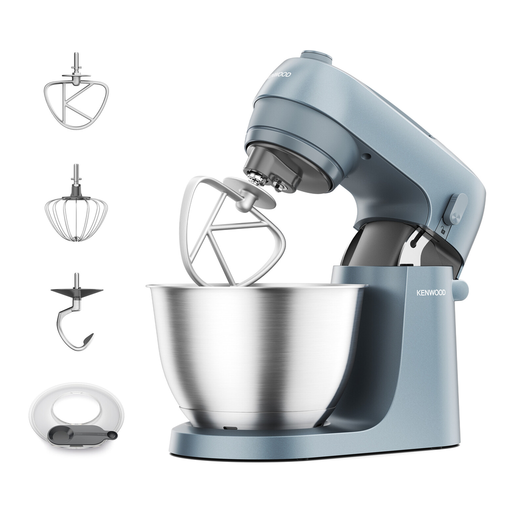
Why this product suits this profile: Its 30 cm height, 4-litre bowl and carry handle make it suitable for smaller worktops and occasional baking.
The compact dimensions are clearly specified. This lets you check before buying whether the appliance will fit beneath a kitchen cupboard.
800-watt motor, six speed settings, pulse function and three basic baking attachments.
We have put together a complete, regularly updated list of products that fully meet these strict selection criteria and the safety regulations applicable in the EU.
Place the food mixer on a dry, stable and level surface. The bowl and attachment must be correctly secured before starting. When adding flour and liquids, begin at a low speed to reduce dust and splashing. Never exceed the dough quantity specified by the manufacturer.
Unplug the appliance before cleaning, changing attachments or raising the motor head. The motor unit must not come into contact with water. Ongoing costs mainly depend on the motor power, usage time and electricity tariff. A higher wattage rating means potentially higher power consumption for the same operating time, not automatically better results.
For bread dough, an appropriate dough hook, a stable base and a dough capacity specified by the manufacturer are important. A large bowl alone is not enough. Also observe any recommended breaks and operating-time limits, as heavy dough places greater strain on the motor.
For individuals or smaller households, 4 to 5 litres is often sufficient. Families and users who regularly bake bread, pizza or several cakes may wish to consider a 6-litre or 7-litre food mixer. The recommended usable quantity is what matters, not just the capacity printed on the appliance.
There is no reliable way to give a standard service life. It depends on the build quality, frequency of use, dough quantities, cleaning and compliance with the recommended operating times. Proper use, avoiding overloading and following the manufacturer’s care instructions can help extend the appliance’s service life.