
Lieferung heute & morgen

Qualitätsgarantie

Willkommens-Angebote freischalten: KOSTENLOSE Lieferung | Bis zu 80 % RABATT | Kostenlose 30-Tage-JoyPlus-Testphase
App herunterladen
A food mixer can take much of the hard work out of kneading, mixing and whisking. But not every model is right for every household. Keen home bakers need different features from those who occasionally make cake batter or only prepare small quantities.
Three common buying mistakes are particularly likely to lead to the wrong choice:
A food mixer with a bowl holding between 4 and 6 litres can suit households of different sizes. A 4-litre bowl may be enough for smaller cakes or pizza for several people. Families and regular bread or pizza makers may prefer a 5-litre food mixer or a 6-litre food mixer.
The maximum dough capacity is also important. The Monsga SM100 has a stated total bowl capacity of 6 litres, but a recommended usable capacity of 5 litres. The Ariete 1589 Moderna has a stated maximum dough capacity of 1.4 kg. These figures are more useful when choosing a machine than bowl capacity alone.
An electric food mixer should be able to handle the tasks you have in mind reliably. A dough hook is usually used at low to medium speed for yeast dough and bread dough. A whisk, on the other hand, is designed for cream or egg whites and usually needs higher speeds.
Models with several speed settings let you fine-tune the mixing speed. The AUCMA food mixer, for example, has 10 speeds and a pulse function, while the Kenwood Go offers six speed settings plus a pulse function. When checking the power rating, buyers should also find out whether it refers to rated power or peak power. The Monsga SM100 is listed with 1,000 watts of peak power and 600 watts of rated power.
A planetary mixing action moves the attachment around the bowl as it rotates, helping to combine ingredients. It does not, however, remove the need to follow the recommended ingredient quantities.
A food mixer for baking should come with at least these attachments:
Dishwasher-safe attachments can make cleaning easier. The motor housing must not be immersed in water. Unplug the machine before changing attachments or cleaning it.

Why it suits this type of user: This model combines a 5-litre stainless steel bowl with 10 speed settings and a pulse function. It’s a good fit for households that bake regularly but don’t need an especially large bowl.
The specifications list the bowl size, speed settings and pulse function separately. The safety information also covers overheat protection and recommended maximum quantities.
5-litre bowl, 10 speeds plus pulse function, dough hook, whisk and beater.
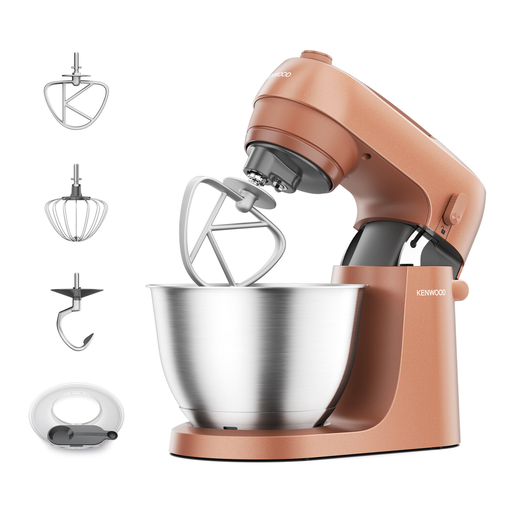
Why it suits this type of user: This compact food mixer is 30 cm tall and has a metal body, a 4-litre stainless steel bowl and front-facing controls. It’s ideal for smaller kitchens and limited storage space.
Its compact height and specific bowl size make it easier to work out how much space it will actually need, rather than relying on a vague promise of compactness.
800-watt motor, 4-litre bowl, six speeds plus pulse function and three baking attachments.
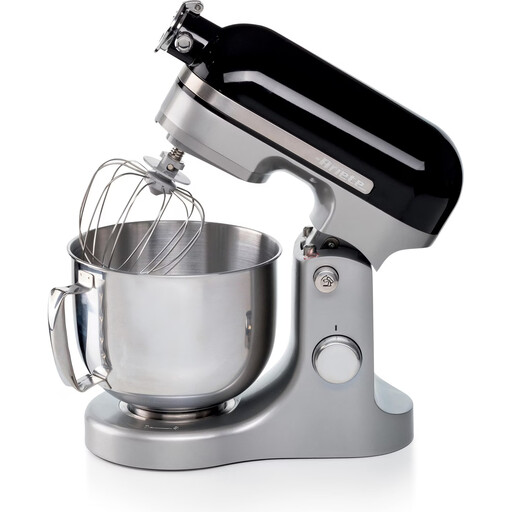
Why it suits this type of user: This 5.5-litre food mixer has 11 speed settings and a stated dough capacity of 1.4 kg. That makes it a useful option for regular bread, pizza and cake making.
As well as the motor power, the maximum dough capacity is clearly stated. This makes it easier to judge whether the mixer can handle heavier mixtures.
1,600 watts, 5.5-litre stainless steel bowl, 11 speeds, planetary mixing action and dishwasher-safe parts.
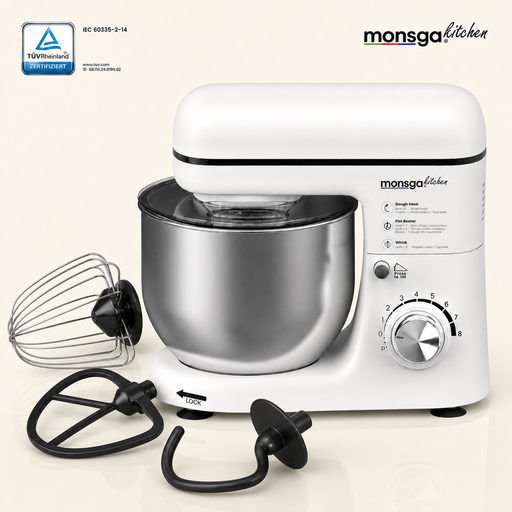
Why it suits this type of user: The large stainless steel bowl is designed for family-sized portions. The manufacturer recommends a usable capacity of 5 litres and lists eight speed settings and a noise level of 75 dB.
The difference between the bowl’s full capacity and its recommended usable capacity is clearly stated. Overload and overheat protection are also described.
6-litre bowl, eight speeds, 360-degree planetary mixing action, dough hook, beater and whisk.
Before you buy, make sure you have enough worktop space for the machine. A food mixer with a tilt-head makes it easier to change the bowl and attachments, but you’ll need enough clearance above it to lift the head. Suction cups or non-slip feet can help keep the mixer steady on a smooth worktop.
Manufacturer noise figures are not always directly comparable, as testing conditions can vary. The stated 75 dB for the Monsga model and less than 60 dB for the Honinst model should therefore be treated as a guide, not as universal comparison figures.
Electricity costs depend on power, how long you use the machine and your electricity tariff. For a rough estimate, use:
Power consumption in kilowatts × operating time in hours × electricity price per kilowatt-hour.
A higher wattage does not automatically mean higher overall costs if the machine runs for less time. For home use, it’s also worth considering how easy the mixer is to clean, the availability of spare parts and the permitted operating time stated in the instructions.
We’ve put together a complete, regularly updated list of products that meet these strict selection criteria and fully comply with the safety regulations in force in the EU.
Look for a suitable dough hook, a stable base, a bowl that’s large enough and a maximum dough capacity specified by the manufacturer. Wattage alone is not a reliable way to choose a mixer. Yeast dough should generally be kneaded at a low or medium speed.
A 4-litre bowl is often enough for smaller households. Families and anyone who regularly makes bread, pizza or larger cakes may want to consider a 5-litre or 6-litre food mixer. The recommended usable capacity matters more than the total capacity printed on the bowl.
There’s no single answer, as lifespan depends on how often you use the mixer, the quantity of dough, operating time, cleaning and care. Sticking to the maximum recommended quantities, avoiding prolonged overloading and only changing attachments when the machine is unplugged can help prevent unnecessary wear.