
Lieferung heute & morgen

Qualitätsgarantie

Willkommens-Angebote freischalten: KOSTENLOSE Lieferung | Bis zu 80 % RABATT | Kostenlose 30-Tage-JoyPlus-Testphase
App herunterladen
A food mixer can take care of much of the manual work involved in kneading, stirring and whisking. However, a low price or high wattage does not automatically mean it is the right choice. What matters is whether the appliance suits your usual recipe quantities, available worktop space and intended use.
Manufacturers often quote a maximum or so-called peak power rating. This figure does not necessarily describe the motor power available continuously. When comparing an electric food mixer, you should also check the stated rated power, permitted dough quantity and usage instructions.
For heavy bread and pizza doughs, a stable base, suitable gearing and the right dough hook are also important. Even a motor with a high advertised wattage may switch off or become very hot if overloaded.
A food mixer with a bowl offering a 6-litre capacity does not automatically provide 6 litres of usable space for every type of dough. Depending on the recipe, liquid ingredients, flour and yeast dough need sufficient room to prevent the mixture from rising over the edge.
You should therefore check the maximum dough quantity specified by the manufacturer. The monsga SM100, for example, is listed with a total capacity of 6.0 litres and a recommended usage capacity of 5.0 litres. This is more relevant when planning family-sized portions than the bowl size alone.
A food mixer with a whisk and dough hook covers the most important baking tasks. However, if it does not include a beater, splash guard or dishwasher-safe component, everyday use can become more cumbersome.
Check the following before buying:
For cake mixtures, cream and whisked egg whites, a finely adjustable speed setting is usually sufficient. A food mixer for kneading should, however, provide enough torque at low to medium speed. For bread and pizza dough, the maximum dough quantity specified by the manufacturer is particularly important.
The Ariete 1589 Moderna, for example, states a dough capacity of 1.40 kilograms. The Kenwood Go is specified for up to 1.5 kilograms of bread dough and up to 1.8 kilograms of cake mixture. These figures cannot be compared directly across all appliances, but they show which specifications you need to consider for your recipes.
A food mixer with a stainless steel bowl is practical for many households, as stainless steel is resistant to odours, robust and easy to clean. The appliance’s dimensions are also important, however. A model with a large bowl needs not only enough worktop space, but also sufficient clearance to operate beneath wall units.
Compact appliances can be a sensible choice for smaller kitchens. According to its product specifications, the Kenwood Go is 30 centimetres high and has a 4-litre bowl. Larger models such as the Kenwood Titanium Chef Baker XL require more space, standing at around 40 centimetres tall, but come with DuoBowl bowls measuring 7 and 5 litres.
Multiple speed settings allow you to adapt the mixer more precisely to delicate mixtures and heavy doughs. A food mixer with multiple speed settings should start smoothly wherever possible and offer a low setting for combining ingredients. A pulse function is intended for short, powerful bursts.
The decibel rating is only meaningful under the stated measurement conditions. Product data, for example, lists 70 dB for an Ariete Vintage and up to 75 dB for the monsga SM100. These figures should be treated as a guide rather than a guarantee of a particular perceived volume in every kitchen.

Why this product suits this profile: This model combines a 5-litre stainless steel bowl with 10 speed settings, a pulse function and three standard attachments for everyday baking tasks at home.
Alongside the motor power, the product data specifies the bowl size, speed settings and overheat protection. This makes it easier to choose based on facts rather than comparing wattage alone.
5-litre bowl, 10 settings plus pulse function, dough hook, whisk and beater.

Why this product suits this profile: For regular baking, this appliance offers integrated scales, continuously variable speed control and DuoBowl bowls measuring 7 and 5 litres.
The specifications go beyond a single wattage figure: bowl sizes, scales, attachments and continuously variable control are all clearly stated.
1200-watt motor, integrated EasyWeigh scales, 7-litre and 5-litre bowls, extensive range of attachments.
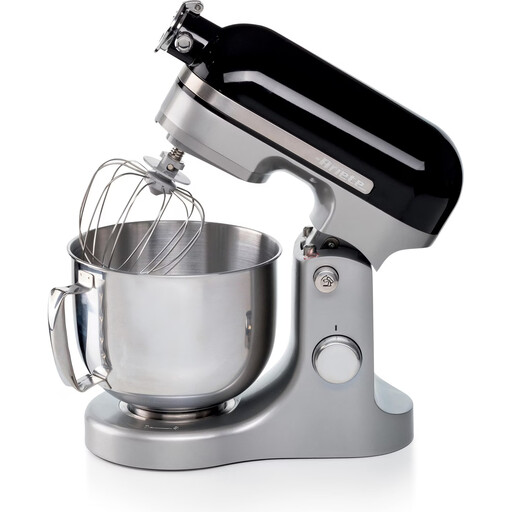
Why this product suits this profile: This model is designed for households that regularly switch between mixing, whisking and kneading larger quantities of dough.
The stated dough capacity of 1.40 kilograms helps you assess the bowl size realistically. The attachments and dishwasher-safe parts are also documented.
1600 watts, 5.5-litre stainless steel bowl, 11 speed settings and 3D planetary mixing system.
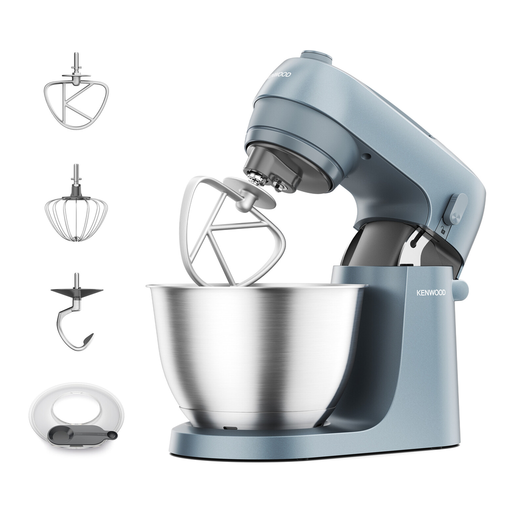
Why this product suits this profile: Its compact height of 30 centimetres and front controls are designed for small worktops and limited storage space.
The smaller bowl and stated bread dough capacity make its limits more transparent than simply promoting its compact design.
4-litre stainless steel bowl, 800 watts, 6 speeds plus pulse function, metal housing and carrying handle.
We have put together a complete, regularly updated list of products that fully meet these strict selection criteria and the safety regulations applicable in the EU.
Look for a stated dough capacity, a stable base, a suitable dough hook and a low speed setting. A large bowl alone says little about how suitable the appliance really is for firm dough.
For regular family-sized portions, models with around 5 to 6 litres are often practical. The recommended usable quantity remains the key consideration. For smaller recipes, a 4-litre bowl may be more suitable when worktop and storage space are limited.
The noise level depends on the motor, gearing, dough consistency and selected speed. Manufacturer figures such as 70 to 75 dB provide a basis for comparison, but they do not replace checking the specific operating conditions and the operating instructions.