Postcard-size photos
If you want to print individual food photos in a size that’s easy to view and can use a power socket at your shared workspace, 100 × 148 mm postcard size is one option. Canon lists this format for the SELPHY CP1500.


For individual food photos in postcard size, a compact photo printer is a natural place to start, provided you have access to a power socket at your desk. If you often need to clear your space, a mini printer with a built-in battery could suit you – as long as you’re happy with a smaller image area. For regular A4 photo printing, consider a photo inkjet printer, but allow for the space it needs and the maintenance involved. In every case, check how you’ll print from the shared device and which consumables you’ll need.
If you want to print individual food photos in a size that’s easy to view and can use a power socket at your shared workspace, 100 × 148 mm postcard size is one option. Canon lists this format for the SELPHY CP1500.
If you regularly need larger images and can set aside a permanent spot for the printer and its maintenance, a photo inkjet printer could be right for you. Canon lists photo printing up to A4 for the PIXMA G650, while Epson describes the EcoTank ET-8500 as suitable for A4 and photo printing.
If you often clear your desk and small photos are enough, a portable printer with a battery could suit you. Fujifilm gives the image area of the instax mini Link 3 as 62 × 46 mm; compatible film is sold separately.
A good fit if: You can print individual food photos in 100 × 148 mm format and have access to power at your desk. Canon lists this postcard media size for the SELPHY CP1500.
Worth noting: The battery for the CP1500 is sold separately, and the paper and ink ribbon must be compatible with the printer.
A good fit if: You want to put the printer away after use and are happy with smaller photos. The Canon SELPHY QX20 has a built-in battery; the Fujifilm instax mini Link 3 prints on instax mini film.
Worth noting: This format is no substitute for a postcard-size print. Fujifilm gives the instax mini Link 3’s image area as 62 × 46 mm, and the film is sold separately.
A good fit if: You regularly print larger food photos or need to print documents too. Canon lists borderless photo printing up to A4 for the PIXMA G650; Epson describes the EcoTank ET-8500 as capable of A4 photo printing.
Worth noting: Allow for a permanent spot and ongoing maintenance. If print quality deteriorates, Epson recommends a nozzle check and, if necessary, a printhead clean.
At a shared desk, you’ll need to consider more than image size: the connection method, available space and consumables all matter too.
| Criteria | What to check before buying | Who it matters most to |
|---|---|---|
| Space and printing method | Check the space available, the power supply and whether you can print from the smartphone or computer you actually use. For shared networks, check the access rules at your workplace. | If I need to free up the desk quickly after printing, I look at the space the printer takes up and whether it offers a suitable connection method. Around 36% of consumers give these factors top priority. |
| Image size | Decide on the image area you want in advance: Canon lists 100 × 148 mm for the SELPHY CP1500, Fujifilm gives the instax mini Link 3’s image area as 62 × 46 mm, and Canon lists photo printing up to A4 for the PIXMA G650. | If I want my food photo to stand out on a card or as a larger print, the output format is key. Around 29% of consumers put image size first. |
| Supplies for print runs | Compare compatible media for the same image size and print volume. The SELPHY CP1500 uses paper and an ink ribbon together; Fujifilm sells film for the instax mini Link 3 separately. | If I regularly print several images, I want to factor in the consumables for the image size I have in mind. Around 21% of consumers prioritise print runs and the supplies they require. |
| Battery and portability | Check whether the battery is built in or sold separately, and whether the app and print media are compatible with your smartphone and the images you want to print. Canon lists a built-in battery for the QX20. | If I want to take the printer away from the shared desk after use, battery power is useful – provided mini prints are large enough for me. Around 14% of consumers give top priority to portability and small prints. |
A small printer doesn’t necessarily work without a power socket. Canon lists a battery for the SELPHY CP1500 that’s sold separately, while the QX20 has a built-in battery.
Check the power supply and what’s included with the specific model. Also consider whether there’s a power socket available at your shared workspace.
The battery is not included with the SELPHY CP1500.
A portable printer may produce much smaller photos than a postcard printer. Fujifilm gives the instax mini Link 3’s image area as 62 × 46 mm; Canon lists postcard media measuring 100 × 148 mm for the SELPHY CP1500.
First decide how large you want your food photo to appear, then choose a printer and compatible media.
Ink yield figures are based on conditions set by each manufacturer. They don’t guarantee that you’ll get the same number of prints with your images and settings.
Compare the compatible consumables for the image size and print volume you have in mind. Canon and Epson publish their yield figures based on their respective manufacturers’ conditions.
Canon’s range includes compact SELPHY models for smaller photo formats, as well as photo inkjet printers for A4.
The instax models featured here combine smartphone printing with smaller instant photo formats.
The EcoTank ET-8500 is an option if you want to combine A4 photo printing with other printing tasks.
The Sprocket Select is a compact ZINK printer with Bluetooth and a smartphone app.
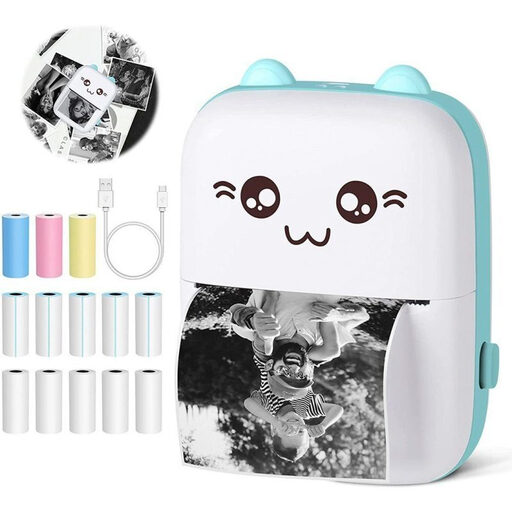
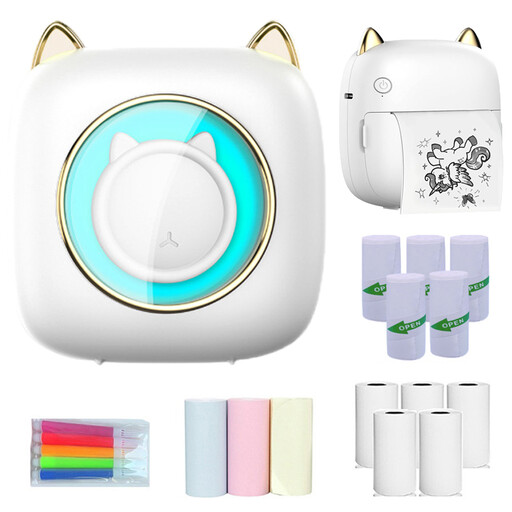
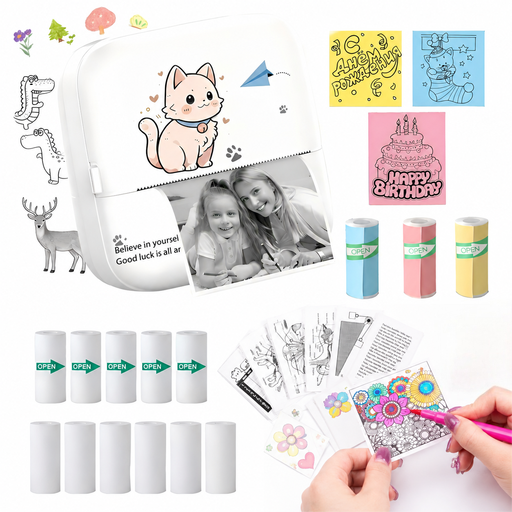
The products below include portable mini printers for smartphone photos. Before buying, check in particular whether their colour output and format suit your food photos.
 No image available
Could suit you if you want to print photos from your smartphone and use a portable device. Before buying, check whether the image quality and print format meet your needs for food photos.
 No image available
It could work for portable use if you want small prints and black and white is suitable for your needs. This is a significant limitation for colour food photos.
Listed in the product name: 1200-mAh battery.
 No image available
Could be an option if you want to print photos from your smartphone. Check that the app and print quality suit your device and how you want your food photos to look.
Listed in the product name: Bluetooth and compatibility with iOS and Android.
 No image available
Better suited if you’re looking for a portable printer for black-and-white prints and don’t need your food photos reproduced in colour.
Listed in the product name: 10 rolls of thermal paper.
 No image available
Could suit you if you want to print small smartphone photos rather than larger food prints. Before buying, check the compatible paper, image size and compatibility with your smartphone.
Yes, provided the printer, smartphone and app are compatible. Canon lists Wi-Fi printing with the SELPHY Photo Layout app for the SELPHY CP1500; Fujifilm points to the smartphone app for the instax mini Link 3 and recommends checking compatibility. At a shared workspace, also check the network and access rules.
For affected EcoTank and Expression printers, Epson recommends starting with a nozzle check and cleaning the printhead if the results indicate that it’s needed. Follow the instructions for your specific model.
Compare media for the same planned image size and print volume. The Canon SELPHY CP1500 uses paper and an ink ribbon together; film for the Fujifilm instax mini Link 3 is sold separately. Manufacturers’ yield figures are based on their own conditions and don’t guarantee how many prints you’ll get.
For a consumer purchase, your statutory rights against the seller are separate from any voluntary manufacturer’s guarantee. The Verbraucherzentrale generally states that the statutory guarantee lasts for two years from delivery. If a specific fault occurs, contact the seller.
No. The German Environment Agency advises that old electrical appliances must be collected separately, for example at recycling centres or through take-back schemes at retailers. If possible, remove the battery and dispose of it separately.