
Lieferung heute & morgen

Qualitätsgarantie

Willkommens-Angebote freischalten: KOSTENLOSE Lieferung | Bis zu 80 % RABATT | Kostenlose 30-Tage-JoyPlus-Testphase
App herunterladen
A food processor can take a lot of the manual work out of kneading, stirring and whisking. At the same time, appliances vary considerably in terms of design, capacity, accessories and cleaning. If you focus only on a high wattage or a long list of accessories, you can quickly end up with a model that does not suit your kitchen or the way you actually intend to use it.
A high motor power rating does not automatically mean that a food processor will handle heavy dough better over extended periods. The gearing, speed control, planetary mixing system, maximum dough quantity and the operating time specified by the manufacturer are also important. When choosing a kneading machine, you should therefore check the permitted quantity for bread or pizza dough.
A food processor with a bowl holding, for example, 6 litres cannot always be filled to the brim. Yeast dough needs room to rise, while liquids can splash out during mixing. You should therefore look for details such as the recommended filling quantity, maximum dough quantity or permitted quantity of flour.
Terms such as multifunction blender or electric food processor do not automatically describe a complete range of functions. A device with a dough hook, whisk and beater is primarily designed for dough and cake mixtures. A blender, on the other hand, processes liquids, fruit, vegetables or ice. Additional attachments such as a meat grinder, chopper or pasta roller must be explicitly listed as included in the delivery.
Basic speed control is sufficient for light mixtures. For a food processor used for baking, several settings are useful, allowing you to switch between gently combining ingredients, mixing at medium speed and whisking quickly. A pulse or turbo function supports short, intensive tasks, but it cannot replace suitable dough capacity.
You should also distinguish between rated power and advertised peak power. When comparing several appliances, compare like-for-like specifications wherever possible and check the instruction manual for the maximum operating time.
For smaller households or occasional baking, a compact food processor with a 4-litre bowl may be sufficient. According to the product details, the Kenwood Go KZM35000GY features a 4-litre stainless steel bowl, a metal housing, six speed settings and a height of 30 centimetres. This is relevant for worktops beneath wall cupboards or where storage space is limited.
Families and users who regularly prepare bread, cakes or pizza can benefit from 5- to 6-litre bowls. The recommended working quantity remains the key factor. A large bowl is not automatically just as practical for small portions if the mixing tools do not reach the bottom sufficiently.
A planetary mixing system moves the tool in several directions, helping it reach different areas of the bowl. A stable base is also important for a food processor with a dough hook. Suction feet, a high net weight or a vibration-reducing construction can help limit movement across the worktop.
Before buying, check the following:
For smoothies, soups and frozen ingredients, a separate blender is usually more suitable than a traditional kneading machine. A blender for smoothies needs a suitable container, sharp stainless steel blades and a clear capacity marking.

Why this product suits this profile: This model combines a 5-litre stainless steel bowl with a dough hook, whisk and beater. Ten speed settings and a pulse function cover typical baking tasks.
The specifications explicitly state the bowl size, attachments, speed settings, overload protection and overheat protection. This makes it possible to check what is included before buying.
5-litre bowl, 10 settings plus pulse function and tilting motor head.
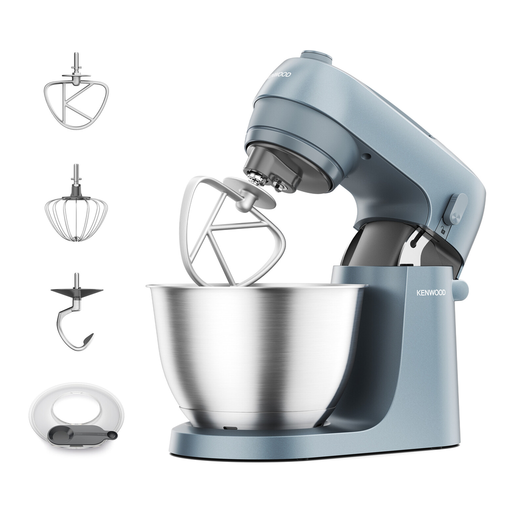
Why this product suits this profile: According to the product data, this compact food processor is 30 centimetres high and has a metal housing, a 4-litre stainless steel bowl and six speed settings.
The appliance height and front control are clearly specified. This allows buyers to check whether it will fit beneath wall cupboards and on their available worktop.
800-watt motor, metal housing, planetary mixing system and dishwasher-safe parts according to the product description.
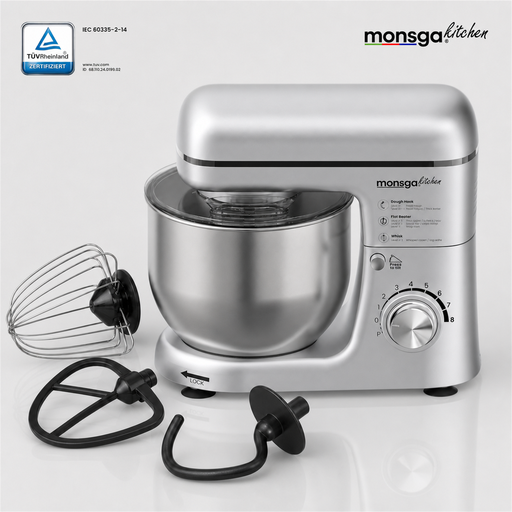
Why this product suits this profile: For larger households and regular dough preparation, this model offers a 6-litre stainless steel bowl, eight speed settings and three essential attachments.
The product details distinguish between the total capacity of 6 litres and the recommended usage of up to 5 litres. This helps you plan around the bowl’s usable capacity rather than its brim-full capacity.
6-litre bowl, tilting motor head, dishwasher-safe accessories and overload protection according to the manufacturer’s specifications.
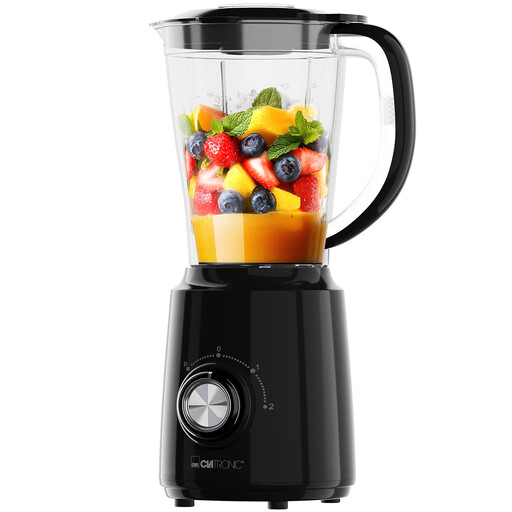
Why this product suits this profile: If you mainly prepare smoothies, soups, sauces or shakes, you do not necessarily need a dough mixer. This blender has a 1.5-litre container, four stainless steel blades and an ice-crushing function.
The functions are clearly focused on blending, puréeing and chopping. This means you do not buy an appliance with unused baking accessories if you mainly make drinks and soups.
500-watt motor, 1.5-litre BPA-free container, three speed settings and removable blades according to the product data.
We have put together a complete, regularly updated list of products that fully meet these strict selection criteria and the safety regulations applicable in the EU.
For bread, you need a food processor with a dough hook, a stable base and a stated dough capacity. For cakes, a whisk and flat beater are also useful. Check the maximum quantity for yeast dough and the recommended operating time.
For one or two people, 3.5 to 4 litres may be sufficient. Families and regular bakers often choose 5 to 6 litres. The important factor is not just the bowl’s volume, but the usable quantity stated by the manufacturer.
Energy consumption depends on the motor power and operating time. An appliance with a higher wattage uses more energy over the same operating period, but it is not automatically more efficient. Switch the machine off after use and follow the recommended operating intervals.